Spain’s Top 5 Deadliest Snakes slithering under the radar in April
By Marc Menendez-Roche • Updated: 15 Apr 2025 • 18:05 • 4 minutes read
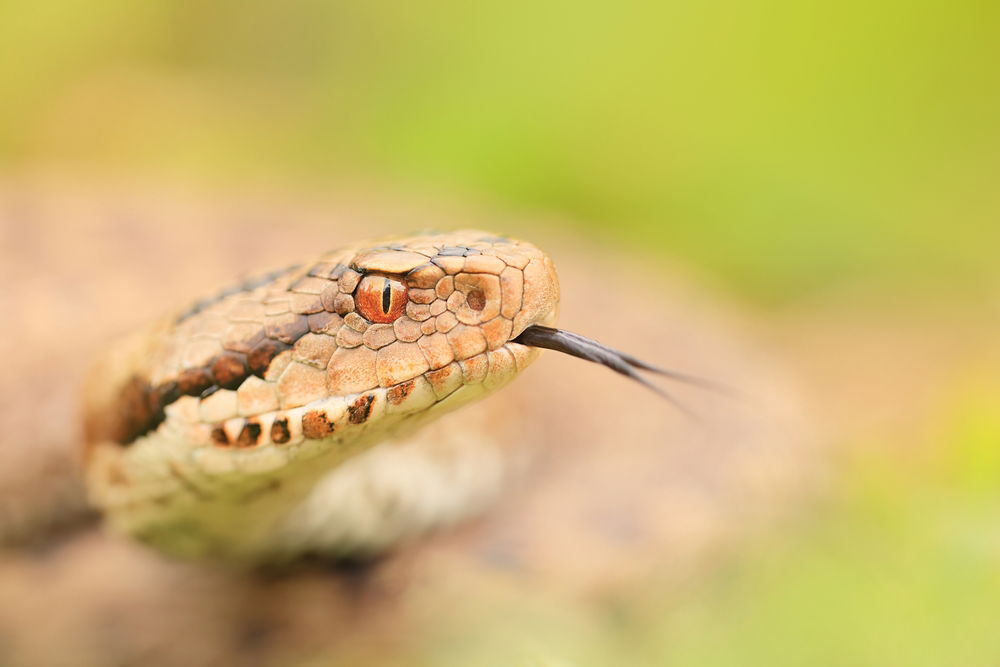
The Vipera seoanei did not take top spot in our list of Spain's deadliest snakes- Baskian viper, Iberian cross adder, Portuguese viper, Seoane's viper. A colourful species of poisonous viper present in the Cantabrian coast of Spain, southwestern France and northern Portugal. From the Pyrenees to the plains: Meet the venomous vipers and sinister serpents calling Spain home. Credit: Shutterstock, Baquez Photography
You might picture Spain as all sunshine, sangria and siestas – but lurking in its undergrowth, rocky hillsides and sun-baked scrublands are some of Europe’s most dangerous reptiles. While it’s no Australia or Amazon, Spain quietly plays host to a clutch of venomous snakes – some with bites that can kill if you don’t act fast.
Here’s your Euro Weekly News lowdown on the five serpents in Spain with venom potent enough to cause serious harm. Read on to find out what slithers beneath…
Ready? Let’s get started. Our countdown to the most dangerous snakes in Spain starts at number 5.
Number 5: The hooded snake – Small, secretive and (just a little) venomous

At just 30 to 40cm long, the culebra cogulla is the smallest on our list- but don’t count her out. Found in southern Spain (Andalucia etc.) and northern Morocco, this nocturnal, elusive serpent hides in sandy, stony areas and quiet woodlands.
She’s got puny venom, yes – barely enough to bother anything bigger than a mouse. With a tiny mouth and a skittish nature, bites to humans are vanishingly rare. You’d have to go out of your way (and probably annoy her quite a bit) to get into trouble.
Still, worth knowing about if you’re exploring barefoot or sporting your favourite Jesus sandals around Andalucia after dark – though you’re far more likely to step on a stone than on this little lass.
Number 4: Bastard snake! – The Montpellier: A monster with a mild bite

With a name straight out of Game of Thrones and a length of up to 2.5 metres, the “culebra bastarda” (yes, that’s her real name) is Europe’s biggest snake. But size isn’t everything… or so we’re told.
Despite her terrifying looks and aggressive reputation, her bite isn’t as dangerous as you’d think. That’s because her venom-injecting fangs are tucked way at the back of her mouth, making it tricky for her to get a proper bite on larger animals – or humans.
That said, if she does manage to sink her teeth in, don’t shrug it off. Immediate medical attention is still a must, especially since bites can lead to swelling, pain, infections, and in rare cases serious reactions.
You’ll most likely spot her in sunny open fields and Mediterranean shrublands, especially in the eastern and southern regions of Spain.
Number 3: The Iberian nose-horned viper – Spain’s most likely to bite
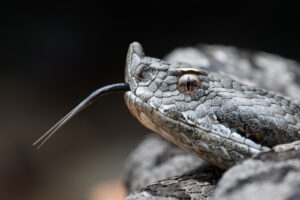
She’s got a face you won’t forget – a sharply raised snout that’s earned her the Spanish nickname “hocicuda” (snouty). The Iberian nose-horned viper is possibly Spain’s most famous serpent, and with good reason: she’s found across almost the entire peninsula (except the far north and Pyrenees), and is the species most often involved in human snakebites.
The good news? Her venom is the least lethal of the bunch. The bad? She’s not afraid to defend herself if you get too close.
Often spotted around bushes, rocky outcrops, pastures, and old stone walls, especially at elevations around 1,000 metres, she’s a true homebody of the Iberian wilds. Respect her space, and she’ll likely leave you alone.
Number 2: The Cantabrian viper – the colourful killer
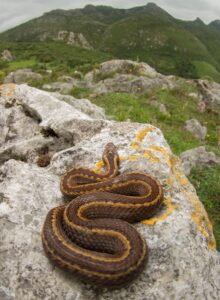
Slinking across the northern coast from Portugal through Galicia to Navarra, the Cantabrian viper is a rainbow-wrapped threat. With hues ranging from reddish and brown to grey or black – and sometimes banded, sometimes not – this snake isn’t easy to pin down in a line-up.
Topping out at 60cm, it’s a more modest-sized menace than its Pyrenean cousin, but don’t be fooled: its venom can still be deadly (in some cases) if not treated quickly.
Spotted mainly along the Cantabrian Mountains, this square-headed viper might be a looker, but if you’re bitten, it’s a one-way trip to A&E if you don’t act fast. Don’t prod it.
And now the winner of Spain’s most dangerous snake award…
Number 1: The Pyrenean viper – the undisputed queen of venom
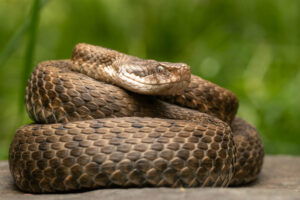
Credit: Shutterstock, Gerard Martin Carrasquero.
She’s got the looks, the size and the sting. Clocking in at up to 85cm, the Pyrenean viper is not only the biggest venomous snake in Spain, but also the most dangerous. With her triangular head, slightly upturned snout, and that eerie two-tone eye (a lighter upper iris, darker below), she’s as recognisable as she is risky – if you’re close enough to spot her, that is.
Found from Catalonia to Cantabria and favouring alpine habitats, this deadly dame of doom prefers to keep to herself in forests, sunlit scrublands, and rocky terrain. But if surprised or threatened, she’ll strike fast and with ruthless precision – and her venom is nothing to trifle with.
Still, don’t expect them to swing at you from trees or chase you down the beach. These snakes are shy and generally want nothing to do with humans. But as with any wild animal, corner her or step too close, and she’ll bite.
Top tip: If hiking in the Pyrenees, keep your eyes on the path – and maybe skip the flip-flops or sandals.
Final hiss of advice…
While these snakes sound scary, remember: they’re not hunting you, most of the time… Most will only bite if they feel threatened or cornered. When in the Spanish countryside, stick to paths, wear boots on hikes, and don’t go poking around in rocks and undergrowth – and you’ll likely never see one, let alone feel its fangs. If you see one, leave it alone.
And if you do get bitten? Don’t panic – but do seek medical help immediately.
The risk is low, but not zero. Stay sensible and alert and you’ll stay safe.
Get more European news in English.
Stay tuned to the Euro Weekly News for the latest Spanish news in English.
Sign up for personalised news
Subscribe to our Euro Weekly News alerts to get the latest stories into your inbox!
By signing up, you will create a Euro Weekly News account if you don't already have one. Review our Privacy Policy for more information about our privacy practices.





Marc Menendez-Roche
Marc is a writer, educator, and language enthusiast with a background in business and legal communication. With over a decade of experience in writing and teaching, he brings a clear, engaging voice to complex topics—guided by a keen interest in educational neuroscience and how people learn. At Euro Weekly News, Marc contributes lifestyle features and community-focused stories that highlight everyday life across Spain. His ability to connect language, learning, and lived experience helps bring depth and relatability to the topics he covers.
Comments
Alan Bowman
14 April 2025 • 11:15It would have been better if pictures had been included
Mark
14 April 2025 • 11:27Was your intention to insert photos of the 5 snakes?It would be very useful.
Brian
14 April 2025 • 13:23Having avoided bites from Hooded Cobra, Green Mamba and Boomslang (tree snake) in Rhodesia, I hope I can continue to keep safe!
eddie
14 April 2025 • 14:46What a waste of a read, I’m not a herpetologist nor a latin scholar but I can understand pictures, pity there were none.
James
14 April 2025 • 20:48Rhodes ia??
Brian
21 April 2025 • 19:48Yes, but without the space. OK so now it’s Zimbabwe but it wasn’t when I lived and served there!
Dee
15 April 2025 • 02:39I got good pictures of each snake
Mark
15 April 2025 • 08:21Thank you! Completes the picture!
Mark
15 April 2025 • 11:25The Common names used here are rarely the ones i see in field guides. I see several mistakes in the text. Anyone reading this, should understand these type of articles are there to sell advertising, and not rely on any non soecialist source for information. Admittedly i have seen a lot worse
Peter Denmark
15 April 2025 • 14:00Poisonous??? Written by a five year old child? Actually, at five, I knew the correct word is venomous.
Lisa
15 April 2025 • 21:01What a shame that another journalist is spreading fear about our beautiful reptiles with this sensationalist type of article. Leave them alone and they’ll leave you alone.
Cathy
18 April 2025 • 18:45Too many ungrateful people in the world…Thank you for sensible reassuring advice !!! X
Comments are closed.