UK expats EES advice – which airports to give extra time or miss flight
By Adam Woodward • Updated: 10 Nov 2025 • 18:09 • 2 minutes read
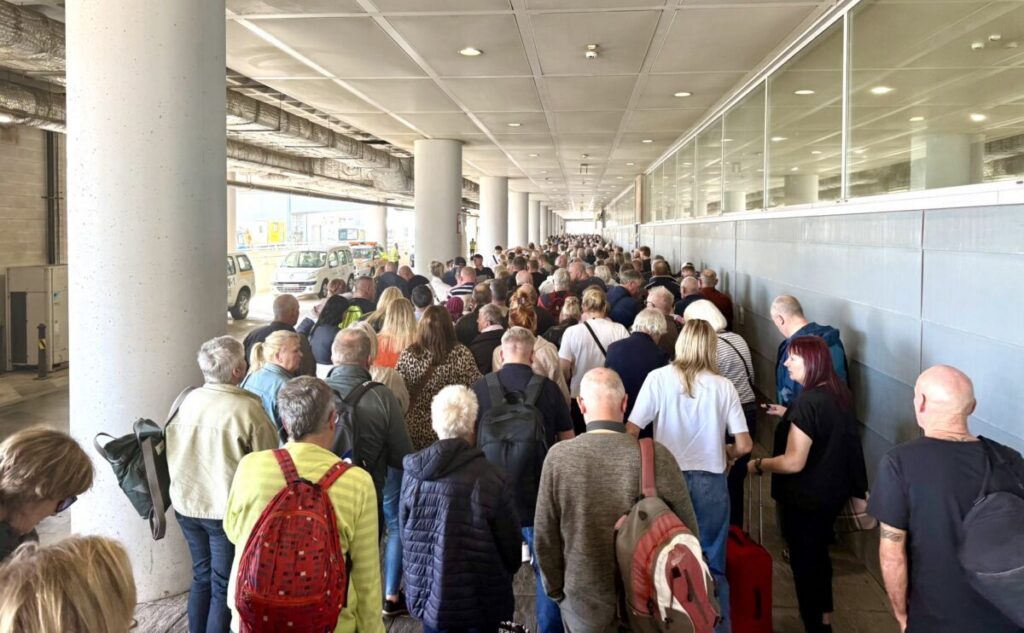
EES queues at Alicante Airport. Credit: Ian Gordon X
The EU Entry/Exit System (EES) launched on October 12, introducing mandatory biometric checks for non-EU travellers entering and exiting Spain.
While Spain’s phased rollout has prevented widespread chaos, EES queues and wait times are already adding 30–60 minutes to border processing at major airports, with recent reports confirming Alicante Airport EES queues exceeding one hour during peak periods. Travel advisors are now encouraging passengers to arrive at least 3 hours before flights, especially for departures where biometric verification on exit can create bottlenecks identical to arrivals.
What is EES and who faces longer wait times?
The EES replaces manual passport stamps with automated kiosks that capture fingerprints and facial scans for all non-EU short-stay visitors, including UK tourists. First-time registration takes 3 to 5 minutes per person; subsequent checks are faster but still require queueing in dedicated lanes.
Spain began implementation at Madrid-Barajas on October 12, followed by Barcelona, Alicante, Malaga and others. Full nationwide rollout should be complete by April 2026, with manual stamping available in parallel during the transition.
“The system proved stable and efficient… with no delays.” – Spanish Interior Minister Fernando Grande-Marlaska
Alicante airport hit by one-hour+ EES queues
Real-time traveller reports confirm Alicante-Elche (ALC) is experiencing some of the longest EES wait times in Spain. Multiple passengers have described queues of at least one hour on November 6–7, particularly for evening UK departures where several flights coincide. According to Natasha Oliver on Facebook, the queues are well over an hour for EES registry and there is no separate queues if you have a TIE card. One saving grace, according to Natasha is that families with children are being prioritised and allowed to jump the queues. Natasha advises leaving plenty of time for the airport procedures, “or you will miss your flight.”
Similar peaks have occurred at Malaga-Costa del Sol (AGP), where lines are said to occasionally stretch all the way back to the plane in arrivals, and security in departures, but Alicante currently leads complaints for sustained hour-long delays.
How to beat EES queues and wait times
- Arrive 3–4 hours early for departures (vs pre-EES 2 hours).
- Use Fast Track where available – many Spanish airports prioritise it for EES lanes.
- Travel mid-week or early morning to avoid flight clusters.
- UK residents with TIE cards may use EU lanes at some airports (confirm locally).
- No pre-registration exists – biometrics must be captured on first post-EES trip.
Advantage Travel Partnership CEO Julia Lo Bue-Said warned: “Allocate four hours… this is going to add even more of an issue”
Recommended Extra Time: Airport-by-Airport Guide
Madrid-Barajas (MAD) – EES active since 12 October: typical extra time 15–30 minutes , but rarely over 45 minutes.
Barcelona-El Prat (BCN) – EES active since 27 October: typical extra time 20–40 minutes, peak reported under 1 hour.
Alicante-Elche (ALC) – EES active since 27 October: typical extra time 45–75 minutes, peak reported 1+ hour (multiple reports of at least one hour on 6–7 November).
Malaga-Costa del Sol (AGP) – EES active since 20 October (trial): typical extra time 30–60 minutes, peak reported 60+ minutes. Peaks reported of even 80 minutes.
Palma de Mallorca (PMI) – EES starts 19 November (upcoming): no data yet.
Long-term outlook: Faster borders after 2026?
Once teething problems end and all kiosks are fully operational, the European Commission predicts EES will reduce average border times by automating checks. Until then, expect variable queues through peak winter sun and Easter periods.
Stay updated via official channels:
- EU official EES page.
- Spanish airports authority.
- UK travel advice.
Sign up for personalised news
Subscribe to our Euro Weekly News alerts to get the latest stories into your inbox!
By signing up, you will create a Euro Weekly News account if you don't already have one. Review our Privacy Policy for more information about our privacy practices.




Adam Woodward
Adam is a writer who has lived in Spain for over 25 years. With a background in English teaching and a passion for music, food, and the arts, he brings a rich personal perspective to his work at Euro Weekly News. As a father of three with deep roots in Spanish life, Adam writes engaging stories that explore culture, lifestyle, and the everyday experiences that shape communities across Spain.
Comments