Received a fine in Spain for not having the V16 beacon? Here is how you can challenge it.
By Adam Woodward • Updated: 24 Feb 2026 • 10:17 • 3 minutes read
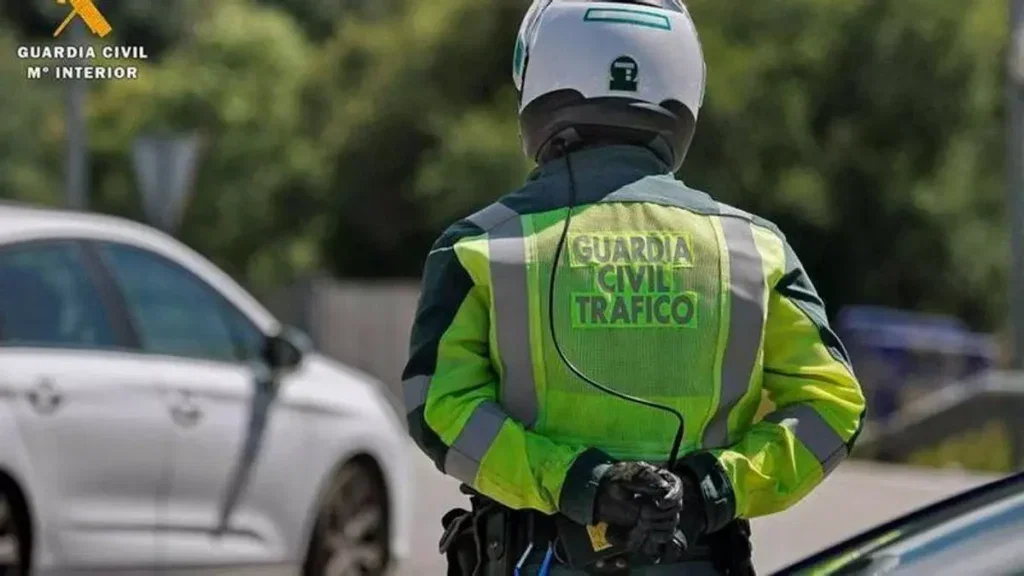
Guardia Civil officers checking if you have the V16 beacon. Credit: GC
The first fine for not carrying the V16 beacon in a vehicle has been given in Spain, provoking debate among drivers about whether it can be appealed by citing the promised “grace period” or moratorium that had been promised. The V16 beacon, a connected emergency light that replaces traditional warning triangles, became law on January 1, 2026, under new regulations in Spain. According to the Spanish Ministry of Transport, the controversial beacon (which costs between €30 and €50) is claimed to be a safer option for broken-down vehicles, while many disagree. Even the European Commission has chimed in, questioning the legality of legally obliging this new tech.
First fine given out: Details from Valencia
The first reported fining occurred on January 6 (Three Kings’ Day in Spain), on the AP-7 motorway near Valencia. A Guardia Civil traffic officer issued an €80 fine (reducible to €40 with prompt payment) to a driver for “not carrying the corresponding regulatory signal (V-16) in the vehicle. The ticket referenced breaches of Article 10.3 of the Traffic Law and Article 18.1 of the General Vehicle Regulations.
This case came to light through a company called Pyramid Consulting, a legal consultancy specialising in traffic fine appeals, which accessed the official punishment and highlighted the apparent contradiction with official statements.
What was the promised “grace period”?
The DGT, which regulates Spanish roads, and government officials, including Interior Minister Fernando Grande-Marlaska and DGT Director Pere Navarro, repeatedly talked about a transitional “period of grace” or flexibility after January 1. Drivers were to be “informed” rather than immediately fined, allowing time to adapt to the new connected beacon requirement.
However, no specific duration or official end date was ever defined in writing. This vagueness has created confusion and legal uncertainty, as enforcement by Traffic Guardia Civil officers has gone ahead without any formal suspension of fines or “grace period2 at all. The fine in Valencia arrived just six days into the new rule, before some public reassurances were even issued, leading to claims of inconsistency between policy announcements and on-the-ground application.
Can you appeal a fine for not having a V16 beacon?
Yes, absolutely, you can file an appeal (recurso) against any fine for lacking the V16 beacon, as with most traffic fines in Spain. The lawyers at Pyramid Consulting argue that such fines are challengeable on the grounds of violating the principle of legitimate expectations (principio de confianza legítima). This legal doctrine requires public administration actions to be predictable, transparent, consistent, and in good faith. Drivers should be able to rely on clear official signals from authorities.
The consultancy says that Supreme Court jurisprudence, including a key ruling from February 9, 2004 (rec. 4130/2001), which protects people when they act based on conclusive external indications from the administration itself. Public declarations from the minister and DGT director promising flexibility and no immediate fines could qualify as such an indication, potentially making early enforcement unfair and disproportionate. In basic terms, the minister promised to do something, and then did nothing, and so it’s not the public’s fault, is the idea here.
While success is not guaranteed, since the obligation has been legally in force since January 1, 2026, experts suggest appeals may succeed in cases from the initial weeks or months, especially if they reference the lack of a defined “grace period” timeline and conflicting official messages.
Key takeaways for drivers
- The V16 connected beacon has been law since January 1, for signalling breakdowns or accidents.
- The fine for non-compliance is typically €80.
- A “grace period” was verbally promised, but nothing was ever signed off, leading to early fines like the one in Valencia.
Appealing remains an option, particularly by invoking legitimate expectations and recent public statements from authorities.
If you’ve received a similar fine, please let us know in the comments below. What happened? Have you paid the fine, or would you ever appeal the decision? Let us know.
Sign up for personalised news
Subscribe to our Euro Weekly News alerts to get the latest stories into your inbox!
By signing up, you will create a Euro Weekly News account if you don't already have one. Review our Privacy Policy for more information about our privacy practices.





Adam Woodward
Adam is a writer who has lived in Spain for over 25 years. With a background in English teaching and a passion for music, food, and the arts, he brings a rich personal perspective to his work at Euro Weekly News. As a father of three with deep roots in Spanish life, Adam writes engaging stories that explore culture, lifestyle, and the everyday experiences that shape communities across Spain.
Comments
Philip
23 February 2026 • 11:27From our own experience we came across a triangle and some little plastic cones whilst approaching a right hand corner on a country road. Good warning of a broken down car. No idea if there was a V16.
Two days later there was a broken down car on a motorway slip road. The hazard lights were far more noticeable than the V16.
It is difficult to believe that comprehensive research was conducted prior to introducing this requirement. Maybe there were financial reasons, not inducements.
I believe you can still be fined for not having a spare set of bulbs in the car. Although, with modern lights you generally need to change the whole lighting unit.
Dr.Trth
23 February 2026 • 13:47V16 beacon not a requirement for foriegn reg vehicles only Spanish.
Pikolona
23 February 2026 • 19:55Why not just buy a V16? Problem solved.
Harold Towle
23 February 2026 • 20:44How about a fixed price and official suppliers. I paid 50 euros at a BP gasolinera..Supermarket were selling them 20 euros cheaper a week later.
Pete Gazzard
24 February 2026 • 12:11One of the reasons cited for the beacon is that the Spanish traffic authorities say they want people to stay in their vehicle and the beacon negates the need to leave the car to put a triangle out. They claim it is safer to stay in the vehicle which categorically it is not. The only advantage this device has is to apparently summon emergency services which is a dubious advantage at best. At the politest, clearly this has not been thought through……
David Swan
24 February 2026 • 16:47I presume hire-car companies are now responsible for providing a V16 in all their cars?
JAMES ROBERTS
25 February 2026 • 15:46Brussels are already contesting the whole charade. The Spanish goverment are corrupt…
Comments are closed.