NASA hit an Asteroid to protect Earth – But it changed more than expected
By Farah Mokrani • Published: 16 Mar 2026 • 17:07 • 3 minutes read
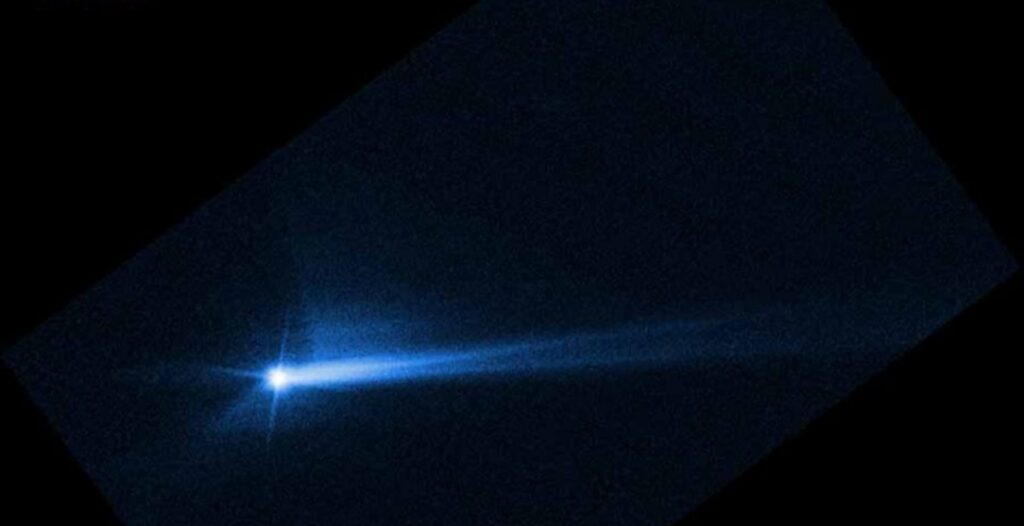
Debris plume captured after NASA’s DART spacecraft struck asteroid Dimorphos. Credit : Nasa
When NASA deliberately smashed a spacecraft into an asteroid in 2022, the goal was simple: test whether humanity could change the path of a dangerous space rock if one were ever heading towards Earth.
The experiment worked – perhaps even better than expected.
Now, new scientific findings reveal something surprising. The impact didn’t just alter the orbit of the small asteroid that was hit. It slightly shifted the trajectory of the entire asteroid system travelling around the Sun, something scientists had not predicted when the mission began.
The discovery is a fascinating step forward for what scientists call planetary defence – the effort to protect Earth from potentially hazardous asteroids.
NASA’s DART mission: the first real asteroid deflection test
The historic experiment took place in September 2022, when NASA’s spacecraft DART (Double Asteroid Redirection Test) intentionally crashed into a small asteroid moon called Dimorphos.
Dimorphos, about 160 metres wide, orbits a larger asteroid named Didymos. Scientists chose the system because it provided a perfect natural laboratory: if the small moon’s orbit changed, astronomers on Earth could measure the difference.
That is exactly what happened.
The impact shortened Dimorphos’s orbit around Didymos by 33 minutes, proving that a spacecraft collision could successfully nudge an asteroid off its original path.
For planetary defence experts, it was a historic moment. For the first time, humanity had demonstrated a practical technique for deflecting a celestial object.
But the story did not end there.
Scientists discover a surprising “domino effect” in space
Three and a half years after the collision, astronomers analysing precise measurements from telescopes have uncovered something unexpected.
The impact appears to have slightly changed the orbit of the entire Didymos–Dimorphos system around the Sun.
The shift is extremely small – almost unimaginably tiny – but it is measurable.
To understand why this is surprising, scientists often use a simple comparison. Didymos is vastly larger than the spacecraft that hit its moon. The asteroid system weighs hundreds of billions of kilograms, while the DART probe weighed just 560 kilograms.
It’s a bit like a mosquito hitting a tennis ball that’s orbiting a cannonball. You might expect the tennis ball to move — but not the cannonball.
Yet physics tells a different story.
By altering the motion of Dimorphos, the impact slightly changed the gravitational balance of the entire system, shifting its overall trajectory.
The hidden force that amplified the impact
The key to the unexpected change lies in what happened during the collision.
When DART slammed into Dimorphos, it didn’t simply push the asteroid like a billiard ball. The impact blasted huge amounts of rock and dust into space, creating a powerful stream of debris.
That ejecta acted almost like a natural rocket engine, producing additional thrust that amplified the force of the impact.
As a result, the asteroid system gained a tiny extra push.
According to researchers, the velocity of the system around the Sun changed by roughly 0.002 millimetres per second.
At first glance, that may sound insignificant. But over astronomical distances and long periods of time, even such a tiny shift can eventually translate into a noticeable change in position.
For scientists studying planetary defence, that detail is extremely important.
It means that asteroid deflection techniques may be more powerful – and more complex – than originally thought.
Why this matters for Earth’s planetary defence
Although there is currently no known asteroid on a collision course with Earth, space agencies are increasingly investing in ways to prevent future impacts.
Asteroids large enough to cause serious regional or global damage do exist, and many pass relatively close to our planet every year.
The DART mission was designed precisely to test whether a kinetic impact – essentially hitting an asteroid with a spacecraft – could change its path enough to protect Earth.
The new findings confirm that this technique works, but they also highlight the importance of understanding every side effect of such a collision.
If a single impact can subtly shift the motion of an entire asteroid system, scientists must carefully model those effects before attempting a real-world deflection.
Europe’s Hera mission will soon investigate the crash site
The next chapter of this cosmic experiment is already underway.
The European Space Agency’s Hera mission is scheduled to reach the Didymos system in late 2026, where it will study the aftermath of the DART collision in unprecedented detail.
Hera will measure the mass of Dimorphos, examine the crater left by the impact and help scientists understand exactly how the debris plume behaved during the collision.
Those measurements will allow researchers to refine their models of asteroid deflection and better prepare for the day when humanity might need to defend Earth from a real threat.
For now, scientists say the DART mission has already achieved something extraordinary.
It proved that, at least in principle, humanity has the ability to alter the course of a celestial object – and perhaps one day prevent a planetary catastrophe.
Sign up for personalised news
Subscribe to our Euro Weekly News alerts to get the latest stories into your inbox!
By signing up, you will create a Euro Weekly News account if you don't already have one. Review our Privacy Policy for more information about our privacy practices.





Farah Mokrani
Farah is a journalist and content writer with over a decade of experience in both digital and print media. Originally from Tunisia and now based in Spain, she has covered current affairs, investigative reports, and long-form features for a range of international publications. At Euro Weekly News, Farah brings a global perspective to her reporting, contributing news and analysis informed by her editorial background and passion for clear, accurate storytelling.
Comments