Fireball flies across Almeria sky at 108,000 km/h, captured by Calar Alto Observatory
By Elli Freeman • Published: 19 Mar 2026 • 17:14 • 2 minutes read
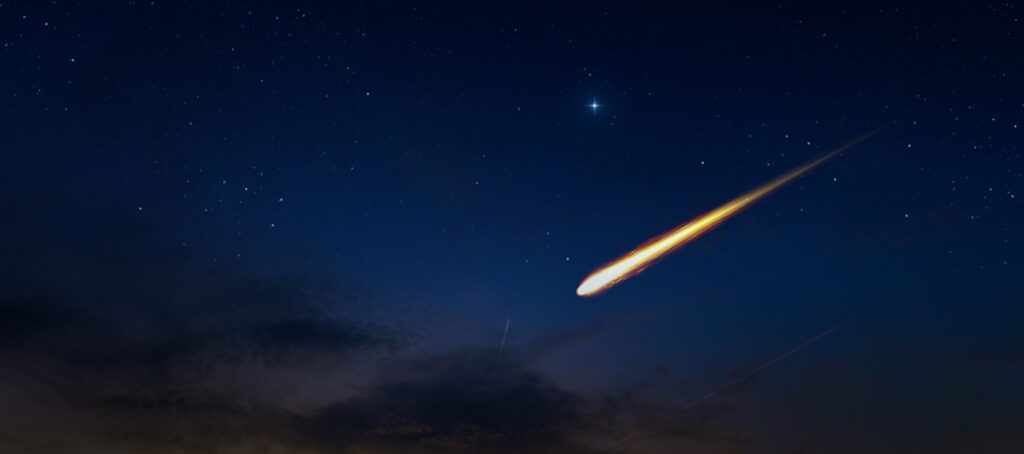
Asteroid lights up the sky in Almeria Credit: Shutterstock, Gergitek
Late Tuesday, March 17, some people looking out their window at just the right moment may have noticed a blinding light shoot through the night sky. This was not a trick of the eyes but rather a fiery asteroid racing across the skyline.
For those not fortunate enough to see the interstellar phenomenon, Almeria’s Calar Alto Observatory captured the moment it flew by. Scroll down to see the full video.
Watch the video:
☄️Bólido 17/03/2026 (22:30 UT):
🔸Tipo de evento: asteroidal.
🔸Velocidad inicial: 108.000 km/h.
🔸Altitud inicial: 95 km.
🔸Altitud final: 42 km.
🧭 AlbaceteProyecto S.M.A.R.T de @jmmadiedo#bolido #observatoriocalaralto #astronomía #ciencia #meteorito pic.twitter.com/SKQazia0WV
— Observatorio Astronómico de Calar Alto (@ObsCalarAlto) March 18, 2026
The blink and you’ll miss it moment was recorded by the North camera of the observatory’s SMART project detector at 10.30pm.
Fireball event recorded in real time
Tuesday’s fireball is the first recorded by Calar Alto in 2026, with the previous cosmic occurrence lighting up the sky on December 20 and 21. The brief but intense flash is part of a growing record of atmospheric entries monitored over southern Spain, offering valuable data for astronomers studying near-Earth objects.
Professor Jose Maria Madiedo, researcher at the Institute of Astrophysics of Andalusia (IAA-CSIC), conducted the preliminary analysis. He determined that the asteroid reached an initial speed of 108,000 kilometre’s and an initial altitude of 95 kilometres before ending its trajectory at an altitude of 42 kilometres.
These measurements help scientists better understand how small celestial bodies disintegrate as they enter Earth’s atmosphere.
Calar Alto Observatory’s role in meteor tracking
Located in the Sierra de los Filabres in the north of Almeria, the Calar Alto Observatory is a remarkable astronomical centre, one of the largest in Europe. Since it was founded in 1973, it has conducted some of the most cutting-edge astronomical research, in addition to capturing mesmerising cosmic events, many of which are available to watch on their website.
The observatory is equipped with advanced monitoring systems that allow continuous sky surveillance, making it a key facility for tracking meteors, fireballs, and other transient space phenomena.
Events like Tuesday’s fireball are not only visually spectacular but also scientifically significant. Each recorded trajectory helps researchers refine models of asteroid behaviour, atmospheric entry dynamics, and potential impact risks. Continuous monitoring also contributes to planetary defence initiatives, ensuring better preparedness for future near-Earth object encounters.
Sign up for personalised news
Subscribe to our Euro Weekly News alerts to get the latest stories into your inbox!
By signing up, you will create a Euro Weekly News account if you don't already have one. Review our Privacy Policy for more information about our privacy practices.





Elli Freeman
Originally from the UK, Elli has lived in Spain for more than half of her life. She holds a B.A in English Literature and Creative Writing. Before joining the Euro Weekly News team, Elli was an avid traveller, with a keen interest in exploring new cultures.
Comments