Spain’s opposition accuses Sánchez of ‘sham pacifism’ in defence spending clash
By Molly Grace • Published: 25 Mar 2026 • 16:08 • 3 minutes read
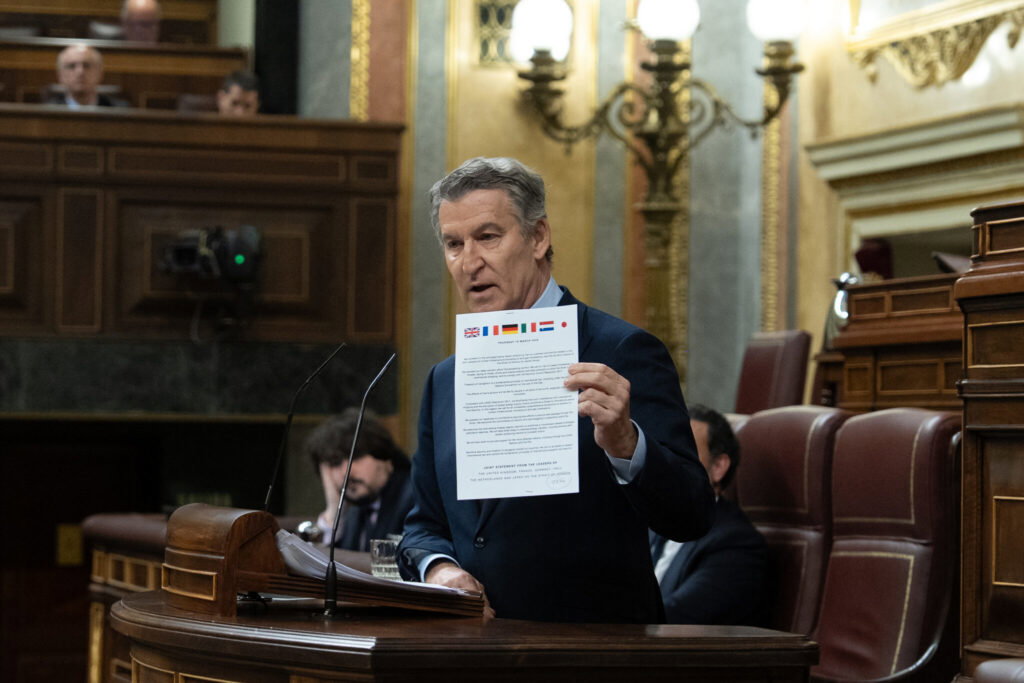
Feijóo’s criticism centres on what he describes as a contradiction between messaging and policy. Photo credit: PP.es
Spain’s Prime Minister Pedro Sánchez and opposition leader Alberto Núñez Feijóo clashed in Congress on March 25 over defence policy, with the leader of the conservative People’s Party (PP) accusing the government of inconsistency between its rhetoric on peace and its approach to military spending.
During a parliamentary session focused on international tensions and Spain’s position on defence, Feijóo described Sánchez as a “pacifista de pacotilla” (roughly translated as a “sham pacifist”). He criticised the Prime Minister for advocating peace while presiding over what he characterised as a significant increase in defence expenditure. The exchange underlined widening political divisions in Spain over how to balance diplomatic positioning with military commitments.
Feijóo concluded his intervention with the remark: “No a la guerra y no a usted” (“No to war and no to you”), directly addressing Sánchez in the chamber.
Debate framed by rising defence commitments
The dispute comes amid broader discussions across Europe regarding defence budgets and security policy. Spain, a member of NATO, has faced sustained pressure from allies to increase military spending in line with collective targets.
Sánchez’s government has defended its approach as necessary to meet international obligations and respond to a shifting geopolitical landscape. While presenting Spain as committed to diplomatic solutions in global conflicts, the administration has also backed increases in defence investment, arguing that deterrence and preparedness remain essential components of national and European security.
Feijóo’s criticism centres on what he describes as a contradiction between messaging and policy. He argued that the government cannot simultaneously position itself as a leading voice for peace while expanding military expenditure, framing the issue as one of political credibility.
Political positioning ahead of key votes
The exchange also reflects ongoing manoeuvring ahead of parliamentary votes linked to defence measures and broader government policy. The PP has not definitively outlined its voting position on all related initiatives, leaving open the possibility of opposing or abstaining on key proposals.
By combining criticism of defence spending with an explicit rejection of the Prime Minister’s leadership, Feijóo sought to consolidate his party’s stance as both anti-war and anti-government. The phrase “No a la guerra y no a usted” encapsulates this dual positioning, signalling opposition not only to military escalation but also to Sánchez personally.
For the government, the debate represents a challenge in communicating a nuanced position that balances commitments to allies with domestic political sensitivities. Ministers have emphasised that increased defence spending does not contradict a commitment to peace, but rather supports stability and international cooperation.
Broader European and domestic context
The confrontation in Congress mirrors debates taking place across the European Union, where governments are reassessing defence priorities in response to ongoing international conflicts and security concerns. Public opinion in Spain, historically cautious about military engagement, adds a further layer of complexity to the issue.
Spain’s role within NATO and its participation in joint defence initiatives have become more prominent in recent years. This has required successive governments to navigate competing expectations: maintaining a diplomatic profile while contributing to collective security frameworks.
For many observers, the language used in the parliamentary exchange reflects an increasingly polarised political climate. Personalised criticism and sharply worded remarks have become more common in debates over foreign and defence policy, particularly as parties seek to distinguish themselves on issues with both domestic and international implications.
Implications for political discourse
While the immediate impact of the exchange is largely rhetorical, it may influence how defence policy is debated in the coming months. The government is expected to continue emphasising its commitment to international alliances, while the opposition is likely to maintain pressure over perceived inconsistencies.
For international audiences and foreign residents in Spain, the dispute highlights a key feature of the country’s political landscape: strong public support for peace coexisting with the practical realities of alliance-based defence commitments.
As discussions continue, the balance between these priorities is likely to remain a central theme in Spanish politics, with both government and opposition seeking to define their positions in a rapidly evolving security environment.
Sign up for personalised news
Subscribe to our Euro Weekly News alerts to get the latest stories into your inbox!
By signing up, you will create a Euro Weekly News account if you don't already have one. Review our Privacy Policy for more information about our privacy practices.





Molly Grace
Molly is a British journalist and author who has lived in Spain for over 25 years. With a background in animal welfare, equestrian science, and veterinary nursing, she brings curiosity, humour, and a sharp investigative eye to her work. At Euro Weekly News, Molly explores the intersections of nature, culture, and community - drawing on her deep local knowledge and passion for stories that reflect life in Spain from the ground up.
Comments
Cati
25 March 2026 • 16:46“Si vis pacem, para bellum.”
Latin adage translated as: “If you want peace, prepare for war”