A major European supermarket chain is tapping into growing public anxiety around emergencies by rolling out ready-made food survival kits designed to keep households going for 24 hours.
Belgium-based retailer Colruyt has begun selling compact “basic packs” filled with essential food and supplies, marking a shift in how supermarkets are responding to consumer fears around disruptions, from power cuts to extreme weather.
The move reflects a wider trend across Europe, where preparedness is no longer niche but increasingly mainstream.
Why emergency kits are suddenly in demand
The launch isn’t happening in a vacuum. Demand for emergency supplies has been steadily rising, driven by recent crises that exposed how quickly daily life can be disrupted.
From devastating floods in Belgium to prolonged energy outages, households are becoming more aware of how vulnerable they can be without basic provisions.
Retailers are now stepping in to meet that demand.
Colruyt says the kits are a direct response to both customer requests and government guidance encouraging citizens to be able to cope independently for short periods.
What’s inside the €29.99 survival pack
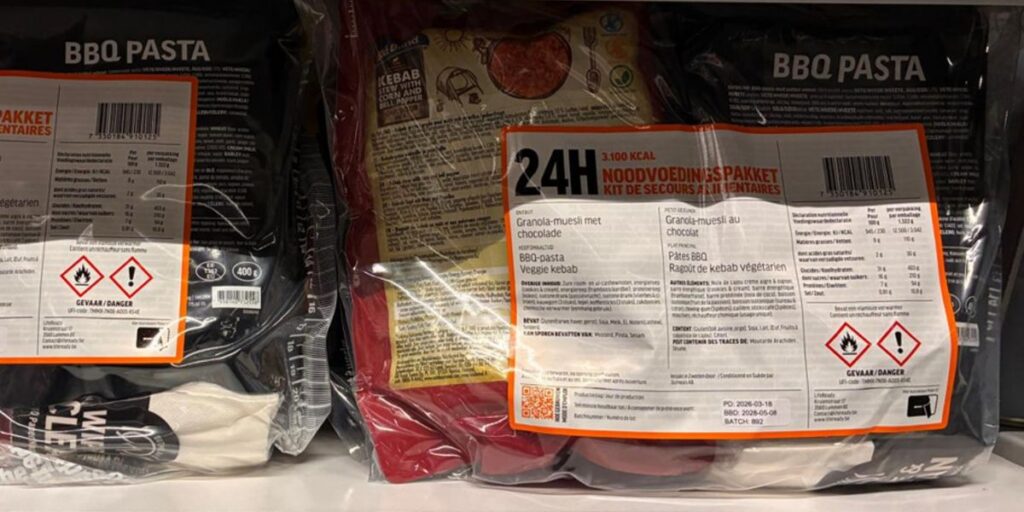
The kit is designed to cover a full day of self-sufficiency, offering around 3,100 calories, enough to sustain one adult for 24 hours.
Inside, customers will find a mix of practical and ready-to-eat items, including muesli, energy bars, nuts, and two prepared meals. There are also extras like isotonic drink powder, coffee sachets, chewing gum, tissues, and even a flameless heating system to warm food without electricity.
It’s a curated, grab-and-go solution aimed at convenience rather than long-term survivalism.
Unlike traditional emergency kits, such as those previously launched by the Red Cross, which focus more on first aid, these packs are heavily centred on food and immediate sustenance.
A trial launch with big potential
For now, the kits are being tested in around 80 stores across Belgium, priced at €29.99.
But the rollout could expand quickly.
If demand proves strong, Colruyt has indicated it may introduce the packs across its entire store network, signalling confidence that preparedness products could become a permanent category in supermarkets.
This would represent a notable evolution in retail, where emergency readiness becomes as normal as weekly grocery shopping.
The bigger picture: preparedness goes mainstream
The rise of supermarket survival kits points to a broader cultural shift.
Preparedness, once associated with extreme “prepper” culture, is now being reframed as practical and responsible. Governments across Europe have increasingly advised citizens to keep basic supplies at home in case of disruptions, whether caused by climate events, infrastructure failures or geopolitical tensions.
Retailers are simply catching up.
By packaging emergency readiness into a simple, affordable product, supermarkets like Colruyt are making preparedness accessible and arguably normalising it.
Convenience meets caution
Ultimately, the success of these kits will depend on whether consumers see them as essential or excessive.
But the timing suggests they are hitting a nerve.
In an era of uncertainty, convenience-driven solutions that promise even a small sense of control are likely to resonate. And if early demand is anything to go by, the idea of picking up a “just in case” survival kit alongside your weekly shop may soon feel entirely routine.





Lottie Verrier
Lottie Verrier is a journalist and digital media specialist based in Mallorca. After a decade in London media, including a role as Deputy Editor for the MailOnline’s eCommerce division, she now combines her editorial expertise with a passion for the island to create engaging content that celebrates the best of life in Spain. Instagram @lottieinmallorca
Comments