Watch Here: NASA launches Artemis II in first crewed Moon mission for over 50 years
By Molly Grace • Updated: 01 Apr 2026 • 16:31 • 3 minutes read
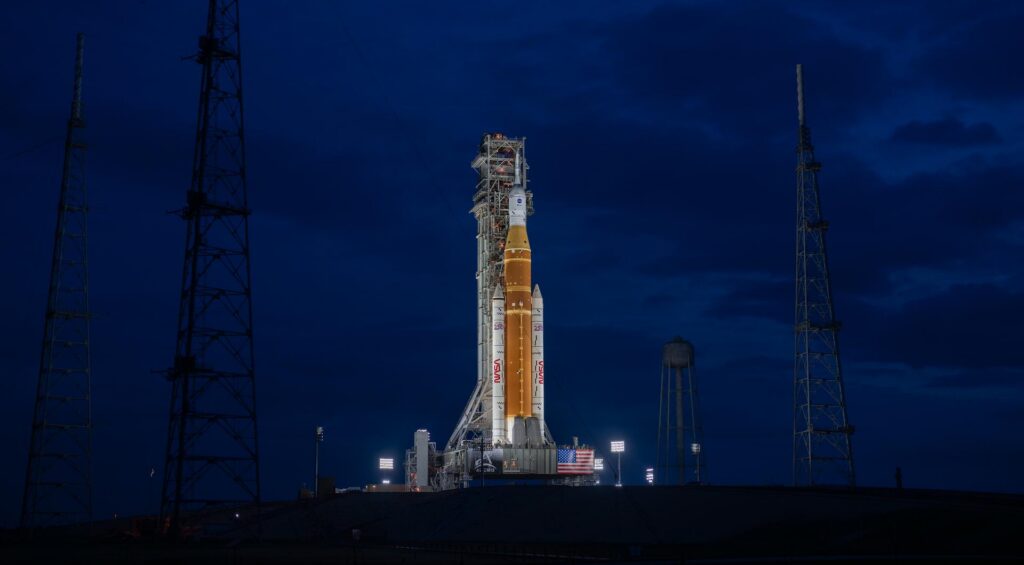
NASA will broadcast the launch live worldwide. Photo credit: NASA/Brandon Hancock
NASA is set to launch Artemis II today, April 1, marking the first time astronauts will travel beyond low Earth orbit since the Apollo era more than five decades ago. The mission represents a pivotal step in the United States’ long-term strategy to return humans to the Moon and establish a sustained presence there.
The launch is scheduled to take place from Kennedy Space Center in Florida at 6:24pm Eastern Time. This corresponds to 11:24pm in the United Kingdom and 00:24am in Spain in the early hours of April 2. A two-hour launch window remains in place, allowing for flexibility in the event of minor technical or weather-related delays.
As the countdown progresses, final checks are being carried out on the Space Launch System (SLS) rocket and the Orion spacecraft, both of which are central to the Artemis programme. The mission follows the successful un-crewed Artemis I test flight and will be the first to carry astronauts.
A mission designed to prove deep space capability
Artemis II will not attempt a lunar landing. Instead, it is structured as a crewed test flight intended to validate critical systems required for future missions. The Orion spacecraft will carry its crew on a trajectory that loops around the Moon before returning to Earth, in a journey expected to last approximately 10 days.
During this time, the spacecraft will travel hundreds of thousands of miles, reaching distances not experienced by human crews since the 1970s. The mission will push Orion beyond the protective reach of Earth’s magnetosphere, exposing both crew and systems to the harsher conditions of deep space.
Engineers will use the mission to assess life-support performance, propulsion systems, navigation accuracy and communications over long distances. The ability of astronauts to manually control the spacecraft will also be tested, providing essential data for more complex operations in future missions.
These objectives are considered critical in preparing for Artemis III, which aims to return humans to the lunar surface later this decade.
The crew leading a new era
The Artemis II crew consists of four astronauts, combining experience with historic firsts. Reid Wiseman will serve as commander, with Victor Glover as pilot. Mission specialists Christina Koch and Jeremy Hansen complete the team.
The mission carries significant symbolic importance. Koch is set to become the first woman to travel into deep space, while Glover will be the first Black astronaut to do so. Hansen, representing the Canadian Space Agency, will become the first non-American astronaut to journey to the Moon’s vicinity.
The crew has undergone extensive training, including simulations of deep space conditions, emergency procedures and spacecraft operations. Their performance will be closely monitored, providing valuable insights into human endurance and teamwork during long-duration missions beyond Earth orbit.
How to watch the launch live
NASA will broadcast the launch live worldwide, with coverage available through NASA+, the agency’s official streaming platform, as well as via its website and YouTube channel. Readers will also be able to watch the launch via the link provided in this Euro Weekly News article.
Live coverage is expected to begin several hours before liftoff, offering commentary, mission updates and behind-the-scenes access from Kennedy Space Center.
For viewers in the UK, coverage will build throughout the late evening, with liftoff expected at approximately 11:24pm. In Spain, audiences can tune in from around 10:30pm, with launch scheduled shortly after midnight.
Major international broadcasters are also expected to provide live coverage or rolling updates, reflecting the global significance of the mission.
Laying the groundwork for lunar return and beyond
Artemis II forms part of a broader effort to establish a long-term human presence on the Moon. Unlike the Apollo missions, which were limited in duration, the Artemis programme aims to develop sustainable exploration capabilities, including repeated missions and extended stays.
Central to this vision is the planned Lunar Gateway, a space station that will orbit the Moon and act as a staging point for surface missions. In addition, NASA and its partners are targeting the lunar south pole, where water ice could support life-support systems and fuel production.
The technologies and operational experience gained through Artemis II will inform these future missions, helping to refine spacecraft systems, mission planning and international collaboration.
A new chapter begins today
The launch of Artemis II represents a defining moment in modern space exploration. It signals not only a return to deep space, but the beginning of a new phase in which the Moon is viewed as a stepping stone rather than a final destination.
If successful, the mission will demonstrate that humans can once again travel safely to lunar distances, paving the way for the next stage of exploration. In doing so, Artemis II will help to transform ambitions of long-term lunar habitation into a practical reality, while bringing humanity one step closer to eventual missions to Mars.
Sign up for personalised news
Subscribe to our Euro Weekly News alerts to get the latest stories into your inbox!
By signing up, you will create a Euro Weekly News account if you don't already have one. Review our Privacy Policy for more information about our privacy practices.





Molly Grace
Molly is a British journalist and author who has lived in Spain for over 25 years. With a background in animal welfare, equestrian science, and veterinary nursing, she brings curiosity, humour, and a sharp investigative eye to her work. At Euro Weekly News, Molly explores the intersections of nature, culture, and community - drawing on her deep local knowledge and passion for stories that reflect life in Spain from the ground up.
Comments