Why drivers suddenly lose control on empty roads and never recover
By Farah Mokrani • Published: 03 Apr 2026 • 13:42 • 3 minutes read
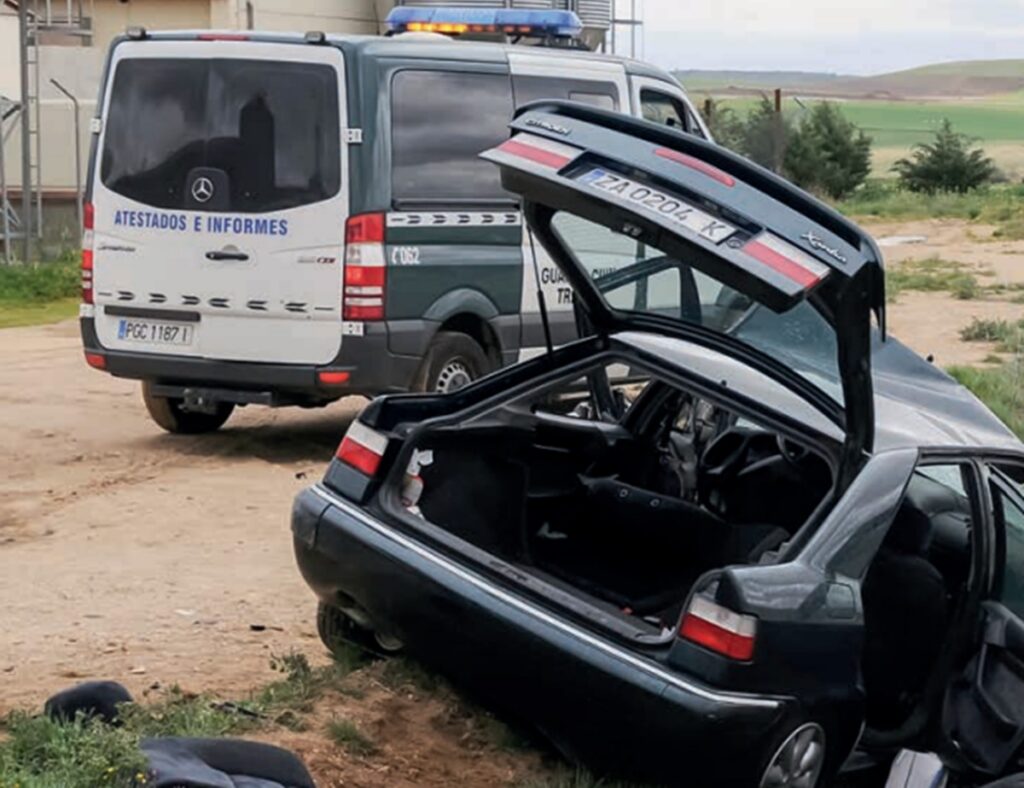
Single-vehicle crash after driver loses control on a rural Spanish road Credit : Revista.dgt.es
As we mentioned in our previous articles, Spain’s traffic authority has just released its latest magazine – and one of the most striking sections focuses on a type of crash that often happens when there’s no one else around.
No collision. No other vehicle involved. Just a driver, a road… and a sudden loss of control.
According to the latest DGT data, 482 people were killed in 2025 in these incidents alone – more than all collisions combined. And despite how common they are, many drivers still don’t fully understand why they happen.
The crash where drivers are completely alone
These are known as run-off-road crashes – when a vehicle leaves the road unexpectedly.
What makes them particularly alarming is that in most cases, there’s only one vehicle involved. In fact, around nine out of ten of these crashes happen without any other driver present.
That’s why experts often describe them as ‘solitary accidents’.
In many cases, there are no signs that the driver even tried to correct the situation. No braking, no steering adjustment – nothing.
And that’s where the real question begins: what actually causes someone to lose control like that?
Where and when these crashes happen most
The DGT’s latest figures give a clear picture.
Most of these crashes happen on conventional roads – the kind many people use every day – rather than on motorways. Curves are particularly risky, accounting for the largest share of incidents, followed by straight roads.
They’re also more common during the day, but the risk increases significantly at night, especially between 2am and 5am – when fatigue tends to peak and visibility drops.
Men account for the vast majority of those involved, and middle-aged drivers appear most frequently in the statistics.
Why drivers lose control without warning
There isn’t just one explanation – but some factors come up again and again.
Distraction and excessive speed are the two main causes, present in around three out of four fatal crashes of this type. Add alcohol into the mix, and the risk increases even more – with around four in ten drivers involved testing positive.
But there’s another possibility that researchers are still trying to understand.
Some experts believe that sudden health-related blackouts or extreme fatigue may explain why many drivers show no signs of reacting before leaving the road. In other words, they may not even realise what’s happening until it’s too late.
Why the outcome is often so severe
Leaving the road is only part of the problem.
What happens next is what makes these crashes so deadly.
Without barriers, a vehicle can hit a slope, a ditch, or a fixed obstacle – or even roll over. And when that happens, the severity of injuries increases dramatically.
Experts say the road environment plays a crucial role. Uneven surfaces, poorly signposted curves, changes in elevation, and lack of lighting all make it harder to recover control once something goes wrong.
And something as simple as wearing a seatbelt can make a life-saving difference – especially in rollover scenarios.
Straight roads vs curves: two different risks
Interestingly, the cause often depends on the type of road.
On straight sections, these crashes are more closely linked to distraction or falling asleep at the wheel. The road feels easy, attention drops — and that’s when control is lost.
On curves, speed becomes the key factor. Enter too fast, misjudge the bend, and there’s very little room to recover.
What drivers in Spain should take from this
If there’s one thing to understand, it’s that these crashes don’t usually start with something dramatic.
They begin with a moment – a lapse in attention, a bit of fatigue, a slight misjudgement.
But once the vehicle leaves the road, the situation can spiral quickly.
Whether you’re driving long distances or just using secondary roads, staying alert is essential. Take breaks when needed, slow down before curves, and avoid anything that takes your focus away from the road.
Because as the DGT’s latest figures show, some of the most dangerous accidents aren’t caused by others – they happen when drivers lose control completely, and don’t get the chance to recover.
Sign up for personalised news
Subscribe to our Euro Weekly News alerts to get the latest stories into your inbox!
By signing up, you will create a Euro Weekly News account if you don't already have one. Review our Privacy Policy for more information about our privacy practices.





Farah Mokrani
Farah is a journalist and content writer with over a decade of experience in both digital and print media. Originally from Tunisia and now based in Spain, she has covered current affairs, investigative reports, and long-form features for a range of international publications. At Euro Weekly News, Farah brings a global perspective to her reporting, contributing news and analysis informed by her editorial background and passion for clear, accurate storytelling.
Comments