Scientists spot ‘yellow brick road’ deep under the ocean and the explanation is even more surprising
By Farah Mokrani • Published: 12 Apr 2026 • 23:45 • 3 minutes read
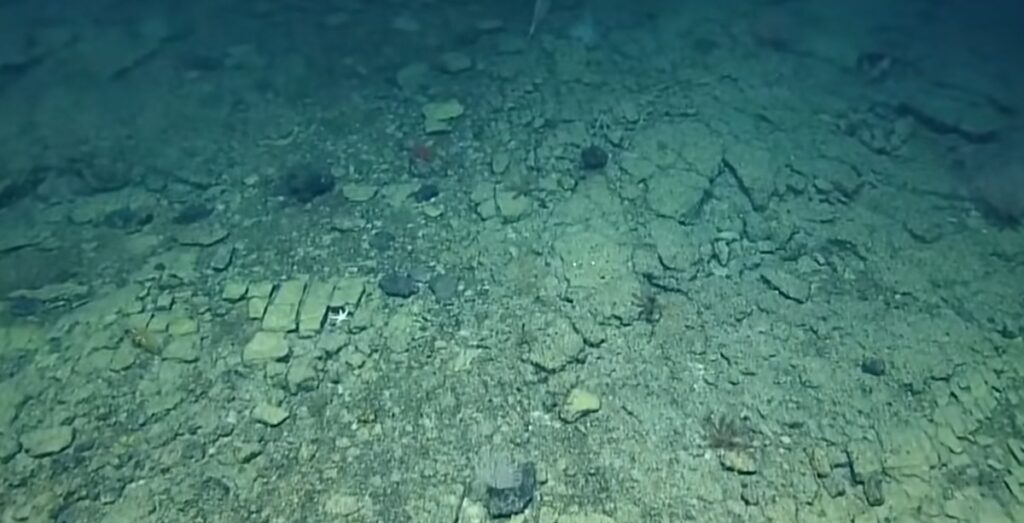
Scientists discover “yellow brick road” formation 3,000 metres underwater Credit: Screenshot - YouTube : EVNautilus
A deep sea expedition north of Hawaii has uncovered a strange formation on the ocean floor that looks uncannily like a path made of yellow bricks. The discovery was made more than 3,000 metres below the surface in one of the least explored marine areas on Earth, and while the images quickly sparked curiosity, scientists say the explanation is entirely natural.
The finding comes from a research mission led by the Ocean Exploration Trust in the Papahānaumokuākea Marine National Monument, a vast protected zone in the Pacific where only a small part of the seabed has ever been studied.
A discovery that looks almost too perfect to be natural
When the team first saw the images, it was hard not to make the comparison. The formation appeared as a stretch of flat, pale rock, cracked into shapes that looked surprisingly regular, almost like tiles carefully laid out in a path.
It did not take long for researchers to describe it as a ‘yellow brick road’, a reference that quickly stuck. From the footage alone, it is easy to see why. The pattern looks far too neat for something formed at the bottom of the ocean.
But as striking as it appears, scientists say there is no mystery in the sense people might imagine. There is no sign of human involvement, and nothing artificial about what lies there.
What is really behind the ‘yellow brick’ effect
The formation is made of hyaloclastite, a type of volcanic rock that forms during underwater eruptions. When molten material meets cold seawater, it breaks apart quickly, creating fragments that settle on the seabed.
Over time, this rock can crack as it cools and shifts. In this case, the fractures have created a pattern that just happens to look unusually structured.
In one specific section, the cracks form almost straight lines and right angles, which is what gives the impression of bricks. It is a coincidence of geology rather than anything designed.
Researchers involved in the mission were quick to point this out. The effect may look familiar, but it is simply the result of natural processes playing out over thousands of years.
A reminder of how little we have actually seen
What makes this discovery interesting is not just how it looks, but where it is. The Papahānaumokuākea area is one of the largest marine protected zones in the world, yet scientists say only a tiny fraction of it has been explored in detail.
In fact, estimates suggest that less than 0.001 per cent of the deep ocean floor has been properly observed. That means discoveries like this are still relatively rare, not because they do not exist, but because we have barely looked.
Each expedition adds a bit more to the picture. The Ocean Exploration Trust has been working to map and document these deep sea environments, focusing on underwater mountains and rocky slopes that are difficult to reach.
These areas can host unique forms of life and geological features that are still not fully understood.
Why scientists keep going back to places like this
Beyond the visual impact, there is a bigger goal behind these missions. Studying deep sea environments helps researchers understand how life adapts to extreme conditions, where sunlight does not reach and pressure is intense.
The slopes of underwater mountains, like those explored during this expedition, are known to support ecosystems that differ from those found closer to the surface.
By documenting these areas, scientists can learn more about biodiversity, geological activity and the history of the ocean floor itself.
It also helps build a clearer picture of how these environments might respond to changes in climate and human activity.
Still plenty left to discover beneath the surface
At a time when much of the attention in science is focused on space missions and exploration beyond Earth, discoveries like this bring the focus back home.
The deep ocean remains one of the least understood parts of our planet. Even with modern technology, reaching these depths is complex and expensive, which is why so much of it remains unseen.
For now, the so called yellow brick road is simply a striking example of what can be found when researchers take a closer look.
It may not lead anywhere magical, but it does highlight something just as important. There is still a vast part of the world beneath the surface that we have barely begun to explore.
Sign up for personalised news
Subscribe to our Euro Weekly News alerts to get the latest stories into your inbox!
By signing up, you will create a Euro Weekly News account if you don't already have one. Review our Privacy Policy for more information about our privacy practices.




Farah Mokrani
Farah is a journalist and content writer with over a decade of experience in both digital and print media. Originally from Tunisia and now based in Spain, she has covered current affairs, investigative reports, and long-form features for a range of international publications. At Euro Weekly News, Farah brings a global perspective to her reporting, contributing news and analysis informed by her editorial background and passion for clear, accurate storytelling.
Comments