“Beyond extinguishing capacity”: Terror as Madrid and Ávila wildfires merge into one unstoppable blaze
By Molly Grace • Published: 24 Jul 2026 • 22:56 • 5 minutes read
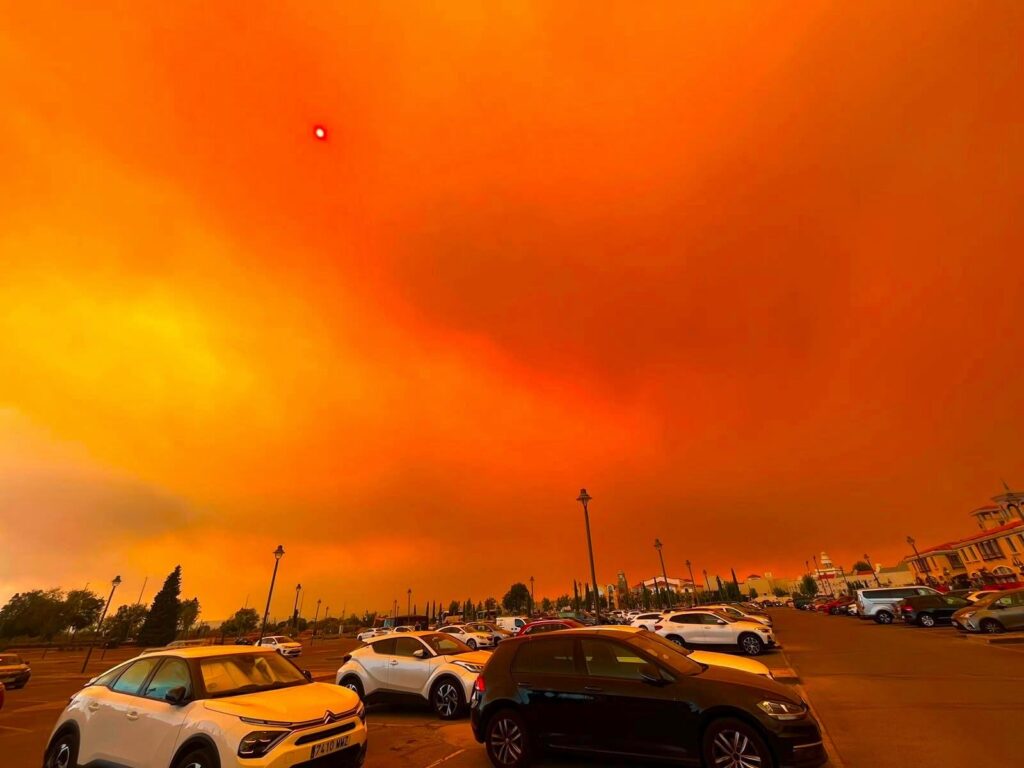
The wildfire’s impact is spreading across central Spain with more than 24 secondary roads closed. Photo credit:@angusjf4 on X
The wildfire emergency gripping central Spain has taken a dramatic turn after it was confirmed that the fires burning across Madrid and Ávila have now merged, creating a much larger and more dangerous blaze that is pushing firefighters to their limits. The development has triggered a stark warning from Madrid’s regional government, which admits the fire has moved beyond its current extinguishing capacity.
With crews unable to simply stop the advancing flames, the focus has shifted to containing the wildfire, protecting key areas and preventing further spread.The threat is no longer limited to those living close to the flames. A change in weather conditions is expected to carry smoke towards Madrid, potentially affecting millions of people with worsening air quality and reduced visibility in the coming days.
Fire reaches a point beyond extinguishing capacity
Madrid’s regional Environment Minister, Carlos Novillo, admitted that the wildfire has reached a stage where it is “beyond extinguishing capacity”, warning of the enormous challenge facing emergency services as crews battle unpredictable conditions. Instead of being able to eliminate every fire front, firefighters are now concentrating on containment, protecting strategic locations and preventing the flames from gaining further ground.
The merger of the Madrid and Ávila fires has created a larger and more complex fire area, with dry vegetation, high temperatures and changing winds making operations increasingly difficult. The blaze is spreading across areas west of Madrid, with locations including El Escorial, one of Spain’s most recognisable historical sites and a major tourist destination, among the areas facing the impact of the advancing wildfire.
Firefighters pushed to their limits as Europe sends help
For the crews on the ground, the scale of the wildfire has created some of the most demanding conditions they have ever faced. Veteran firefighters have described the operation as unlike anything they have experienced before, with rapidly changing fire behaviour making every intervention more dangerous. Some teams have found themselves trapped by advancing flames and forced to react quickly as conditions shifted around them.
But the crisis has also left many rural residents in Ávila facing heartbreaking decisions of their own. People living in cortijos and rural properties with animals have described being told last minute once the flames were upon them that they needed to evacuate, leaving them being abandoned and having to rely on themselves as they fight to protect their pets and livestock while flames approach their homes.
Many have been working desperately to move animals to safety, protect their land and defend their properties while emergency crews focus on containing the advancing wildfire. For those living in isolated areas, the battle has not only been against the flames but also against the fear of losing the animals and livelihoods they have spent years caring for.
#ifburgohondo esto vivimos ayer en LA RINCONADA, abandonados a nuestra suerte, avisados con el fuego encima. Han puesto en juego vidas humanas y animales, QUE VERGÜENZA 💔 @Meteoavila2 pic.twitter.com/62K3Qmqnp9
— Ana Navazo (@blackxnitt) July 24, 2026
Europe sends reinforcements as Spain’s firefighting resources are stretched
The pressure on emergency crews has prompted international support. Through the European Union’s civil protection response, additional aircraft have been sent to help Spain fight the blaze, including two firefighting aircraft from Italy and two from Greece. The arrival of European reinforcements draw attention to the sheer the scale of the emergency, with Spain requiring support as firefighters continue battling a wildfire that authorities admit has moved beyond normal extinguishing capacity.
At the same time, questions have been raised over Spain’s available aerial firefighting resources after reports that 15 Airbus A400M aircraft available to the government could not be used for direct firefighting operations because they did not have the necessary anti-fire kits installed.
Smoke threat moves towards Madrid
While firefighters continue battling the blaze, the consequences could soon be felt far beyond the areas directly affected by the flames. According to Meteoiberia, a change in wind direction towards northwesterly winds from Saturday is expected to push smoke from the Madrid and Ávila fires towards the capital.
The forecast warns that millions of people could experience poorer air quality and reduced visibility as the smoke plume moves across Madrid. The effects are also expected to spread to other parts of Spain’s interior in the following days. The development means that even people far from the wildfire itself could soon see the impact of the crisis through hazy skies, smoke pollution and worsening conditions outdoors.
Roads cut off as flames threaten key locations
The wildfire is also causing major disruption across central Spain, with several roads closed as emergency crews battle to contain the advancing flames. Among the affected routes are the M-512, M-521 and M-522 in the Madrid region, which have been closed due to the fire situation around the Sierra Oeste area. In Ávila, several secondary roads have also been affected as the merged wildfire continues spreading across the province.
Authorities have urged drivers to avoid affected areas and check the latest road information before travelling, as access restrictions remain in place to allow emergency services to work safely. The closures are affecting residents, commuters and emergency access routes, showing how the wildfire is impacting daily life far beyond the areas directly threatened by flames.
A wildfire threatening NASA’s link to deep space
The advancing flames have also placed the Deep Space Communications Complex at Robledo de Chavela under pressure, a facility that plays a vital role in humanity’s exploration beyond Earth. The complex forms part of NASA’s Deep Space Network, a global system of giant antennas used to communicate with spacecraft travelling across the Solar System. The network allows scientists and engineers to send commands to missions exploring distant planets and receive the vast amounts of scientific data collected from space.
The Robledo de Chavela facility is one of only three major Deep Space Network locations worldwide, alongside sites in California and Australia, making it an essential part of NASA’s ability to maintain contact with deep-space missions. The possibility of the wildfire affecting such a strategically important site demonstrates the extraordinary scale of the crisis. This is no longer only a battle to protect forests and local communities; emergency crews are also working to safeguard infrastructure connected to some of the world’s most advanced scientific missions.
17:40 Antenas de Robledo de Chavela..
🔥 ardiendo la Base espacial de Robledo.#IfBurgohondo pic.twitter.com/bVrh6xJ3yd
— Infues Avila (@InfuesAvila) July 24, 2026
The coming days will be critical
The next few days will be decisive as firefighters continue working to contain a blaze that authorities admit has moved beyond normal extinguishing operations. With changing winds, extreme conditions and smoke expected to spread across central Spain, the impact of the wildfire is no longer limited to the areas where flames are burning.
What began as separate fires in Madrid and Ávila has now become one much larger emergency, testing firefighters, disrupting transport and threatening internationally important infrastructure as crews fight to prevent further destruction. For those on the front line, the challenge is no longer simply putting out the fire, it is stopping one of Spain’s most difficult wildfires from becoming even more destructive.
Follow Euro Weekly News on Google News
Get breaking news from Spain, travel updates, and expat stories directly on your Google News feed.
Follow on Google NewsSign up for personalised news
Subscribe to our Euro Weekly News alerts to get the latest stories into your inbox!
By signing up, you will create a Euro Weekly News account if you don't already have one. Review our Privacy Policy for more information about our privacy practices.


Molly Grace
Molly is a British journalist and author who has lived in Spain for over 25 years. With a background in animal welfare, equestrian science, and veterinary nursing, she brings curiosity, humour, and a sharp investigative eye to her work. At Euro Weekly News, Molly explores the intersections of nature, culture, and community - drawing on her deep local knowledge and passion for stories that reflect life in Spain from the ground up.
Comments