€80m Renaissance masterpieces stolen from Sicily museum despite working alarms and guards on duty
By Harry Dennis • Published: 17 Aug 2026 • 14:18 • 2 minutes read
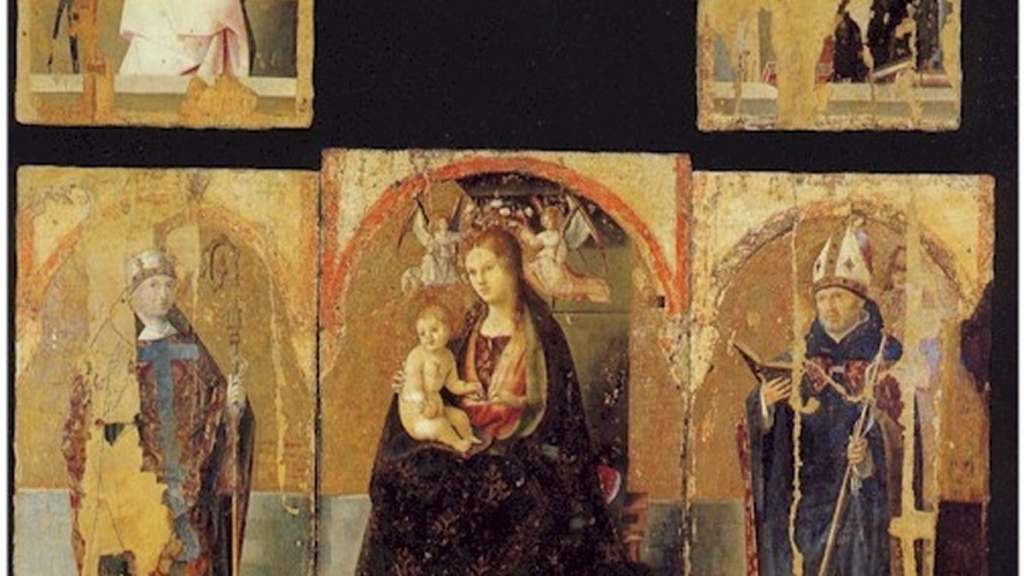
Antonello da Messina's 1473 San Gregorio Polyptych. Credit: Antonello da Messina, Public domain, via Wikimedia Commons
Four Renaissance masterpieces worth up to €80 million vanished from a Sicilian museum as a religious procession filled the streets outside, yet the thieves left two of the removed panels propped behind a wall as they fled. Art crime experts say works this recognisable may be almost impossible to sell.
Masterpieces prised from their frames, only to be left behind
Thieves broke into the Museo Regionale Interdisciplinare di Messina in Sicily just before 10pm on Saturday August 15, prising all five surviving panels of Antonello da Messina’s 1473 San Gregorio Polyptych from their frames. Three panels were carried away, the centre panel showing the Madonna of the Rosary enthroned, flanked by portraits of Saint Gregory the Great and Saint Benedict, while the other two smaller panels showing the Annunciation were abandoned behind a wall as the thieves made their escape.
Another more secure painting was taken from its armoured case
A separate double-sided panel, showing the Madonna and Child on one side and a Pieta of the dead Christ on the other, was also stolen from a secure display case elsewhere in the museum. Its small size suggests it was originally made for private devotion rather than public display, adding to its rarity.
How the Ferragosto celebrations made a perfect distraction
The theft happened while much of Messina’s attention was on the Ferragosto holiday, with a religious procession known as La Vara converging on Piazza del Duomo for the traditional blessing. Museum director Marisa Mercurio said the theft was carried out just before 10pm and that the museum’s alarms and cameras had been working normally, though police are still trying to establish how the thieves avoided triggering them. “We are devastated by what happened,” she said. “They were two of Antonello da Messina’s most important and best-known works. It is a tremendous loss for the museum, the city, the community and the art world.”
Why the most famous paintings can be the hardest to sell
Italian art expert Alberto Fiz valued the missing works at between €70 million and €80 million (£60 million to £68 million). But art crime analyst Lynda Albertson, chief executive of the ARCA art crimes research association, said fame can work against the thieves. “Stealing an Antonello may be far easier than selling one,” she said. “If these are ordinary thieves, they will soon discover that, to their cost.” She said famous stolen works often pass between criminals as collateral rather than being sold outright, since any attempt to move them through legitimate channels would be instantly recognised.
Sicily’s loss follows two other major Italian art heists
The theft is the third major art heist to hit Italy in under a year. In March, a gang stole paintings by Cézanne, Renoir and Matisse worth about €9 million from a foundation near Parma. Those three works were recovered by police just days before the Messina theft. In October, art theft wasn’t just tied to Italy either. In Paris, thieves also made off with €88 million in French royal jewels from the Louvre, works that remain missing.
Messina’s top culture official, Enzo Caruso, called the theft “more than a loss” and “a disaster”, saying that Messina without Antonello is deprived of the very essence of the greatest artist of the European Renaissance. The museum stayed closed on Sunday while investigators gathered evidence. The two missing polyptych panels and the double-sided Pieta panel had not been recovered.
Follow Euro Weekly News on Google News
Get breaking news from Spain, travel updates, and expat stories directly on your Google News feed.
Follow on Google NewsSign up for personalised news
Subscribe to our Euro Weekly News alerts to get the latest stories into your inbox!
By signing up, you will create a Euro Weekly News account if you don't already have one. Review our Privacy Policy for more information about our privacy practices.



Harry Dennis
Born in the UK and raised on the Cádiz coast, Harry brings his background in design, music, and photography to his writing for Euro Weekly News, sharing stories that celebrate culture and lifestyle across Spain and beyond.
Comments