Beavers chew down sign warning walkers about beavers in Poland
By Harry Dennis • Published: 09 Oct 2026 • 11:28 • 2 minutes read
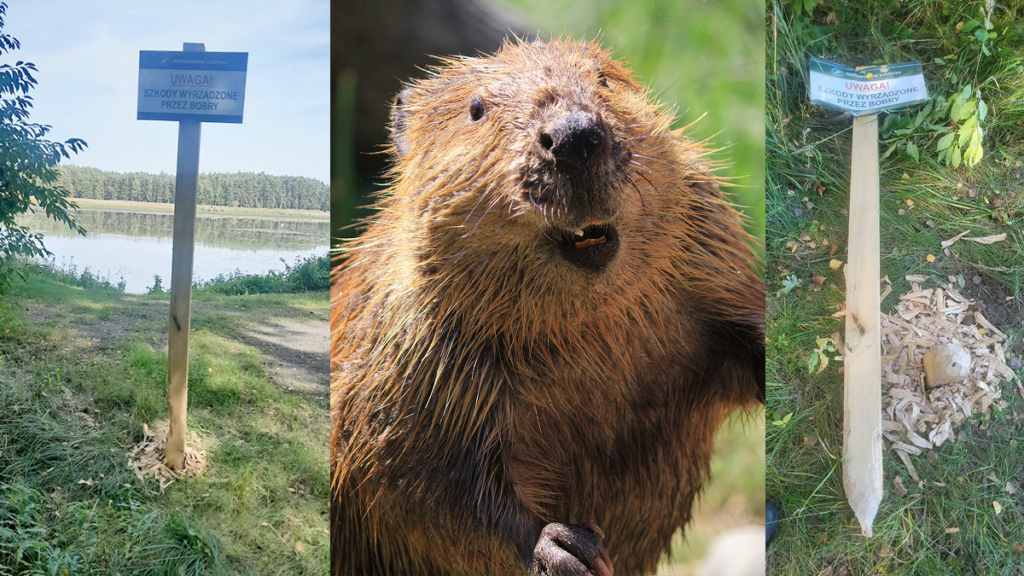
The warning that didn’t last. Credit: Nadleśnictwo Lubliniec / FB / Martens Coyotes / Shutterstock
Foresters in southern Poland put up a sign to warn walkers about beavers felling trees beside a pond, but it didn’t last long. The beavers chewed straight through the oak post, leaving the warning face down in the grass.
The oak post faced the same fate as the trees
The sign, reading ‘Warning! Damage caused by beavers’, was put up by foresters from the Lubliniec forestry district (Nadleśnictwo Lubliniec), in Poland’s Silesia region. However, photos they shared on Facebook show the wooden post gnawed through at the base, with the sign lying on the ground and wood shavings scattered around the stump.
It was there for a very practical reason too, as beavers at a nearby pond have been digging burrows under a road and felling trees, leaving sharpened stumps sticking out of the ground that walkers could easily trip over.
The foresters took it in good humour, joking that the beavers just didn’t want anyone to be warned.
The foresters’ advice: “just imagine the sign is still there”
So, rather than rushing to replace it, the district asked people to take care around the pond. If walkers spot a pointed stump left behind by a beaver, they said, they should picture the warning sign still standing in its place.
The photos have since spread widely across Polish social media, with many people no doubt thinking ‘well, at least the sign was accurate’.
From 235 beavers to around 150,000
Now, the animals behind the kerfuffle were once almost wiped out in Poland. By 1928, hunting had left an estimated 235 beavers in the country, according to Krytyka Polityczna, before postwar reintroduction efforts helped the population climb back to around 150,000 today.
Ecologists say that recovery brings real benefits, with dams holding back water and helping to fight drought. Poland’s state water agency, Wody Polskie (PGW WP), has described the areas their dams create as oases of biodiversity.
However, beavers can also damage roads, homes and farmland, which has led to calls for culls in some areas. In 2022, flooding caused by beavers was blamed for a road collapsing in one Polish town.
Spain’s beavers are spreading too
Spain has its own beaver story, though. The European beaver is native to the Iberian Peninsula, but hunting wiped it out here in the 18th century. It came back without anyone’s permission in 2003, when 18 beavers were released illegally on the Ebro and Aragón rivers, on the border between Navarra and La Rioja. They’ve since been confirmed in the Ebro, Duero, Tajo and Guadalquivir river basins, with sightings near Jaén in 2023 and on the Tajo in 2025.
Experts have raised concerns about the damage to crops and riverside trees, as well as the knock-on effect on fish and other wildlife.
So anyone walking along a riverbank in the Ebro valley who spots a pointed, freshly gnawed stump should watch where they’re putting their feet, as it usually means beavers are busy nearby.
Follow Euro Weekly News on Google News
Get breaking news from Spain, travel updates, and expat stories directly on your Google News feed.
Follow on Google NewsSign up for personalised news
Subscribe to our Euro Weekly News alerts to get the latest stories into your inbox!
By signing up, you will create a Euro Weekly News account if you don't already have one. Review our Privacy Policy for more information about our privacy practices.



Harry Dennis
Born in the UK and raised on the Cádiz coast, Harry brings his background in design, music, and photography to his writing for Euro Weekly News, sharing stories that celebrate culture and lifestyle across Spain and beyond.
Comments