Spain general strike on November 11: What holidaymakers need to know before flying
By Farah Mokrani • Published: 09 Oct 2026 • 8:59 • 5 minutes read
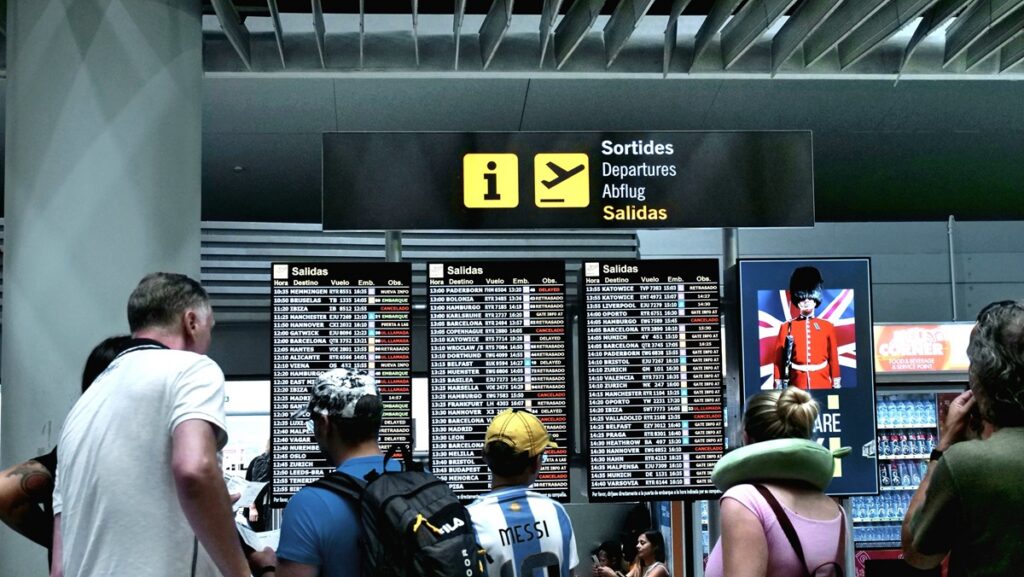
Travellers could face disruption during Spain’s November 11 general strike. Credit : ena_b, Shutterstock
Spain on 11 November, a general strike is being planned, which could affect the airport and the transport system in general. Travellers are being urged to keep an eye on their reservations.
The two main trade union federations in Spain, UGT and CCOO, have confirmed that the strike will be on Wednesday, November 11, 2026, causing some alarm for those who were going to visit Spain that day or were to return to their homes that day.
Just a few weeks before Spain’s snap general election on November 29 and amidst a growing revolt against rents, wages, and the rising cost of living, the announcement was made.
According to a Reuters report, Spain’s trade unions are calling for a national strike on November 11, two weeks before a general election. The general strike is the first by both union federations since 2012.
For British holidaymakers and travellers from around the world heading to Spain, the big questions are: Could their flight be cancelled? What if they are stranded at the airport? And what happens if their holiday is disrupted?
Will flights to Spain be cancelled during the November 11 general strike?
On November 11, the flights arriving, departing, or functioning in Spain may suffer some inconveniences. However, a general strike doesn’t mean that airports will be closed or that planes will not fly.
The extent of the impact will depend on the workers who participate, the number of staff and the essential minimum services determined for essential operations.
Airport ground handling, baggage services and other activities could potentially be affected if employees in those sectors join the walkout.
For passengers of British Airways, Ryanair, Iberia, and other carriers, it is most important to check directly with the carriers as to whether their flight is operating or not.
There is as yet no accurate list of the flights cancelled all over the country on account of the strike on November 11. Consequently, it is not necessary to cancel or change reservations without consulting the carrier before departure.
The potential problems may also extend beyond the airport itself.
Rail passengers could face reduced services, including on Renfe trains, high-speed connections and regional routes, depending on the level of participation and the minimum requirements that are imposed.
Metros and local buses may also be affected, which might make it difficult to go from airports to hotels or city centers.
In certain cities, such as Madrid or Barcelona, it might happen that the traffic, besides being blocked by a march, would be stopped up on the streets where the buses and the cabs commuting to the airports would be using.
The exact places and times of individual demonstrations are still not known, nor are the precise rules of transport.For the holidaymaker arriving on November 11, this means that a scheduled flight does not mean a straightforward drive to their place of lodging.
Spain general strike: What happens if your flight is cancelled?
Another worry is whether they will lose their money if their flight is cancelled.
In terms of the European air passenger rights, in the event of a flight being cancelled, the carriers must give the passengers entitled to it a choice between a refund and another means of transport.Its protection is extended to all flights leaving EU airports, including Spain, irrespective of the nationality of the airliner.
It generally also applies to flights arriving from outside the EU and operated by an EU airline.
If one flies from Spain to the UK, for example, one is covered by EU passenger rights, but if you travel from the UK to Spain, you may be covered by either the EU rules or those of the UK, depending on the nationality of the airline.
In the case of a flight being cancelled, the regulations of the European Commission give the following rights to the passengers.
- A refund: Reimbursement of the unused ticket, subject to the applicable rules.
- An alternative flight: Re-routing to their destination under comparable transport conditions.
- Assistance while waiting: Meals, refreshments and, where necessary, accommodation and transport between the airport and hotel.
However, refunds and financial compensation are not the same thing.
Even if no compensation is payable to a passenger, he is still entitled to the reimbursement of his expenses or to the re-routing of his itinerary.
Under EU rules, compensation for long delays and cancellations can amount to €250, €400 or €600, depending on the distance of the flight and the circumstances.
Extraordinary circumstances do not include strikes, according to their nature.The European Commission makes a distinction between strikes that affect the employees of the operating company and strikes that involve employees of an outside company, such as airport workers or air traffic controllers.
A strike of an airline’s own employees is not generally a reason to withhold compensation. A strike by employees of other companies can count as an extraordinary circumstance, but the company must show that the strikes could not have been prevented even with the most prudent measures.
Travellers should not therefore be under the impression that strike-related journeys do not always preclude compensation.
Travelling to Spain on November 11? How to prepare for possible disruption
It is a holiday period, there are several weeks to go to the date of the strike, and it will be possible for travellers to make arrangements for their journey without causing too many inconveniences.
First you have to check whether your airline has your correct contact information. In that case you can be notified of changes to the schedule, cancellations, or alternative flights.
Also worth having is the app of the company you are flying with, especially if it provides flight information in real time or digital boarding passes.
Passengers relying on trains, buses or airport transfers should check their arrangements closer to departure.
If your plane lands at the Madrid, Barcelona, Malaga, Alicante, or any other Spanish airport, think of the means by which you will arrive at your destination in case public means of transport operate on reduced schedules.
Allowing extra time for airport journeys could be particularly important, especially if demonstrations or transport restrictions affect roads around major cities.
Travellers who have booked organised transfers should check with the service provider to see if the service is expected to operate.
Those who are going to take the train must monitor the announcements of Renfe and any other relevant rail operator, and those who are travelling by bus or metro must consult the appropriate transport authority.
Another consideration is travel insurance.Some of the insurances cover strike damage, but the extent of the cover varies considerably.
Whether a claim is granted depends on the clauses in the policy, when the insurance was taken out, and whether the strike was publicly known at the time of purchase.
On October 7, the date of November 11 was announced, and since that day it has been of great importance to travellers, who have afterwards obtained insurance, to ascertain whether it includes the expected strike.
Taking this into consideration, not every travel insurance taken out before this announcement will cover strike expenses.
Lastly, it is advisable to keep receipts of all necessary expenses incurred during the course of the journey, especially if you want to claim from the airline or insurance company.
For now, there is no reason to assume that every flight to Spain on November 11 will be cancelled.
The strike is confirmed, but its practical consequences for individual airports, carriers and transport companies will become clearer as the date approaches.
For anyone planning to travel that day, the best approach is to keep an eye on their booking, check for any last-minute changes and, where possible, have alternative travel arrangements in mind.
It would be a case of avoiding any inconvenience by that foresight, for the difference between a manageable delay and an unexpectedly expensive beginning or end to a journey.
Follow Euro Weekly News on Google News
Get breaking news from Spain, travel updates, and expat stories directly on your Google News feed.
Follow on Google NewsSign up for personalised news
Subscribe to our Euro Weekly News alerts to get the latest stories into your inbox!
By signing up, you will create a Euro Weekly News account if you don't already have one. Review our Privacy Policy for more information about our privacy practices.


Farah Mokrani
Farah is a journalist and content writer with over a decade of experience in both digital and print media. Originally from Tunisia and now based in Spain, she has covered current affairs, investigative reports, and long-form features for a range of international publications. At Euro Weekly News, Farah brings a global perspective to her reporting, contributing news and analysis informed by her editorial background and passion for clear, accurate storytelling.
Comments