Tenerife introduces new Mount Teide rules as visitors face fines of up to €600
By Farah Mokrani • Published: 19 Oct 2026 • 13:52 • 4 minutes read
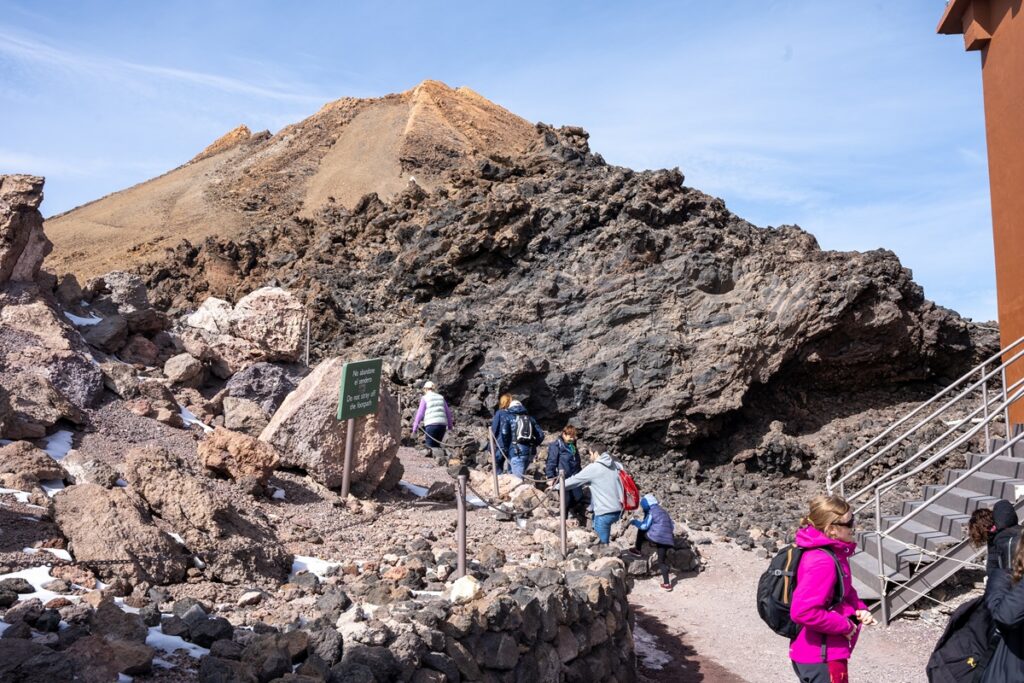
Visitors exploring Mount Teide, where updated hiking rules include permits and fines of up to €600. Credit : Abinieks, Shutterstock
Updated access rules are now in force on Mount Teide, with daily limits on hikers, compulsory safety equipment and fines of up to €600 for entering regulated trails without a permit. The updated arrangements cover three mountain trails, with 150 daily places allocated to individual hikers and another 75 reserved for accredited professionals.
October 15 saw the Council of Tenerife announced the updated arrangements, designed to improve visitor safety and protect the natural environment of Teide National Park.
Reservations for the three routes are free. However, hikers must obtain authorisation before setting off, carry suitable mountain equipment and be prepared to show identification to park staff.
The latest resolution updates existing access restrictions and establishes daily quotas rather than opening three entirely new hiking trails.
Three Mount Teide trails now have a combined limit of 225 visitors a day
According to the Cabildo de Tenerife’s official announcement, the updated instructions refer to three existing routes within the National Park.
The first is PNT 09, Teide–Pico Viejo–Mirador de Las Narices del Teide, which has a maximum of 95 places per day. 70 are reserved for individual visitors and 25 for accredited professionals.
The second, PNT no. 23, Los Regatones Negros, has a maximum of 65 people per day, with 40 places set aside for individual walkers and 25 for the professionals.
This is also the arrangement for PNT 28, Chafarí, which admits 65 people per day.
The overall capacity of 225 visitors per day applies to the three trails. This figure is divided into 150 places for individual hikers and 75 for accredited professionals.
These limits are not a total ban on all visitors to the National Park, but refer only to these three trails.
The routes were already subject to access restrictions under earlier regulations. The latest resolution sets out their daily quotas within the updated reservation system.
Importantly, reservations for these three trails remain free.
Visitors risk €600 fines and must carry compulsory hiking equipment
If you want to use these designated tracks, you must apply for a permit at www.tenerifeon.es, the official reservation site of the island.
Visitors must sign up, choose their route, and obtain a place on the desired date. They must also be able to show their reservation and official identity card on demand by the park staff.
Entering a regulated trail without the required permit can result in a fine of up to €600. This is the maximum penalty and is not automatically charged to all who make mistakes.
A confirmed booking does not grant the right to enter if the traveller does not have the necessary equipment.
The latest regulations stipulate that a hiker must have a pair of mountain boots, long trousers, warm clothing, a charged mobile phone, emergency blanket, bottled water, hat, gloves and torch or headlight with a spare battery.
The park staff have the right to examine your equipment and may deny entry to those who do not meet these requirements.
These precautions apply even in good weather, as conditions on Mount Teide can change rapidly at high altitude, particularly when temperatures fall or snow and ice develop.
The authorities may even close a route in whole or in part at times when it is dangerous. In certain circumstances, access to some routes may be reserved for mountaineers experienced in the high mountains, or for small groups accompanied by accredited professionals.
How to book Mount Teide trails and what else is changing
Tenerife ON is the official reservation service, where you can find out if there is any availability, check the conditions for each individual trip and obtain the necessary authorisation.
Visitors should check the latest booking windows and availability directly on Tenerife ON before travelling.
Visitors are asked to find out about the latest information before travelling, especially if they intend to take part in one of the mountain walks at the busy periods or when mountain conditions are unsure.
The October resolution also updates arrangements for two other regulated trails: PNT 07, Montaña Blanca–La Rambleta, and PNT 10, Telesforo Bravo, which provides access towards the summit of Mount Teide.
Upon Telesforo Bravo, the waiting periods were shortened from two hours to one and a half, and provisions were made for sunrise access and places for registered mountaineers and accredited professionals.
Unlike the three trails covered by the updated daily quotas, these two established routes are subject to charges for certain visitors.
Tenerife residents will continue to qualify for free access. On Telesforo Bravo, those from elsewhere in the Canary Islands pay six euros, while those living outside the archipelago pay fifteen. Children under fourteen are exempt.
In the case of the Montaña Blanca – La Rambleta, visitors living outside the Canary Islands are charged €6 on weekdays and €10 at weekends and on public holidays, during the stipulated hours of operation.
Visitors should also remember that a cable car ticket is not the same as a hiking permit. Anyone planning to use a regulated trail must check whether separate authorisation is required.
The cabildo stated that these changes would improve the safety of the visitors, limit their number, and protect the natural environment of the national park.
To tourists who want to discover one of the most visited sites in Tenerife, there is nothing much to be altered except the need for more careful preparations: making sure that one knows the route, obtaining the necessary permissions and carrying the requisite materials can make the difference between enjoying one’s excursion and being refused admission, or even having to pay a hefty fine.
Follow Euro Weekly News on Google News
Get breaking news from Spain, travel updates, and expat stories directly on your Google News feed.
Follow on Google NewsSign up for personalised news
Subscribe to our Euro Weekly News alerts to get the latest stories into your inbox!
By signing up, you will create a Euro Weekly News account if you don't already have one. Review our Privacy Policy for more information about our privacy practices.





Farah Mokrani
Farah is a journalist and content writer with over a decade of experience in both digital and print media. Originally from Tunisia and now based in Spain, she has covered current affairs, investigative reports, and long-form features for a range of international publications. At Euro Weekly News, Farah brings a global perspective to her reporting, contributing news and analysis informed by her editorial background and passion for clear, accurate storytelling.
Comments