Spain is not the only country suffering train accidents as Prague collision injures 46
By Molly Grace • Published: 17 Nov 2026 • 16:18 • 3 minutes read
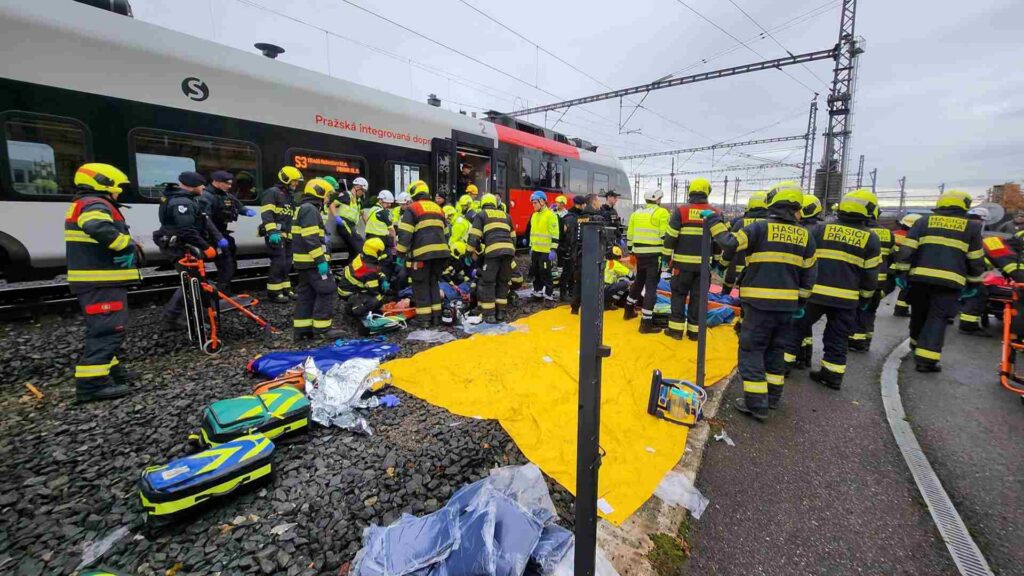
The crash disrupted services in and around Prague’s main railway station. Photo credit:HZS hl. m. Prahy - poskytnuto HZS ČR
It seems like Spain is not the only country that is having a bad bout of luck with their trains, as the Czech Republic has now suffered a serious railway collision of its own. It was a frightening start to Tuesday for dozens of people travelling through Prague, after two passenger trains crashed near the Czech capital’s main railway station, leaving dozens people injured, four of them were also seriously injured, including both train drivers, as emergency crews rushed to the scene shortly after 07:00am on November 17.
The injured were taken to hospitals across the city, while passengers were evacuated from both trains. The collision happened on a railway bridge above Seifertova Street in Prague 3, close to the main station. The trains were travelling at relatively low speed when they struck head-on. Firefighters said the crash was not destructive, and nobody needed to be cut free. However, the number of people hurt required emergency services to coordinate their response and distribute patients between hospitals.
Forty-six people injured
Prague’s emergency services confirmed that 46 people had been injured. Four suffered serious injuries, 12 were classed as moderately injured and 30 had minor injuries. Sixteen of those hurt were foreign nationals, according to police. Slovakia’s foreign minister later confirmed that two Slovak citizens were among the injured, both with minor injuries.
Firefighters, police and ambulance crews attended, assessing passengers and identifying those who needed urgent medical treatment. Everyone aboard the two trains was eventually evacuated. The trains involved were a service travelling to Milovice and another coming from Mladá Boleslav. Czech Railways said passengers affected by the collision would be compensated for injuries and damage to their belongings.
Všechny složky IZS zasahují u srážky dvou vlaků u Hlavního nádraží na přemostění se Seifertovou ulicí v Praze 3. Na místě je několik zraněných osob. https://t.co/33NUSn7zjI
— Policie ČR (@PolicieCZ) November 17, 2026
Red signal under investigation
The cause of the crash has not yet been formally established, but the Czech transport minister has raised the possibility that one of the trains passed a red signal. Ivan Bednárik told reporters that early information suggested a train travelling towards Milovice had passed a signal showing that it must stop. He cautioned against drawing conclusions about whether the incident was caused by human error or a technical fault.
The railway’s central safety system activated an emergency stop, halting trains across the network. However, it did not prevent the two trains from making contact. They collided while braking, at a lower speed than they might otherwise have been travelling. Railway investigators and police are examining the circumstances. The Railway Inspectorate has estimated the damage at more than 16 million Czech crowns, while officials are also expected to assess the signalling and safety systems.
Disruption around Prague station
The crash disrupted services in and around Prague’s main railway station during the morning rush hour. Trains on routes towards Vysočany and Libeň were affected, while some long-distance services were diverted to other stations in the city. Czech Railways advised passengers to expect delays and changes to their journeys. Services were gradually restored, with four platforms at the main station back in operation during the morning.
The two trains were separated later, allowing work to begin on clearing the scene. The disruption left passengers checking whether their trains were running from a different station or had been delayed, affecting people trying to reach work and onward connections.
Safety questions after the collision
The Prague crash comes during a grim year for railways across Europe. Spain has suffered two devastating train disasters, with 46 people killed near Adamuz in January and another 69 near Urda in October. A commuter train crash near Gelida also claimed the driver’s life.
France has seen a TGV driver killed after a collision with a lorry at a level crossing, while a separate derailment in Normandy injured 44 passengers. In Germany, a collision between two freight trains in Munich killed one person after wagons fell from a railway bridge.
Bednárik said an extraordinary meeting of the Czech transport ministry’s railway safety commission would take place this week to examine the Prague crash and consider further safety measures. Investigators are examining reports that one train passed a red signal, although this has not been confirmed. They must also establish whether a technical fault contributed to the collision and why the emergency braking system did not prevent the impact.
Follow Euro Weekly News on Google News
Get breaking news from Spain, travel updates, and expat stories directly on your Google News feed.
Follow on Google NewsSign up for personalised news
Subscribe to our Euro Weekly News alerts to get the latest stories into your inbox!
By signing up, you will create a Euro Weekly News account if you don't already have one. Review our Privacy Policy for more information about our privacy practices.




Molly Grace
Molly is a British journalist and author who has lived in Spain for over 25 years. With a background in animal welfare, equestrian science, and veterinary nursing, she brings curiosity, humour, and a sharp investigative eye to her work. At Euro Weekly News, Molly explores the intersections of nature, culture, and community - drawing on her deep local knowledge and passion for stories that reflect life in Spain from the ground up.
Comments