Earthquakes under southern Spanish seas: Should residents be concerned about tsunami risk?
By Adam Woodward • Published: 24 Nov 2026 • 10:14 • 3 minutes read
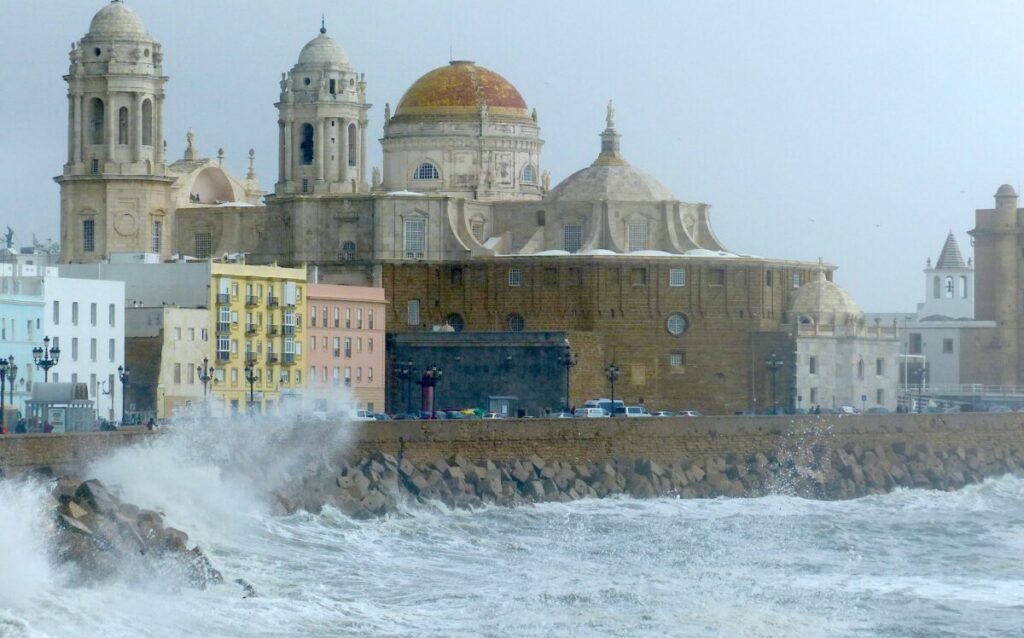
Waves crash on Cadiz rocks. Credit: lensfield - Shutterstock
Several earthquakes recorded beneath the waters between the Strait of Gibraltar and Gulf of Cadiz have raised questions about potential dangers of a tsunami hitting southern Spain.
Although the latest tremors are relatively small, they have been more frequent and emergency authorities are taking no chances when preparing for a possible coastal disaster.
A magnitude 2.9 earthquake struck west of Tarifa at 1.50am on Sunday, November 22, at a depth of approximately 63 kilometres. It followed several other movements in the Gulf of Cadiz, including a magnitude 3.9 tremor on Saturday, November 21, and a 3.5 earthquake on Thursday, November 19.
Other recent movements recorded by Spain’s National Geographic Institute (IGN) include:
- November 17: Magnitudes 2.0 and 2.2 in the Gulf of Cadiz.
- November 19: Magnitude 3.5 in the Gulf of Cadiz.
- November 20: Magnitude 2.4 in the Gulf of Cadiz.
- November 21: Magnitude 3.9 in the Gulf of Cadiz.
- November 22: Magnitude 2.9 west of Tarifa.
- November 22: Magnitude 2.6 in the southern Alboran Sea.
According to the IGN’s latest earthquake records, none of these movements has been linked to a tsunami warning as yet. The latest Tarifa tremor was not reported as felt by residents.
Why the Strait of Gibraltar is an earthquake hotspot
Southern Spain occupies a geologically active area where the African and Eurasian tectonic plates meet. The African plate moves slowly northwards, creating pressure along a complex network of faults beneath the land and seabed. Movement along these faults releases energy in the form of earthquakes. Several tremors within a short period can form a seismic sequence, but this does not automatically mean a larger earthquake is coming.
Small earthquakes such as those recorded recently are not normally capable of generating destructive tsunamis. The greater concern is a powerful, shallow underwater earthquake that displaces a large volume of the seabed.
Readers can find out more about Spain’s earthquake risk and the towns included on the government’s official list.
Could a tsunami hit the Costa del Sol?
History provides a sobering reminder of what can happen. On November 1, 1755, a massive earthquake off Portugal triggered a tsunami that devastated coastal communities, including parts of Cadiz and Huelva. Thousands of people died across the affected areas.
According to the Junta de Andalucia’s official tsunami preparedness guide, the Atlantic coastline faces the greatest tsunami hazard in the region. Flooding heights could approach 12 metres in particularly exposed locations, including parts of Cadiz and the coastline between Conil de la Frontera and Cape Trafalgar.
Mediterranean coastal areas face a different threat. Although potential waves are generally smaller, the guide warns that arrival times could be as short as 10 to 30 minutes.
Huelva tsunami exercise tested 40-minute warning
Preparations are not simply theoretical. On November 18, Salvamento Marítimo carried out an exercise through its Huelva coordination centre, simulating a major earthquake capable of generating destructive tsunami waves.
According to Europa Press, the fictional emergency alert gave authorities just 40 minutes before the first wave was expected to reach the Huelva coastline. The exercise tested communication and coordination between emergency organisations, while simulated warnings covered several Spanish regions. Maritime traffic was instructed to avoid affected ports and coastal areas, with vessels told to monitor VHF channel 16 for safety information.
The exercise followed Andalucia’s large-scale Response25 tsunami drill in Cadiz in November 2025, when more than 20,000 people participated in evacuation and emergency procedures.
What should residents do if a tsunami warning is issued?
Residents and visitors should know that a tsunami warning is not the same as an ordinary weather alert. If an official warning is issued, people should move away from beaches, harbours, promenades and low-lying coastal areas, following emergency services’ instructions towards higher ground.
Anyone who feels a strong or prolonged earthquake near the coast should also take natural warning signs seriously, rather than waiting at the shoreline to see whether the sea changes.
The recent earthquakes are not a reason to panic, and there is no indication that a tsunami is imminent. However, the latest seismic activity is a timely reminder that southern Spain needs to be prepared for a natural hazard that, and that regional authorities are on their toes with this one.
Follow Euro Weekly News on Google News
Get breaking news from Spain, travel updates, and expat stories directly on your Google News feed.
Follow on Google NewsSign up for personalised news
Subscribe to our Euro Weekly News alerts to get the latest stories into your inbox!
By signing up, you will create a Euro Weekly News account if you don't already have one. Review our Privacy Policy for more information about our privacy practices.





Adam Woodward
Adam is a writer who has lived in Spain for over 25 years. With a background in English teaching and a passion for music, food, and the arts, he brings a rich personal perspective to his work at Euro Weekly News. As a father of three with deep roots in Spanish life, Adam writes engaging stories that explore culture, lifestyle, and the everyday experiences that shape communities across Spain.
Comments