Easter week 2025 in Spain: when, where and how to make the most of your days off
By Farah Mokrani • Published: 02 Apr 2025 • 8:37 • 2 minutes read
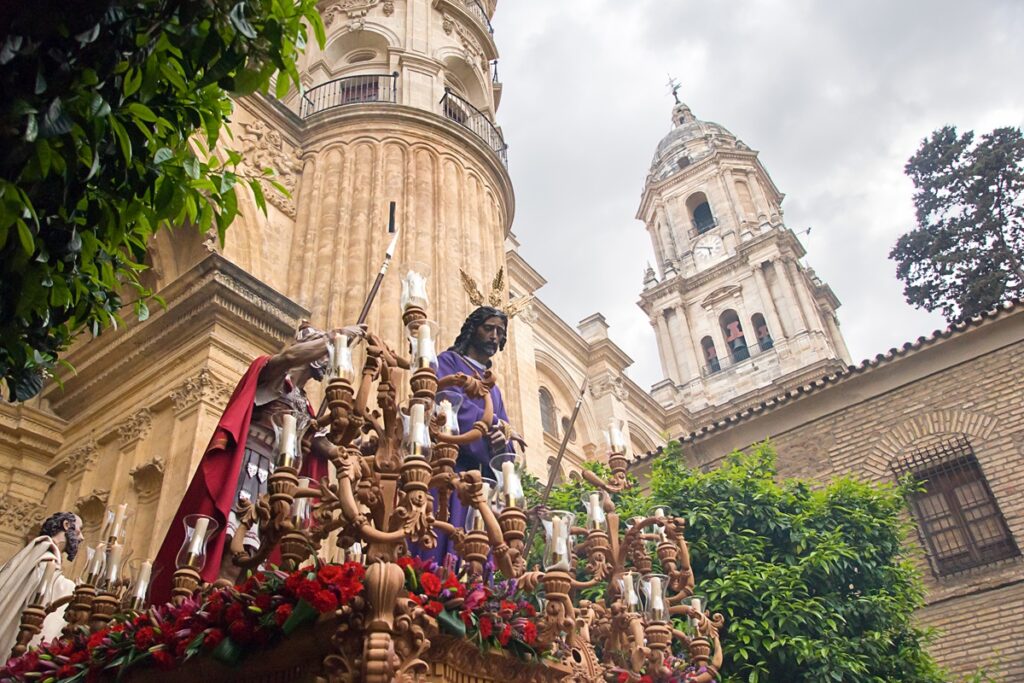
The Dulce Nombre procession during Semana Santa in Málaga, with an ornate religious float moving past the city’s cathedral Credit : Shutterstock, Pabkov
Easter Week 2025 is coming later than usual this year, and if you’re living in Spain, you might be in for a lovely long break—up to five days off in some regions.
It’s the perfect excuse to switch off, travel a little or simply enjoy some quiet time at home. Here’s what you need to know about the key dates, who gets what days off, and where you’ll find the longest ‘puentes’ this spring.
When is Semana Santa 2025 in Spain and why does the date change?
This year, Semana Santa (Holy Week) runs from Sunday 13 April to Sunday 20 April. That’s quite a bit later than in 2024, and there’s a reason for it: Easter isn’t fixed like Christmas—it shifts around based on the lunar calendar. The rule is simple: Easter falls on the Sunday after the first full moon of spring. That’s why you’ll sometimes find yourself celebrating Easter in March, and other times in mid-to-late April like this year.
Still, there’s a limit. Holy Week never starts earlier than 22 March and never ends later than 25 April.
Why Semana Santa 2025 is such a big deal in Spain
Beyond the time off, Semana Santa holds deep meaning for many people. It’s one of the most powerful and emotional moments of the year, especially in cities like Seville, Málaga, or Valladolid, where the processions are both stunning and moving.
It marks the final days of Jesus Christ’s life, from his arrival in Jerusalem to his crucifixion and resurrection. The week begins with Palm Sunday, peaks with Holy Thursday and Good Friday, and ends in celebration on Easter Sunday. But even if you’re not religious, it’s hard not to feel something during this week—the atmosphere is unique, and the whole country seems to slow down.
Where can you enjoy the longest Easter break in Spain this year?
Let’s get to the bit everyone’s curious about: the days off. No matter where you are in Spain, Good Friday (18 April) is a national holiday—so you’ve already got that day in your calendar.
But if you’re lucky, you might get more:
Five-day break (Thursday 17 to Monday 21 April):
If you’re in Catalonia, the Valencian Community, Navarre, La Rioja, the Basque Country or Murcia, congratulations—you’ve hit the jackpot. These regions also treat Holy Thursday and Easter Monday as public holidays, which means five full days off. Hello, long weekend.
Four-day break (Thursday 17 to Sunday 20 April):
Most other regions—including Andalusia, Madrid, the Canary and Balearic Islands, Galicia, Castilla-La Mancha, Castilla y León, Aragon, Extremadura and a few more—will enjoy Holy Thursday and Good Friday off. That gives you a neat four-day weekend, which is still plenty of time to get away or just take a proper breather.
Extra public holidays and regional variations during Semana Santa 2025
In Aragon and Castilla y León, there’s an extra holiday on Wednesday 23 April for regional celebrations—but sadly, it falls mid-week, so no extra puente there. And if you’re in Andalusia, you’ve already had your spring bonus with a February break.
No matter where you are, Semana Santa is a great time to recharge. Whether you’re into religious traditions, exploring new corners of Spain, or just enjoying the slower pace of life, April is a beautiful time to be in the country. And with a bit of luck and the right postcode, you might get a few extra days to enjoy it.
Stay tuned with Euro weekly news for more news from Spain
Sign up for personalised news
Subscribe to our Euro Weekly News alerts to get the latest stories into your inbox!
By signing up, you will create a Euro Weekly News account if you don't already have one. Review our Privacy Policy for more information about our privacy practices.




Farah Mokrani
Farah is a journalist and content writer with over a decade of experience in both digital and print media. Originally from Tunisia and now based in Spain, she has covered current affairs, investigative reports, and long-form features for a range of international publications. At Euro Weekly News, Farah brings a global perspective to her reporting, contributing news and analysis informed by her editorial background and passion for clear, accurate storytelling.
Comments