Adif awards €31.5 million for new high-speed rail section between Vera and Almeria
By Harry Dennis • Published: 04 Nov 2025 • 14:34 • 2 minutes read
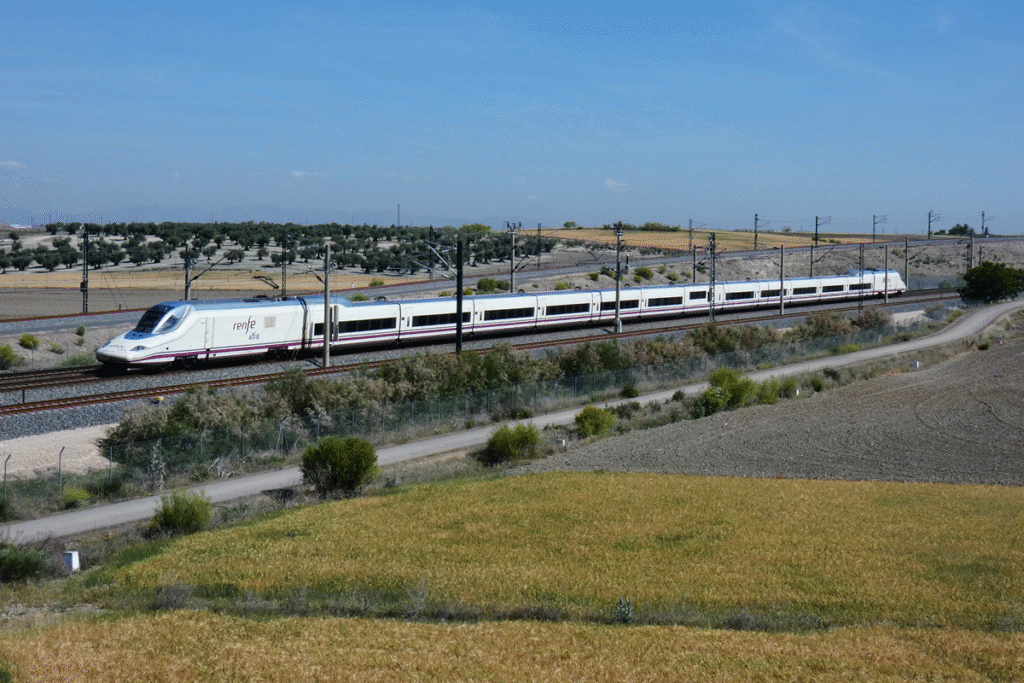
Spain’s new Vera–Almeria high-speed rail on its way. Credit: Miguel Angel Masegosa Creative Commons
Spain’s high-speed network takes another major step forward as Adif Alta Velocidad signs a €31.5 million contract to install track on the Vera-Almeria stretch of the Murcia-Almeria high-speed line, advancing the Mediterranean Corridor’s southern link.
Another milestone for the Mediterranean Corridor
Adif Alta Velocidad has awarded €31.5 million contract for track installation on the 68-kilometre Vera-Almeria section of Spain’s long-awaited Murcia-Almeria high-speed rail line (Línea de Alta Velocidad, LAV).
The works will connect the town of Vera with Almeria city via a route that includes some of the line’s most complex engineering feats – notably the Sorbas twin-bore tunnel, stretching 7.5 kilometres and standing as the longest in Andalucia, alongside the Almendral (1.1km) and Viator (878m) tunnels.
A total of 36 viaducts are included in this section, along with the Nijar emergency siding (PAET) and links to the El Puche assembly base near Almeria. Around 10,7 kilometres of slab (in-concrete) track will be laid in key tunnel and viaduct sections to improve stability and reduce maintenance.
63 per cent of track installation now under contract
This latest award follows the €38 million contract for the Murcia-Lorca San Diego stretch granted earlier this year. Together, both packages cover 125 kilometres of track – roughly 63 per cent of the 200-kilometre route between Murcia and Almeria.
The final gap, between Lorca and Vera, is expected to be tendered soon, completing the main civil works framework for the high-speed link. The project forms part of the wider EU-backed Mediterranean Corridor, which will eventually connect southern Spain to France and the rest of Europe.
Power, signalling and safety systems on the way
In parallel, Adif is advancing complementary projects worth tens of millions of euros. These include “electrification” – installing the power lines and substations that supply the trains’ overhead cables – and the GSM-R (Global System for Mobile Communications – Railway) and ERTMS (European Rail Traffic Management System) signalling upgrades that enable drivers and control centres to communicate securely and prevent collisions.
At the same time, work continues on the El Puche assembly base in Almeria, which functions as the logistical heart of the project — a site where track components, concrete slabs and rails are delivered, stored, and prepared before installation.
Although the Vera–Almeria contract speeds up progress, the overall project still faces tight timelines. Electrification schedules extend into 2031, and Lorca’s ongoing underground works are expected to continue through 2027, suggesting gradual rather than immediate completion.
Funded by Europe and built for the future
The Murcia-Almeria line has already racked-up €411 million in European Regional Development Fund (ERDF) support, with further financing from the EU’s Connecting Europe Facility (CEF).
Designed for speeds of up to 300km/h, the line will carry both passenger and freight trains on the same standard-gauge track, transforming Almeria’s links to the rest of Spain and Europe.
For the province, the project also brings urban renewal – from new intermodal station access to biodiversity measures, including a special nesting tower for local swifts affected by construction.
Once completed, the new line will slash journey times, strengthen the local economy, and connect Almeria to the European high-speed network – a goal that’s finally coming into view after years of anticipation and steady progress along the tracks.
Sign up for personalised news
Subscribe to our Euro Weekly News alerts to get the latest stories into your inbox!
By signing up, you will create a Euro Weekly News account if you don't already have one. Review our Privacy Policy for more information about our privacy practices.


Harry Dennis
Born in the UK and raised on the Cádiz coast, Harry brings his background in design, music, and photography to his writing for Euro Weekly News, sharing stories that celebrate culture and lifestyle across Spain and beyond.
Comments