Spanish government criticised for covering up another train derailment
By Molly Grace • Published: 11 Feb 2026 • 23:12 • 3 minutes read
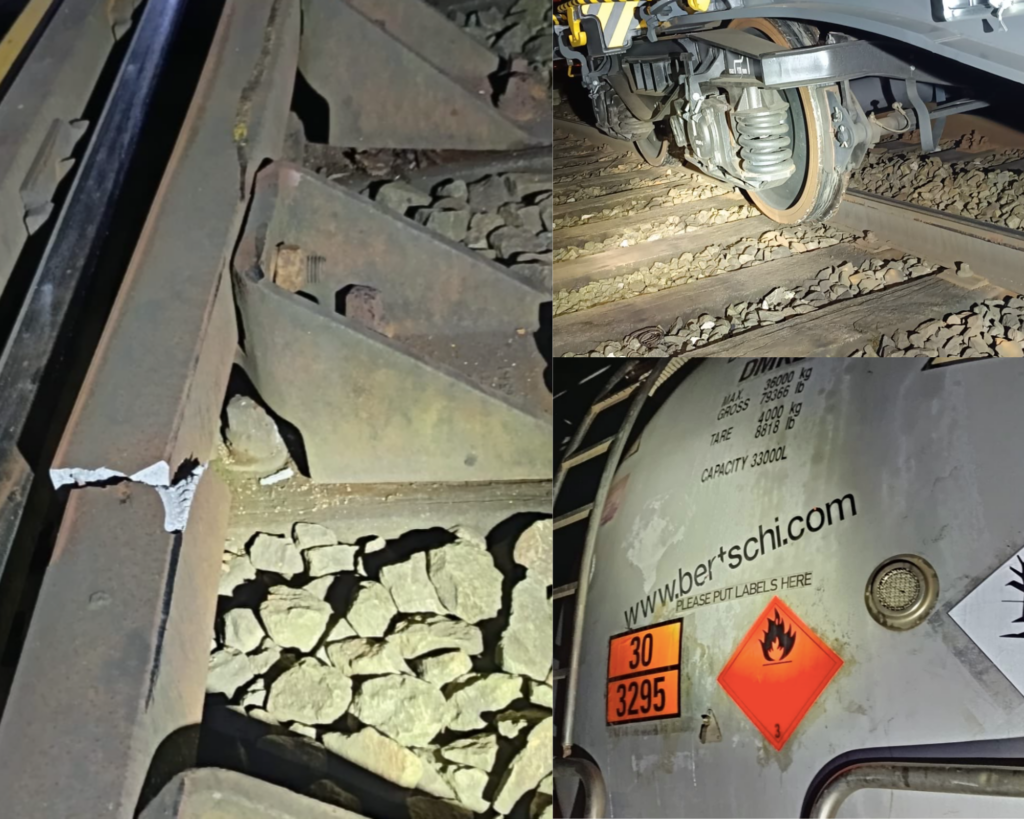
The first public information about the incident came not from official sources, but from a PP spokesperson. photo credit:Borja Corominas on X
Criticism is mounting in Spain’s Basque Country over what opposition leaders describe as an “information blackout” following the derailment of a train carrying hazardous goods in Irún, Gipuzkoa, an incident that exposed gaps in public communication from both regional and national authorities.
The freight train came off the rails late on Friday, February 6, at the Belaskoenea station in Irún, close to the French border. At least some of the wagons were designed for transporting dangerous materials, such as highly flammable liquids, prompting concern given the proximity of residential buildings and businesses.
Despite this, neither the Basque Government nor infrastructure operator Adif issued detailed information about the causes or consequences of the derailment in the days that followed, drawing sharp criticism from regional politicians.
Opposition accuses authorities of silence
The People’s Party (PP) in the Basque Parliament has vigorously condemned what it calls a “silence” from the regional executive in Vitoria. The party’s parliamentary spokesman Santiago López lodged a formal request for information, saying that it was “inexcusable” that no official explanation had been provided on a matter that “affects railway safety”.
According to López, the absence of a public briefing or press conference from the Government Vasco, Euskal Trenbide Sarea (ETS) or the Basque Department of Sustainable Mobility has left the public in the dark about key details of the episode. “This is not a minor incident or just another technical fault,” he said, urging full transparency.
The party has also raised other unanswered questions, including which authority is responsible for the track where the incident took place, which administration should have overseen safety measures, and which protocols were activated once the derailment was discovered.
Local officials break the silence
The first public information about the incident came not from official sources, but from Borja Corominas, PP spokesperson on the San Sebastián City Council, who posted images on social media showing a rail break and a wagon off the tracks. The post emphasised that the train was transporting liquids marked as highly flammable.
Later, rail operator Renfe acknowledged to fact‑checking outlet Maldita.es that “there was an incident involving a freight train on 6 February at 22:21” and confirmed that the cargo was classified as dangerous. Renfe said the situation had only a limited effect on passenger services, as trains were diverted and traffic restored early the following morning.
Adif also told Maldita.es that overall rail traffic was not seriously affected during the incident.
Authorities’ response and confusion
In contrast to the silence over the Irún incident, the Basque Government reportedly disputed that a derailment had occurred at all in that location. According to some statements, officials pointed out that multiple lines run through the area, some under central government competence, and that the event might have involved sections outside regional control.
Meanwhile, sources quoted by national daily La Razón suggest that the derailment involved the axle of a wagon leaving the rails, without overturning the entire train. In that account, there were no significant disruptions to traffic beyond the affected locomotive and carriages.
The lack of official detail comes amid heightened scrutiny of railway safety in Spain following a series of high‑profile accidents, including a fatal collision in Adamuz (Córdoba) earlier this year that killed dozens and triggered national discussions about maintenance and infrastructure oversight and the Rodalies R4 accident that killed a driver and injured over 30 passengers in Barcelona a few days after.
Calls for accountability
The PP has indicated that it will pursue the matter further, including in the Spanish Congress, where it plans to ask the national government to explain both the Irún incident and broader concerns about rail safety. Some reports suggest the party intends to hold Prime Minister Pedro Sánchez directly accountable for improved transparency and maintenance policies.
Local PP leaders in Gipuzkoa have echoed these sentiments, saying that residents deserve clear answers, particularly given the risk posed by transporting hazardous materials near housing and industrial zones.
Public concern persists
The episode has added to growing unease among train users nationwide, who have expressed diminishing confidence in rail safety in the wake of recent crashes and near‑misses, according to independent surveys. Some segments of the public have even reconsidered rail travel due to perceived information gaps and infrastructure issues.
As political pressure builds, authorities in both Madrid and Vitoria are likely to face renewed demands for more transparent communication about rail incidents, not just the technical causes but also their implications for public safety and maintenance regimes.
Follow Euro Weekly News on Google News
Get breaking news from Spain, travel updates, and expat stories directly on your Google News feed.
Follow on Google NewsSign up for personalised news
Subscribe to our Euro Weekly News alerts to get the latest stories into your inbox!
By signing up, you will create a Euro Weekly News account if you don't already have one. Review our Privacy Policy for more information about our privacy practices.




Molly Grace
Molly is a British journalist and author who has lived in Spain for over 25 years. With a background in animal welfare, equestrian science, and veterinary nursing, she brings curiosity, humour, and a sharp investigative eye to her work. At Euro Weekly News, Molly explores the intersections of nature, culture, and community - drawing on her deep local knowledge and passion for stories that reflect life in Spain from the ground up.
Comments
Mark
12 February 2026 • 10:19This can not be just about transparency. The maintenance of rail tracks is at question here, and it is this aspect more than anything else which needs urgent review. I will not be using trains in Spain for the foreseeable future.
Mark
12 February 2026 • 17:01The immediate concern should not be the lack of transparency, but rather work towards an overhaul of the track maintenance procedures.
Comments are closed.