Costa living crisis? With rising prices, is Spain an expensive country to live in now?
By Adam Woodward • Published: 19 Feb 2026 • 17:41 • 4 minutes read
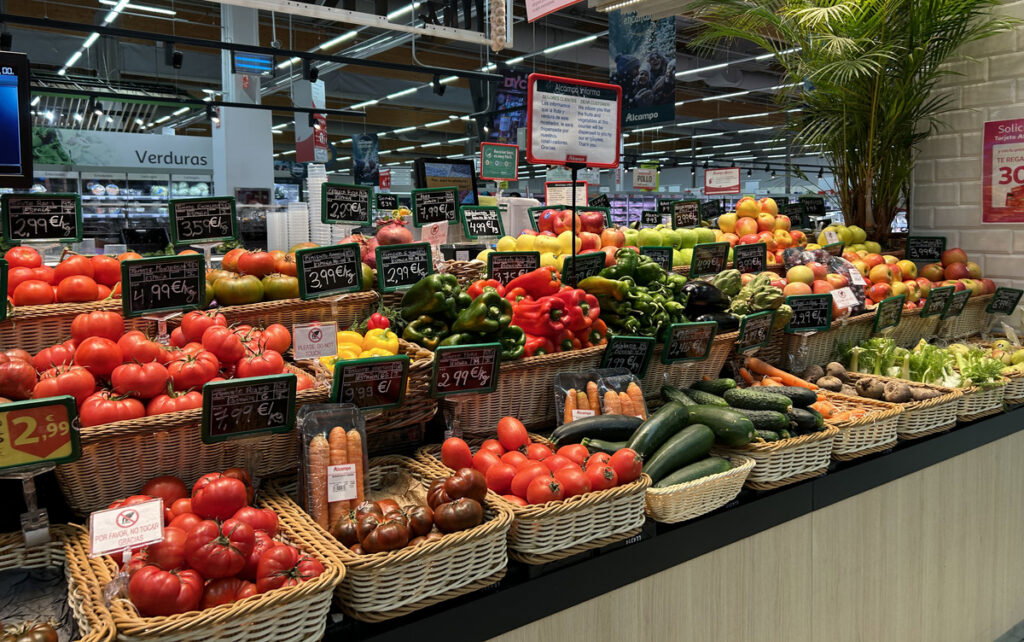
Fruit and veg in Alcampo supermarket. Credit: EWN
Once one of the cheapest countries in Europe by comparison, Spain has seen its cost of living sky-rocket in recent years, while salaries have, like in many other EU countries, stagnated. But is the country still a feasible option for consideration when choosing a sunnier-clime to escape to?
There is no question that the real cost of living in Spain has been rising steadily, with essential everyday expenses now eating up a major portion of household income. According to the latest 2026 Consumer Spending Report (Informe de Gastos del Consumidor) from comparison platform Roams, released in January 2026, basic day-to-day costs absorb close to seven out of every ten euros of average income for Spanish households. But does it have to be that expensive?
Roams’ comprehensive data covers housing, energy, telecoms, groceries, insurance, transport, local taxes, and some everyday leisure. The figures reveal a tightening squeeze on finances, particularly for those in high-demand areas, and offer a more-or-less benchmark for anyone considering a future in Spain.
Housing: The biggest drain on budgets
Housing remains the dominant money pit in Spanish household budgets, often accounting for over half of essential spending. A crisis in the rental market with changing laws that do not favour the owner of the property, have caused major limits on rental availability and subsequently average price.
For mortgaged households, annual housing costs average around €10,845, represent about 65 per cent of their total essential outgoings. Renters face a steeper burden, with average annual rent at €12,044, roughly 66 per cent of essentials. But for those moving to Spain with no family ties keeping them fixed to one location, unlike the 20-somethings who “absolutely must” live in the centre of Malaga or Barcelona, an option always worth investigating is further inland. There is not one Spain, but many experiences far from the fashionable hubbub.
The variation by location is stark. In popular coastal and urban-fashion-Instagram locations like the Balearic Islands, Malaga, and Barcelona, essential costs can exceed 90 per cent of a typical couple’s net salary in certain scenarios, leaving minimal room for savings or unexpected costs, but perfect for a young person whose parents say they will pay for it all. Statistically, these elevated housing figures drive much of the average increase in overall living costs over the past decade.
While theses figures may help compare country by country, there’s little hope on using it for deciding on which corner of the country is more economically viable. In Catalonia, for example, average annual household expenditure is approximately €37,409 (2024 data from INE/Idescat). Per person, that’s €14,746 (about 8.2 per cent above national average). In the wild west of Extremadura, for example, average annual household expenditure is more like €26,890 to €28,474 (variations in sources; e.g., INE shows lower per-person figures), or per person: €11,398 (about 16.3 per cent below national average in 2024).
Daily groceries: The often forgotten “silent cost”
Food ranks as the second-largest essential expense after housing. The average household spends approximately €4,097 per year on groceries.
This amount often flies under the radar because it accumulates through frequent small supermarket trips. For expats or those preferring imported products, international brands, or organic options, for example, the real figure can climb higher than the national average. Adopting a modest Mediterranean diet like most Spaniards might always be worth considering.
Energy bills: Rising despite some relief
Energy costs continue to pressure budgets, and year after year, they increase faster than inflation, with average annual household spending on electricity and gas just over €1,200, an increase of about €133 compared to the previous year.
Even with falling gas prices in some periods, bills are still reasonably high. Households in older, poorly insulated properties, or regions with extreme weather often exceed this national figure. Choosing between regulated and free-market tariffs can make a big difference when signing new contracts. One element to keep in mind is that most Spanish homes were built not with cold winters in mind, and it shows. Many expats complain that their homes feel colder inside than out during the winter months.
Fixed costs: Local taxes, water, utilities and “community charges”
Again, this can vary wildly, depending on region, locality, and it’s certainly worth investigating before signing on any dotted lines. My quarterly water bill is around €25, whereas the Euro Weekly News recently heard of a case of one Costa del Sol readers who was paying almost €11,000 every three months. Another in Costa Blanca had his water pipe punctured by an overgrown Bougainvillea plant on his neighbour’s property with similar quarterly results. While the situation has been sorted out now, without local knowledge and connections, the initial outlay can be expensive.
Local taxes “average” €484 per year, broken down as:
- IBI (property tax): ~€320
- Waste collection fee: ~€107
- Vehicle circulation tax: ~€58
- The average annual water bill stands at around €218.
These fixed items, while not the largest individually, add consistency to monthly budgeting and contribute to the overall essential spend.
What this means for expats and overall living costs in 2026 – Is Spain an expensive country to live in?
Combining these elements, mortgaged households spend roughly €21,338 annually on essentials, about 65 per cent of average income, while renters average €22,538, or 68.3 per cent of income. However, choosing location wisely can radically change this.
For expats earning local salaries or planning a relocation, these national averages from the Roams report serve as a solid starting reference comparing countries. Earning from a digital nomad salary based on averages in other higher paying countries, could make all the difference. However, the true cost will always boil down to specific location: high-demand coastal and urban zones intensify housing pressures while sharing the average nationwide rises in everyday expenses.
It is not like the 1990s, and while Spain maintains appeal compared to many Western European neighbours, 2026 data shows essentials are consuming an ever-larger share of income, leaving less margin for discretionary spending, savings, or financial shocks. But, generally the global answer is “yes” with careful location choice and budgeting remaining key to living well.
Follow Euro Weekly News on Google News
Get breaking news from Spain, travel updates, and expat stories directly on your Google News feed.
Follow on Google NewsSign up for personalised news
Subscribe to our Euro Weekly News alerts to get the latest stories into your inbox!
By signing up, you will create a Euro Weekly News account if you don't already have one. Review our Privacy Policy for more information about our privacy practices.





Adam Woodward
Adam is a writer who has lived in Spain for over 25 years. With a background in English teaching and a passion for music, food, and the arts, he brings a rich personal perspective to his work at Euro Weekly News. As a father of three with deep roots in Spanish life, Adam writes engaging stories that explore culture, lifestyle, and the everyday experiences that shape communities across Spain.
Comments
Steve B
20 February 2026 • 12:37You can save a lot of money by buying food in the likes of Iceland and Poundland etc and I haven’t seen any of those big discounters in Spain yet, but, yes Spain is still cheaper than the UK in many respects, I’d say.
Although, as you say, nowhere near as cheap as it was.
I expect much of that is down to the “levelling” effect of the EU, which I am supportive of.
Algoz
21 February 2026 • 09:59Overseas International sells Iceland products (along with other UK supermarket and Irish retailers). However the prices are roughly twice what you would pay for an equivalent item in Spain
Comments are closed.