Travelling to Spain? New EU system causing long airport queues and missed flights
By Farah Mokrani • Updated: 16 Apr 2026 • 14:38 • 3 minutes read
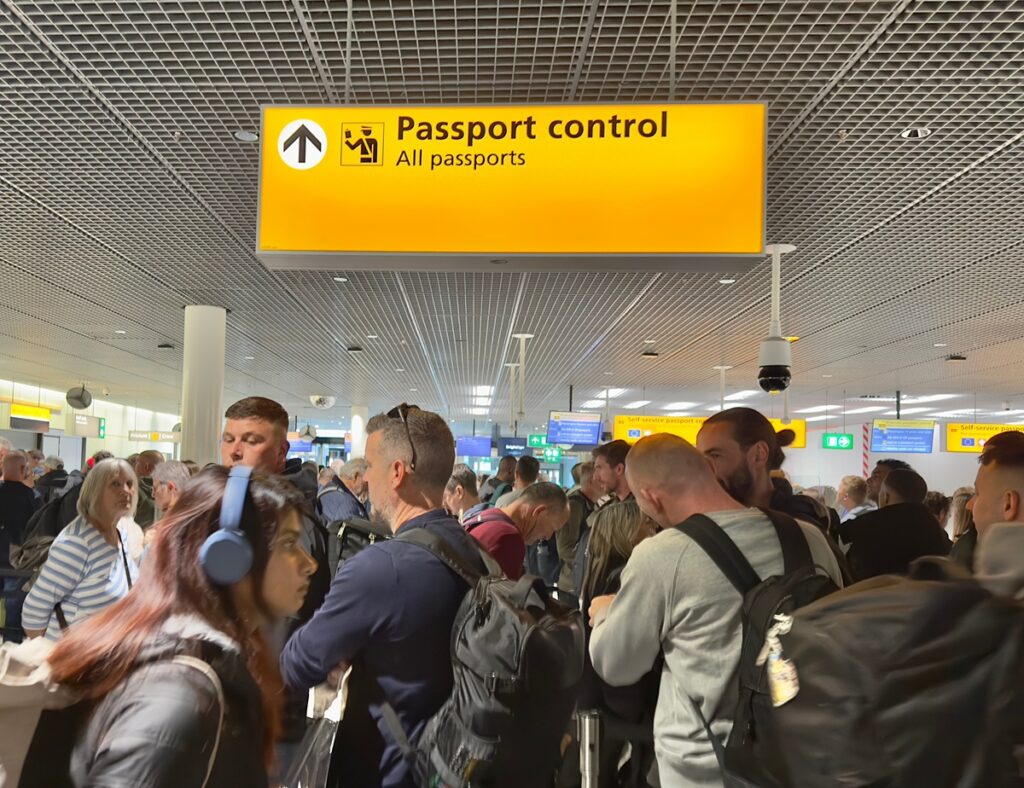
Travellers face long queues at passport control following new EU entry system rollout Credit : Nigel J. Harris, Shutterstock
Travellers flying to and from Spain are facing long airport queues and even missed flights after the EU’s new Entry Exit System went live, with delays of up to three hours already being reported at some airports.
The system, which became fully operational on 10 April 2026, replaces passport stamping for non EU visitors with digital checks. While designed to modernise border control, the first days have shown how much longer the process can now take, especially at busy times.
Anyone travelling from the UK or other non EU countries is most affected. What used to be a quick passport check can now take significantly longer, with queues building up quickly as passengers go through the new system for the first time.
Why the new EU system is causing long airport queues
The Entry Exit System introduces several extra steps at the border, and while each one is relatively quick on its own, the impact adds up when large numbers of passengers arrive at the same time.
Instead of a simple passport stamp, travellers may now need to go through passport scanning, facial recognition and fingerprint registration, particularly on their first trip under the new system.
On paper, each step only takes a short time. In reality, when every passenger has to complete the process, delays start to build. Reports from the first days mention queues stretching for hours in some airports, with some travellers missing their flights as a result.
Airports and airline groups have already raised concerns, warning that the system is putting pressure on border control just as travel demand begins to rise again.
EES outage raises further concerns for travellers
The pressure increased further over the weekend after a reported server overload temporarily affected the new system at Paris Charles de Gaulle and other major hubs.
European border authorities issued a warning advising travellers to carry printed copies of key documents, including visas, boarding passes and hotel confirmations, in case digital systems become unavailable.
Because the system stores facial images, fingerprints and travel records for non EU travellers entering and leaving the Schengen area, any technical issue can slow checks significantly. When systems go down, border officers may need to verify travel details manually.
That can create serious delays, particularly for travellers moving under the 90 days in 180 rule, including many UK passengers.
The warning has also highlighted a growing issue. Many travellers now rely entirely on digital documents stored on their phones, which can become difficult to access if systems fail or internet connections are disrupted.
What has changed for UK travellers heading to Spain
Since Brexit, British travellers are no longer treated as EU citizens when entering Spain or other Schengen countries. That means they are now fully subject to these new checks.
For those travelling under the new system for the first time, the process may take longer than expected. Passengers could be asked to provide a facial image, fingerprints and passport details before being allowed through border control.
Once registered, future trips should become quicker, as their information will already be stored in the system. However, for now, most delays are happening during this first stage.
The system also automatically records entry and exit dates, replacing passport stamps and making it easier to enforce the 90 day stay limit.
Queues, missed flights and pressure on airports
The early days of the rollout have already caused disruption across several European airports, including those serving Spain, where large numbers of international travellers pass through.
Reports of long queues and missed flights have raised concerns among airport operators, especially with the busy summer travel season approaching.
Some industry groups have called for more flexibility in how the system is applied during peak periods, warning that delays could become more difficult to manage if passenger numbers continue to increase.
What travellers should do now to avoid delays
For now, the safest approach is to plan ahead and allow extra time at the airport.
Passengers travelling from the UK or other non EU countries should consider arriving earlier than usual, particularly during busy travel periods. In some cases, arriving at least three hours before departure may help reduce the risk of missing a flight.
Checking airline guidance before travelling is also recommended, as some airlines are already advising passengers to adjust their arrival times.
Travellers with connecting flights should allow more time between connections, as delays at border control could leave little margin for catching onward flights.
It is also worth carrying printed copies of important travel documents, including boarding passes and accommodation details, in case digital systems are unavailable.
Will the situation improve over time
Officials expect the situation to improve as the system becomes more established. Once travellers have completed their initial registration, future journeys should be faster and more efficient.
However, the early days have shown that the transition period may take time, and both airports and passengers will need to adapt.
With the summer season approaching, travellers heading to Spain should be prepared for a different airport experience for now, with longer waits at border control likely to continue in the short term.
Follow Euro Weekly News on Google News
Get breaking news from Spain, travel updates, and expat stories directly on your Google News feed.
Follow on Google NewsSign up for personalised news
Subscribe to our Euro Weekly News alerts to get the latest stories into your inbox!
By signing up, you will create a Euro Weekly News account if you don't already have one. Review our Privacy Policy for more information about our privacy practices.




Farah Mokrani
Farah is a journalist and content writer with over a decade of experience in both digital and print media. Originally from Tunisia and now based in Spain, she has covered current affairs, investigative reports, and long-form features for a range of international publications. At Euro Weekly News, Farah brings a global perspective to her reporting, contributing news and analysis informed by her editorial background and passion for clear, accurate storytelling.
Comments
Philip
16 April 2026 • 11:17Unfortunately, once again those running the EU have shown themselves to be incompetent at organising any major project.
When travelling to the EU don’t forget your passport, printed boarding pass, hotel booking, bank statements, marriage certificate, birth certificate, last payslip and loads of cash.
Travelling in and around Europe in the 1960s and 70s was an easy, no hassle exercise.
The lack of ability to organise a drinks party in a brewery springs to mind.
Stephen
17 April 2026 • 20:49God bless brexit
Adrienne
16 April 2026 • 13:52How strange that it should cause delays and disruptions, what a joke. Relying on online access is inherently flawed. The number of services, and individuals relying on technology is bound to fail at some point, and the world seems keen to introduce AI everywhere. Many people, regardless of age, do not have access, or the knowledge, or both, to be able to print out boarding passes and hotel bookings that are confirmed online. With the chaos in the Middle East caused by ‘You Know Who’ this years travel arrangements look doomed for non-Schengen members. With the predicted weather patterns and travel costs I think Spain, and the rest of the EU, had better start looking for other ways to make a quick ‘buck’ rather than tourism, or am I just a Doomsayer?!
Robert Smith
16 April 2026 • 19:16Not a Doomsayer, but the mans name is President D. Trump and he is not the cause of any problems he is trying to fix the problems people like the corrupt EU avoid and hide from
Comments are closed.