Mystery fireball lights up skies across Europe as meteor may have fallen in France
By Farah Mokrani • Published: 21 Apr 2026 • 6:25 • 3 minutes read
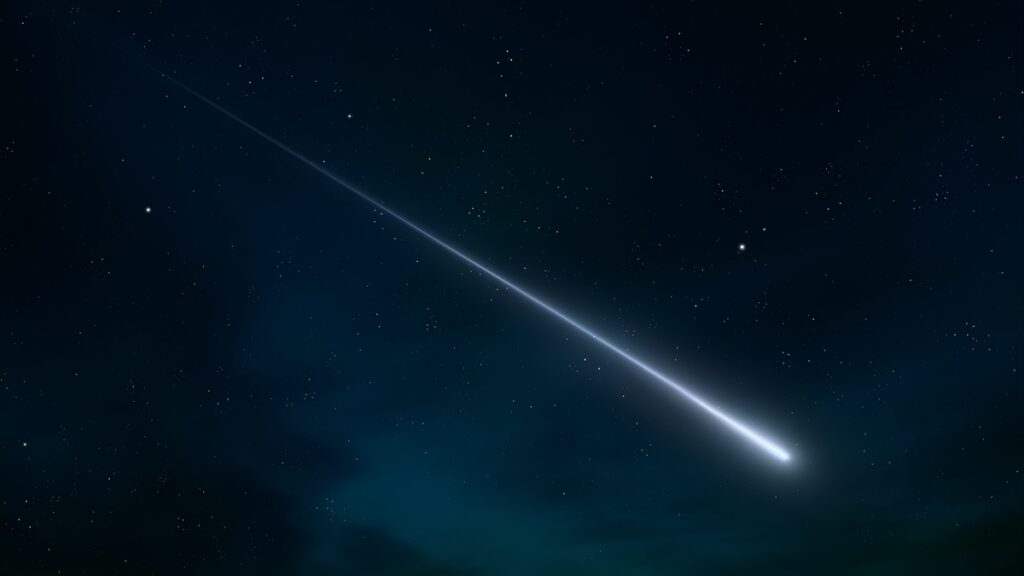
Hundreds reported seeing a bright fireball over Europe as meteor may have landed in France Credit : Nazarii_Neshcherenskyi, Shutterstock
Hundreds of people across Europe looked up in surprise after a bright fireball crossed the night sky, with experts now saying a fragment may have reached the ground in France. The object was seen on Sunday April 19, at around 9.40pm from Belgium, France, the Netherlands, the UK and Germany, making it one of the most talked about sky events of recent days.
Witnesses described an intense glowing object moving quickly overhead, bright enough in some cases to rival the full moon. Because of its strength and long visible path, specialists believe it may not have fully burned up in the atmosphere.
That possibility has now turned a dramatic sky sighting into a real search on the ground.
A normal evening suddenly became something unusual
For most people, it began as an ordinary Sunday night. Then phones came out, people pointed at the sky and social media quickly filled with the same question: did anyone else just see that?
The object appeared as a blazing streak or glowing ball, depending on where people were standing. Some described it as greenish white, others as orange or bright white. That is common with meteor events, as colours can vary depending on minerals, speed and viewing angle.
Many witnesses said it lasted several seconds, longer than the quick flash people usually associate with shooting stars.
That extra time is one reason it caught so much attention. When something bright stays visible while crossing such a large part of the sky, it feels less like a passing sparkle and more like a real event unfolding above you.
Why experts think something may have survived
Most meteors never reach the ground. Small rocky fragments from space hit Earth’s atmosphere at high speed, heat up through friction and burn away before getting anywhere near the surface.
But larger or denser objects can survive partly intact. That is when a meteor becomes a meteorite.
In this case, observers noted how bright the fireball remained during its journey. According to early trajectory estimates, the visible path began at around 80 kilometres altitude south west of Paris and ended near 47 kilometres above northern France.
That means the object was still high when it disappeared from view, but it may already have slowed enough for fragments to continue falling unseen.
Experts are therefore treating the possibility of a landing as realistic, though not yet confirmed.
Why France is now the focus
Early analysis points towards north west France as the most likely area where any surviving pieces could have fallen.
The wider zone mentioned includes areas near Rouen and Le Havre, though that does not mean fragments landed in towns themselves. They could just as easily be in open countryside, woodland or farmland.
When meteorites fall, they are often smaller than people imagine.
Instead of a giant crater or smoking rock, the result may be a dark stone no larger than a fist lying quietly in a field. That is why locating one can be difficult, even when the flight path is known.
Hundreds of reports are helping scientists
The International Meteor Organisation, which collects witness reports, received hundreds of observations after the event.
France produced the highest number, followed by Belgium, with further reports from the Netherlands, the UK and Germany.
Every report helps. The direction people were facing, how long they saw it, the brightness and location all help specialists refine the trajectory.
France also has dedicated camera networks that monitor the sky for this kind of event. By comparing footage from several locations, scientists can build a more accurate picture of what happened.
That work is now under way.
Why people never lose interest in fireballs
Even in an age of satellites, apps and constant online distraction, a fireball still stops people in their tracks.
Part of that is surprise. You are walking the dog, driving home or closing the curtains, then suddenly the sky lights up.
Part of it is scale. You are watching something ancient, possibly older than Earth itself, arriving from space in real time. And part of it is mystery.
Did it burn up? Did it land somewhere? Could someone actually find it?
Those questions keep interest alive long after the glow has gone.
Could anyone really find the meteorite?
Possibly, but patience is needed. Scientists first need to narrow the probable fall zone. Only then can searches begin in a sensible way.
Even then, nature does not make it easy. Fields, mud, trees and ordinary stones all complicate the hunt.
Still, genuine meteorites are found every year, often after events exactly like this one.
So while most people simply enjoyed the show, someone in France may yet stumble across a small black rock with an extraordinary story behind it. For now, the sky has gone quiet again, but the search below it may only be starting.
Sign up for personalised news
Subscribe to our Euro Weekly News alerts to get the latest stories into your inbox!
By signing up, you will create a Euro Weekly News account if you don't already have one. Review our Privacy Policy for more information about our privacy practices.





Farah Mokrani
Farah is a journalist and content writer with over a decade of experience in both digital and print media. Originally from Tunisia and now based in Spain, she has covered current affairs, investigative reports, and long-form features for a range of international publications. At Euro Weekly News, Farah brings a global perspective to her reporting, contributing news and analysis informed by her editorial background and passion for clear, accurate storytelling.
Comments