Spain’s Princess Leonor heads to public university after three years of military training
By Molly Grace • Published: 27 Apr 2026 • 15:34 • 3 minutes read
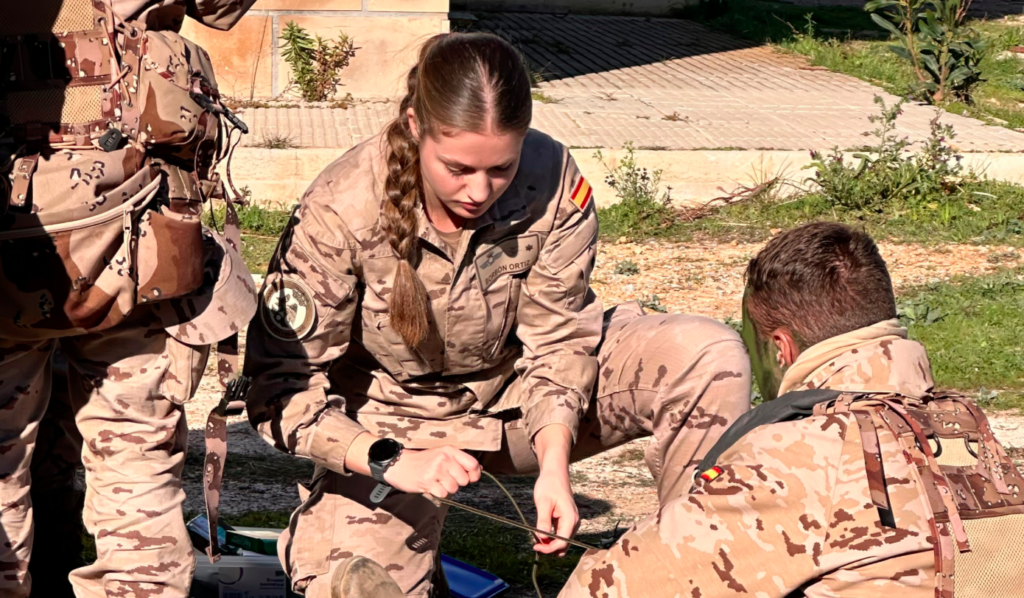
The Princess has completed a three-year programme of military instruction across Spain’s armed forces. Photo credit: Casa de S.M. el Rey on X
Princess Leonor, heir to the Spanish throne, will study Political Science at the Universidad Carlos III de Madrid from the next academic year, the Royal Household has announced. The decision marks the next stage in her public and academic preparation after three years of military training. According to the official statement, the Princess of Asturias will enrol on the university’s four-year undergraduate degree in Political Science.
The course is taught at the Getafe campus, south of Madrid, and is due to begin in the third term of 2026, which Spanish reports have also described as the autumn intake. Leonor, 20, has completed a three-year programme of military instruction across Spain’s armed forces. That training included periods with the Army, the Navy and the Air and Space Force, following a route long seen as part of the formation of future commanders-in-chief.
Standard admissions route for overseas-qualified students
The Royal Household said the princess had successfully completed the admissions process used for students who finished secondary education outside Spain. Leonor studied the International Baccalaureate at UWC Atlantic College in Wales, meaning she did not apply through the standard Spanish university entrance examination route. Reports in Spain state that she received approval from the university’s evaluation committee after passing the relevant selection process. The palace also said she would follow the same academic timetable as other students.
Spanish media have emphasised that she is expected to study under the ordinary degree structure, taking the same classes, assessments and examinations as her fellow students. That is a notable point because her father, King Felipe VI, followed a more individually arranged university path during the 1980s and 1990s, combining formal study with bespoke constitutional and state training.
Degree choice aligns with constitutional role
The course includes subjects linked to politics, law, economics, sociology, history, humanities and international relations. The selection is widely viewed in Spain as closely connected to Leonor’s future constitutional role as head of state.
As Princess of Asturias, she is first in line to succeed King Felipe VI. Spain’s monarch serves as head of state under the constitution, carrying out representative, ceremonial and institutional duties rather than party-political office. A grounding in political institutions and public administration is therefore likely to be seen as directly relevant to her future responsibilities. The Royal Household added that Leonor will continue to carry out official engagements while studying, as she did during both her school years and military training. The balancing of education with public duties has become a defining feature of her preparation for the throne.
How it compares with royal education in Britain
There is no single fixed model for higher education among British royals, although recent generations have often attended university and many have also undertaken military training or active service. King Charles III studied at the University of Cambridge before serving with the Royal Navy and Royal Air Force, Prince William studied at the University of St Andrews before training at Sandhurst and serving with the RAF, while Prince Harry trained at Sandhurst and served in the British Army.
In that sense, Leonor attending a public university and following a recognised degree course is broadly in line with modern British practice, where senior royals have combined education, public duties and, in many cases, military experience. The main distinction is that Spain has publicly presented a more clearly defined sequence for the heir to the throne: overseas schooling, three-service military training, then university study in Spain alongside official engagements.
A significant domestic choice
Leonor’s decision to study in Madrid is also notable because it keeps her in Spain during a formative stage of her adult life after boarding school in Wales and military postings around the country. It places the future queen within one of Spain’s leading public universities while maintaining regular access to official duties in the capital.
The announcement offers the clearest indication yet of how the Spanish monarchy intends to prepare its future sovereign: military service, formal academic study and gradual exposure to public life, all undertaken within established national institutions.
Follow Euro Weekly News on Google News
Get breaking news from Spain, travel updates, and expat stories directly on your Google News feed.
Follow on Google NewsSign up for personalised news
Subscribe to our Euro Weekly News alerts to get the latest stories into your inbox!
By signing up, you will create a Euro Weekly News account if you don't already have one. Review our Privacy Policy for more information about our privacy practices.

Molly Grace
Molly is a British journalist and author who has lived in Spain for over 25 years. With a background in animal welfare, equestrian science, and veterinary nursing, she brings curiosity, humour, and a sharp investigative eye to her work. At Euro Weekly News, Molly explores the intersections of nature, culture, and community - drawing on her deep local knowledge and passion for stories that reflect life in Spain from the ground up.
Comments