A small step from Almería to Mars: how Almería supports space exploration
By Elli Freeman • Published: 30 Apr 2026 • 5:00 • 2 minutes read
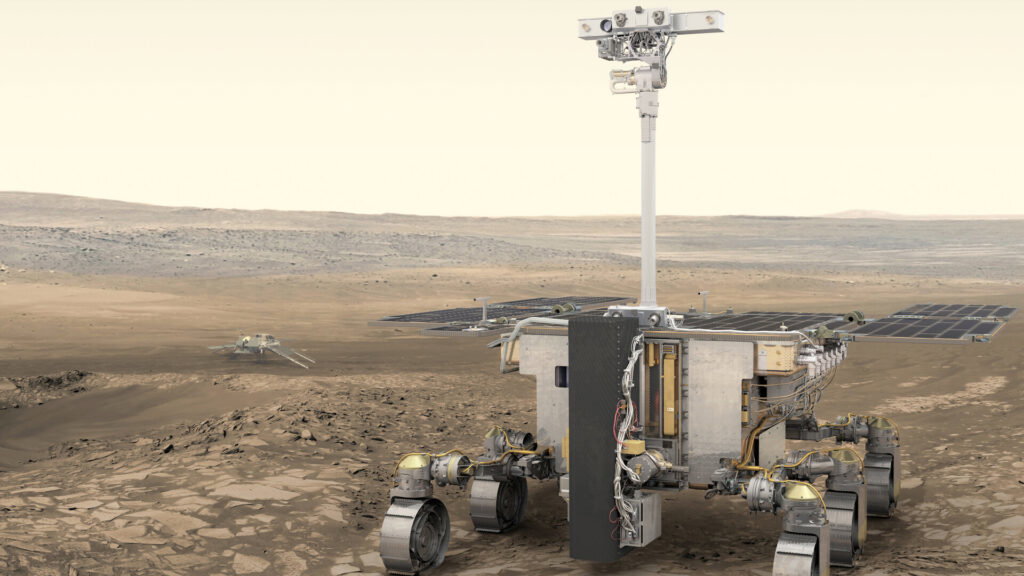
The Rosalind Franklin robot Credit: The European Space Agency
First the stars, then the moon, now Mars. Humans have always had their sights set on exploring the solar system, and Almería is playing a vital role in helping take that next interplanetary step.
Almería’s Tabernas Desert: a Mars training ground
Ahead of the European Space Agency’s 2028 Mars mission, the Rosalind Franklin robot has been conducting training sessions in Almería’s Tabernas Desert. Known as one of the driest places in Europe, the desert’s harsh, rocky terrain and extreme conditions make it an ideal Earth-based stand-in for the Martian surface. Scientists have long turned to this unique environment to simulate space exploration scenarios, allowing them to test equipment in conditions that closely resemble those on Mars.
Rosalind Franklin Rover and its scientific mission
Once it lands on Mars, the rover will be responsible for drilling up to two metres below the planet’s surface, where viable, radiation-protected samples may be found. These subsurface samples are considered crucial in the search for past or present microbial life. The rover will analyse these materials on-site using advanced onboard instruments, transmitting valuable data back to scientists on Earth for further study.
Simulating real Mars conditions on Earth
To ensure mission success, scientists created an authentic simulation in Almería, even incorporating communication delays to mimic the time it takes for signals to travel between Earth and Mars. This forced teams to operate as they would during the real mission, relying on pre-programmed instructions and delayed feedback rather than real-time control.
During these trials, researchers carefully observed how the rover navigated uneven ground, selected drilling locations, and handled delicate sample collection procedures. These rehearsals are essential for identifying potential issues and refining both the rover’s software and operational strategies before launch.
Why Almería matters for space exploration
Martian exploration has often relied on Almería’s unique environment. Locations such as the Pulpí geode and surrounding desert landscapes provide valuable geological comparisons that help scientists interpret Martian data more accurately. The region’s combination of mineral diversity and extreme dryness offers insights into how life might survive in similarly hostile conditions beyond Earth.
Looking ahead to the 2028 Mars mission
With each successful test in Tabernas, confidence in the upcoming mission continues to grow. The work being carried out in Almería is not only preparing a robot for Mars but also advancing humanity’s broader understanding of planetary exploration. As the 2028 launch approaches, this quiet corner of southern Spain is proving to be an essential stepping stone in the ongoing search for life beyond our planet.
Sign up for personalised news
Subscribe to our Euro Weekly News alerts to get the latest stories into your inbox!
By signing up, you will create a Euro Weekly News account if you don't already have one. Review our Privacy Policy for more information about our privacy practices.


Elli Freeman
Originally from the UK, Elli has lived in Spain for more than half of her life. She holds a B.A in English Literature and Creative Writing. Before joining the Euro Weekly News team, Elli was an avid traveller, with a keen interest in exploring new cultures.
Comments