The school choice in Spain most expat families live to regret
By EWN • Published: 12 May 2026 • 16:04 • 6 minutes read
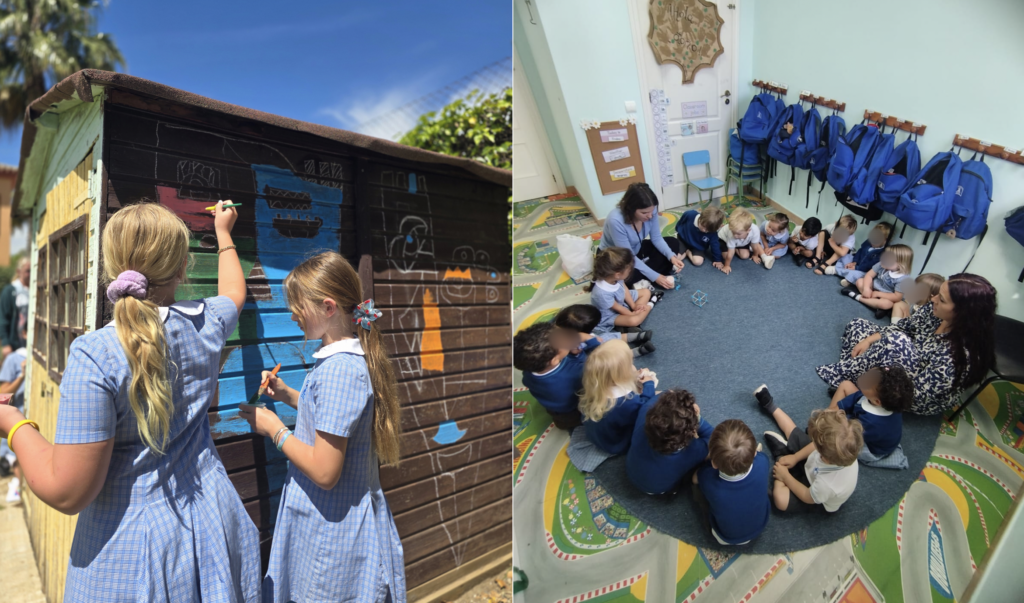
A dynamic and supportive educational environment.Credit: International School Estepona.
Most families moving to the Costa del Sol make the school decision fast, usually based on proximity, what other expats have done, or a quick Google search. Three years later, many wish they had thought harder. The gap between a British and Spanish education is not just about language. It shapes your child’s academic foundation, their ability to transition if you move on, and the level of support they receive if they need it.
This is the honest comparison most school prospectuses will not give you.
What do British and Spanish schools in Spain actually offer?
British and Spanish schools in Spain operate under entirely different frameworks, and understanding that difference is the starting point for everything else.
Spanish state and private schools follow the Spanish national curriculum, the LOE/LOMLOE framework. Lessons are delivered in Spanish, with English taught as a subject. The structure runs from Infantil (age 3) through Primaria (6–12) into Secundaria and eventually Bachillerato. It is a broad, content-led system with a strong emphasis on the Spanish language and national identity.
British international schools follow the UK national curriculum, teaching through English with Spanish as a structured daily subject. The British primary phase covers roughly ages 2–11, focusing on strong foundations in reading, writing, numeracy, and language before children move into secondary education, whether that stays in Spain or moves back to the UK or another country.
The International School Estepona is a British primary school serving children from age 2 to 12 across the Costa del Sol. With small class sizes, Spanish lessons every day, and a curriculum built on strong English literacy and language, it offers what many families in the Estepona and Marbella area are looking for: a serious, structured start that travels with the child wherever life takes them next.
Key takeaway: These are not just different schools; they are different educational systems. Your choice in the primary years sets the academic foundation your child carries into everything that follows.
The reality nobody puts in the prospectus: life on the Costa del Sol is transient
Most people who move to the Costa del Sol do not stay for the entirety of their child’s academic journey from age 2 to 18. Expat life in Marbella, Estepona, Benahavís, and Fuengirola is transitional. Families arrive for work, lifestyle, or opportunity. Some stay five years. Some stay two. Some move on to Dubai, back to the UK, or to another European city. Very few decide at age 3 that this is where their child will complete all sixteen years of education.
If there is any meaningful chance your family will relocate, a British primary education is significantly lower risk. A child educated in English, following the British curriculum with Spanish as a strong secondary language, can step into a British, Irish, Australian, or international school and continue with minimal disruption. A child educated entirely through the Spanish system, who has built their academic identity in Spanish, faces a much steeper transition at age 9, 10, or 11.
Giving children a strong base in English reading, writing, and academic language during the primary years is not a rejection of Spain. It is a practical decision that keeps options open in a life that will likely involve more than one country.
Key takeaway: For families whose future plans are uncertain, a British primary education offers academic portability that a Spanish-only education cannot.
How does language of instruction affect development?
Language is the most contested factor in this decision, and the one most parents underestimate.
Younger children immersed in a Spanish school environment will often achieve conversational fluency in Spanish within 18–24 months. For very young children with no prior Spanish, immersion is often the fastest route to fluency, but it comes with a short-term academic cost. While a child is decoding a new language, maths concepts, reading comprehension, and core learning can lag behind.
For older children arriving at age 9, 10, or into secondary school, the challenge is greater. Conversational Spanish comes relatively quickly, but academic language – the vocabulary needed to understand science, history, or geography in Spanish – takes years to build. A child who joins a Spanish secondary school without strong prior Spanish may spend years working below their potential.
A British school environment addresses this by teaching the full curriculum in English while delivering Spanish as a structured daily subject. At The International School Estepona, Spanish is taught every day in a planned, measurable way rather than left to chance. Children develop real Spanish alongside their core subjects without sacrificing academic progress.
The result is not full bilingual immersion. It is something arguably more valuable for mobile families: a child who is academically strong in English and functionally capable in Spanish, able to integrate socially in Spain while remaining academically portable.
Key takeaway: Daily structured Spanish in a British school builds real language skills without derailing academic progress, a practical combination for families who may not stay on the Costa del Sol indefinitely.
British vs Spanish curriculum: why structure matters in the primary years
The British and Spanish curricula are built on different philosophies, and those differences show up in the classroom from the earliest years.
The Spanish primary curriculum offers broad subject coverage taught in Spanish, with a strong emphasis on content knowledge, written work, and national identity. Progression is largely teacher-led, with significant weight placed on tests and content recall.
The British primary curriculum is built around the Early Years Foundation Stage (EYFS) and Key Stages 1 and 2. It places early, explicit emphasis on phonics-based reading, structured writing, and mathematical reasoning. Assessment is regular and developmental, focused on where each child is and what they need next, rather than simply pass or fail thresholds.
For primary-age children, this structured approach to reading and writing tends to produce strong literacy foundations – skills that transfer across languages and subjects throughout a child’s academic life.
Key takeaway: The British primary curriculum’s emphasis on phonics, structured writing, and developmental assessment builds literacy skills that travel with your child, wherever they go next.
Learning difficulties and SEN: where the British system often serves children better
For families with a child who has a learning difficulty or special educational need, this may be the most important difference of all.
The British special educational needs (SEN) framework is one of the most developed in the world. In well-run British international schools, the identification, assessment, and support process for dyslexia, ADHD, processing difficulties, autism spectrum conditions, and other needs is structured and documented. Staff are trained to spot early signs. Referral pathways exist. Support plans are written and reviewed.
In Spain’s school system, particularly in private and international schools, provision is more variable. State schools have increased SEN provision, but assessment can be slow, waiting lists long, and the framework for documenting and following an individual child’s needs is less consistently applied. A bright child with dyslexia, or a child on the autism spectrum without obvious behavioural issues, can go unidentified for years.
A British primary school with an active SEN process means that if your child is struggling, there is a structure in place to identify it and respond. Early identification in the primary years often determines whether a child’s secondary school experience is a success or a struggle.
Key takeaway: For any family where learning difficulties are diagnosed or suspected, a British primary school’s SEN framework typically offers earlier identification and better-structured support than most Spanish options.
Social integration and life in Spain
School choice does affect your child’s social life in Spain, but not always in the way parents assume.
Children at British schools in Spain tend to form friendships within an English-speaking international community – British, Irish, Scandinavian, South African, and others. It is a stable, familiar environment, especially for children who have just relocated and need grounding quickly.
Children at Spanish schools often integrate into local Spanish life faster. They develop Spanish friendships, local cultural fluency, and a social identity rooted in Spain. For families who are certain they are staying long-term and want their children to grow up as fully Spanish, that matters.
However, most Costa del Sol families are not certain how long they will stay. For these families, the risk of some social isolation at a British school is usually easier to manage than the academic disruption of uprooting a child from a Spanish-medium education at age 9 or 11 and switching them into an English-speaking secondary school.
Many families manage this balance by supplementing a British education with intentional Spanish life: local football clubs, Spanish-speaking playdates, and community activities. This produces children who are academically secure in English and genuinely comfortable socially in Spain.
Key takeaway: British schools provide social stability and academic portability; Spanish integration works best when families actively build Spanish life outside school hours.
What should you do next?
The decision comes down to three questions: How long are you likely to stay in Spain? Where do you want your child’s secondary education to take place? And does your child have any learning needs that require specialist support?
If your answers lean towards uncertainty, possible relocation, and a desire for a solid, transferable foundation, a British primary school is the lower-risk choice for ages 2 to 12.
For families on the western Costa del Sol, in Estepona, Marbella, Benahavís, and surrounding areas, The International School Estepona offers exactly that: a British primary education from age 2 to 12, small class sizes, daily Spanish lessons, and a clear focus on giving every child the strongest possible academic foundation before they transition to secondary school, wherever in the world that may be.
Follow Euro Weekly News on Google News
Get breaking news from Spain, travel updates, and expat stories directly on your Google News feed.
Follow on Google NewsSign up for personalised news
Subscribe to our Euro Weekly News alerts to get the latest stories into your inbox!
By signing up, you will create a Euro Weekly News account if you don't already have one. Review our Privacy Policy for more information about our privacy practices.



EWN
Comments