Norway joins France in new European security discussions
By Farah Mokrani • Published: 28 May 2026 • 23:54 • 3 minutes read
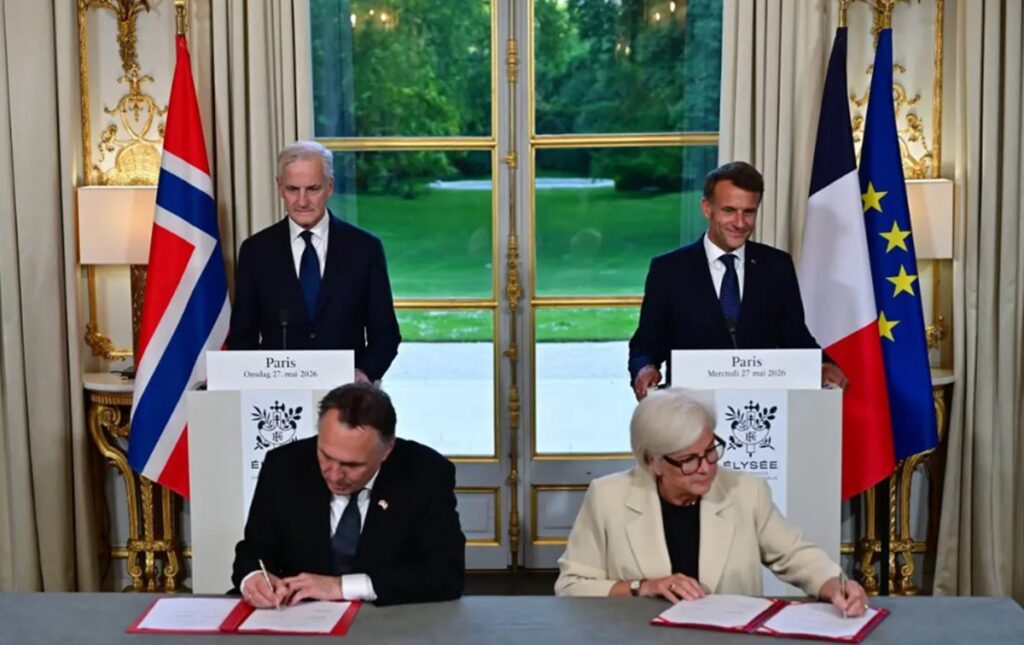
France and Norway signed a new defence and security agreement during talks in Paris. Credit: Christian Liewig / Office of the Prime Minister of Norway
A few years ago, the idea of Norway joining discussions around French nuclear deterrence would probably have sounded unlikely to many people in Europe.
Now it is happening openly. And the reason is simple.
Europe’s sense of security has changed dramatically since Russia invaded Ukraine.
On Wednesday, May 27, Norwegian Prime Minister Jonas Gahr Støre confirmed in Paris that Norway will join France’s growing discussions with European countries about nuclear deterrence and defence cooperation.
Standing beside French President Emmanuel Macron, Støre said Norway would participate alongside several other European countries already involved in talks about how French nuclear capabilities could contribute to European security.
The announcement may sound highly technical at first glance, but politically it says a lot about the atmosphere currently spreading across Europe.
Countries that once felt relatively comfortable relying almost entirely on NATO and American military protection are now starting to think much more seriously about what Europe’s own defence structure could look like in the future.
And honestly, the fact that Norway is participating makes the situation feel even more significant. Because Norway has traditionally been one of the European countries closest to the United States when it comes to defence and security cooperation.
Why France is suddenly becoming central to Europe’s defence discussions
Since Brexit, France has become the European Union’s only nuclear power. That reality has pushed Emmanuel Macron into a much more important position inside Europe’s defence conversations over the past few years.
Back in March, Macron revealed that several countries had already agreed to begin discussions with France around possible nuclear cooperation.
Germany, Poland, Sweden, Denmark, Belgium, Greece and the Netherlands were among the countries mentioned at the time.
Now Norway has officially joined that group too.
Much of what is being discussed remains confidential, but officials have already indicated the talks could involve joint military exercises, intelligence sharing and possible cooperation involving French nuclear capable Rafale fighter jets.
French officials reportedly described the broader concept as a form of ‘forward nuclear deterrence’.
At the moment, nobody is suggesting France is preparing to place nuclear weapons across Europe tomorrow. Norway itself stressed very clearly that no nuclear weapons would be deployed on Norwegian soil during peacetime.
Still, the symbolism matters enormously. Because Europe’s political mood around defence has changed very noticeably since 2022.
Conversations that once felt uncomfortable or politically sensitive are now happening far more openly. And a lot of that anxiety comes directly from geography.
Norway shares a border with Russia in the Arctic region and sits close to some of Russia’s most important military and nuclear infrastructure.
Speaking in Paris, Støre pointed out that Russia’s largest nuclear arsenal is located in the High North only a relatively short distance from Norwegian territory.
Why many European countries are rethinking defence strategy
Officially, NATO remains at the centre of European security. That has not changed.
Norwegian leaders themselves repeated very clearly that the alliance remains the foundation of Norway’s defence policy.
But at the same time, many European governments are becoming increasingly nervous about depending too heavily on a single system during a period of growing geopolitical uncertainty.
Especially with questions continuing around future American foreign policy.
Donald Trump’s return to US politics has added another layer of concern for some European governments, particularly those wondering how stable long term American military commitments may remain in the future.
That uncertainty has encouraged several countries to strengthen defence ties inside Europe itself alongside NATO structures rather than relying exclusively on Washington.
Before 2022, discussions about European “strategic autonomy” in defence often sounded abstract and distant.
Now they feel much more real. Military budgets are rising across Europe. Countries are modernising armed forces at speed and defence cooperation between European governments has intensified significantly over the last few years.
Nordic countries especially have moved much closer together on security matters since the start of the war.
Finland joined NATO, Sweden followed shortly afterwards and Arctic security itself has become far more important strategically as tensions continue growing between Russia and NATO countries in northern Europe.
The new France Norway defence agreement reflects a changing Europe
Alongside the nuclear discussions, France and Norway also signed a wider defence and security agreement on Wednesday known as the Narvik agreement.
The deal includes cooperation around air defence, military planning, Arctic security and increased coordination between the armed forces of both countries.
Again, none of this appeared suddenly out of nowhere. The political atmosphere across Europe has shifted steadily over the past few years.
And honestly, many European leaders no longer seem convinced that the continent can afford to think about security the same way it did before Russia invaded Ukraine.
That does not mean Europe is preparing for war tomorrow. But it does mean governments are increasingly planning for a future where military deterrence, defence coordination and long term security risks are no longer treated as distant theoretical problems. Because for many European countries today, especially those geographically closer to Russia, the sense of vulnerability feels far more real than it did only a few years ago. And that changing feeling is starting to reshape Europe’s defence conversations very quickly.
Follow Euro Weekly News on Google News
Get breaking news from Spain, travel updates, and expat stories directly on your Google News feed.
Follow on Google NewsSign up for personalised news
Subscribe to our Euro Weekly News alerts to get the latest stories into your inbox!
By signing up, you will create a Euro Weekly News account if you don't already have one. Review our Privacy Policy for more information about our privacy practices.



Farah Mokrani
Farah is a journalist and content writer with over a decade of experience in both digital and print media. Originally from Tunisia and now based in Spain, she has covered current affairs, investigative reports, and long-form features for a range of international publications. At Euro Weekly News, Farah brings a global perspective to her reporting, contributing news and analysis informed by her editorial background and passion for clear, accurate storytelling.
Comments
Capt
29 May 2026 • 00:10100% EU CORRUPTION – The lies, deception and fraud at the EU needs jail time for all EU politicians involved and the EU citizen need to wake up! THE EU is a monster in fraud and lies
Comments are closed.