New Pacific Ocean discovery could reshape what scientists know about earthquakes
By Farah Mokrani • Published: 29 May 2026 • 18:00 • 3 minutes read
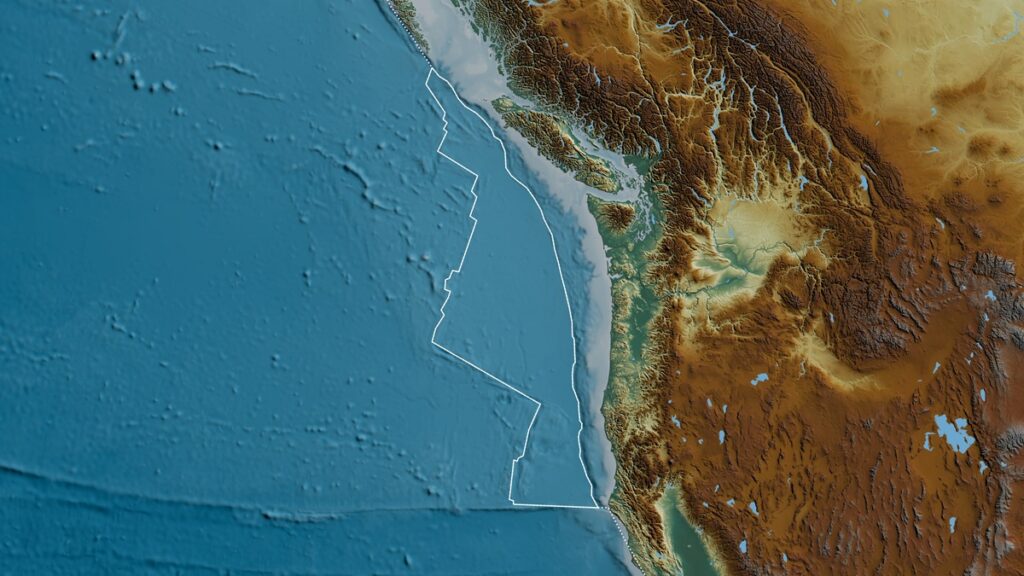
Researchers studied the Juan de Fuca Plate off Canada's Pacific coast, where new findings are raising questions about future earthquake risks. Credit : Yarr65, Shutterstock
Millions of people living along North America’s Pacific coast probably gave little thought this week to what is happening thousands of metres beneath the ocean floor. Scientists, however, have been talking about little else.
A newly published study has identified unexpected geological changes off the coast of western Canada in a region linked to one of the world’s most closely watched earthquake zones. Researchers are not warning that a major earthquake is around the corner. What has caught their attention is that the area appears to be behaving differently from what they expected, prompting fresh questions about how one of North America’s most important fault systems is evolving.
The research, published in Science Advances, was led by geologist Brandon Shuck of Louisiana State University. His team spent years analysing data collected beneath the Pacific Ocean and found signs that tectonic processes may be developing in ways that had not previously been documented.
For scientists who study earthquakes, discoveries like this do not happen every day and that is precisely why the findings have attracted international attention.
What researchers found beneath the Pacific Ocean
The focus of the study is a stretch of ocean extending from northern California to Vancouver Island.
Hidden beneath those waters is the Juan de Fuca Plate, a small tectonic plate that is slowly moving underneath the North American continent.
The movement is incredibly slow. Nobody can see it happening and nobody can feel it. Yet over long periods of time, these underground shifts can build enormous pressure.
Eventually, that pressure is released through earthquakes.
The area forms part of the Cascadia subduction zone, a fault system that geologists have been studying for decades because of its potential to generate very large earthquakes.
Using underwater seismographs, high precision GPS measurements and detailed mapping of the ocean floor, the researchers created a clearer picture of what is happening beneath the seabed.
What they found suggests the region may be experiencing increasing geological stresses.
To explain the process, Brandon Shuck compared it to pushing a train uphill.Getting the train moving requires tremendous effort. Once it starts moving, however, the dynamics change and the movement becomes easier to sustain.
For researchers, observing signs that these processes may be evolving is particularly valuable because geological changes usually unfold over timescales that far exceed a human lifetime.
Why cities along the Pacific coast are watching closely
The discovery matters because of where it has been made.Millions of people live within the broader area influenced by the Cascadia subduction zone.
Major population centres including Vancouver, Seattle and Portland all sit within a region that scientists know has produced giant earthquakes in the distant past.
The last known Cascadia megathrust earthquake occurred in January 1700 and is estimated to have exceeded magnitude 9.
There were no modern instruments at the time, but evidence of the event has survived through geological records and historical documents. Scientists later linked the earthquake to a tsunami that crossed the Pacific Ocean and reached Japan.
That history is one reason researchers continue monitoring the region so closely today.
At the same time, experts are keen to avoid unnecessary alarm.The study does not suggest a major earthquake is imminent.
In fact, one of the biggest challenges in earthquake science remains that researchers cannot reliably predict exactly when large earthquakes will occur.
What studies like this provide instead is a better understanding of how fault systems behave and how geological forces build beneath the Earth’s surface.
For communities located near major fault zones, that knowledge plays an important role in long term planning and preparedness.
Why scientists are excited about the discovery
While the headlines naturally focus on earthquakes, many researchers are equally interested in what the discovery could reveal about the Earth itself.
Large tectonic systems are constantly changing, but those changes often happen so slowly that scientists only see the results after hundreds or even thousands of years.
The opportunity to observe signs of these processes while they are unfolding is relatively rare.
That is why the team plans to continue monitoring the region in the years ahead, adding more sensors and collecting additional data from beneath the ocean floor.
Every new measurement helps researchers refine computer models and improve their understanding of how tectonic plates interact.
Those insights could eventually contribute to better hazard assessments not only in North America but in earthquake prone regions around the world.
For now, the study leaves scientists with an intriguing puzzle.The Pacific Ocean off Canada’s coast appears to be revealing something new about one of the planet’s most powerful geological systems.
Exactly what that means in the long run remains unclear. But for the researchers studying the region, it is a reminder that some of the most important changes on Earth happen far from public view, deep beneath the ocean floor, where the forces shaping our planet never truly stand still.
Follow Euro Weekly News on Google News
Get breaking news from Spain, travel updates, and expat stories directly on your Google News feed.
Follow on Google NewsSign up for personalised news
Subscribe to our Euro Weekly News alerts to get the latest stories into your inbox!
By signing up, you will create a Euro Weekly News account if you don't already have one. Review our Privacy Policy for more information about our privacy practices.




Farah Mokrani
Farah is a journalist and content writer with over a decade of experience in both digital and print media. Originally from Tunisia and now based in Spain, she has covered current affairs, investigative reports, and long-form features for a range of international publications. At Euro Weekly News, Farah brings a global perspective to her reporting, contributing news and analysis informed by her editorial background and passion for clear, accurate storytelling.
Comments