Why Mercadona fish comes in blue and green boxes — and what it actually means
By Molly Grace • Published: 21 Jun 2026 • 23:52 • 2 minutes read
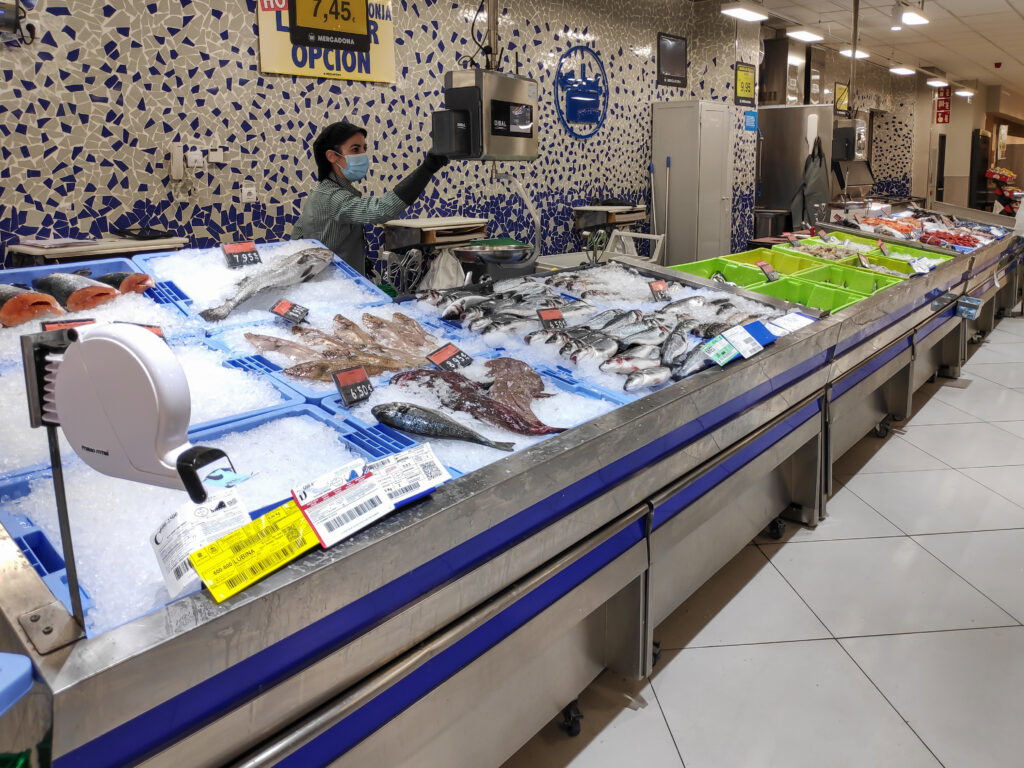
the boxes are part of an internal system that helps staff organise fish depending on how it arrives. Photo credit: m.e.s.t.o.c.k/Shutterstock
If you have ever stopped at the fish counter in Mercadona, you have probably seen it without giving it much thought. Some fish are placed in blue boxes, others in green ones.
It is one of those details that sits in the background for years. Then one day you notice it and suddenly start wondering what it is actually about. A lot of people assume the colours are just for organisation, or that they might show something about quality.
What the blue and green boxes actually mean
The colours are used to show where the fish comes from before it reaches the store. Blue boxes contain farmed fish. These are fish raised in controlled environments and supplied in a standard way to stores across the country. It allows Mercadona to keep a consistent supply available all year round.
Green boxes contain fish that comes from local fish markets. This is fish that arrives through daily catches and is selected locally depending on what has been brought in that day. So in simple terms, blue is farmed fish and green is fish sourced from local markets.
Why people started noticing it
For a long time, most shoppers did not think twice about it. The boxes were just part of the counter setup. That changed when social media posts and short videos started pointing out the colour difference. Once people realised there was a system behind it, curiosity took over.
And when there is no explanation in front of you at the supermarket, people naturally start guessing. Some thought it was about quality, others thought it was about the country the fish were coming from and then there were some that thought it was simply decoration. That is how the confusion started, not because the system is complicated, but because it was never really explained to the customer in the first place.
Why many people prefer the green boxes
For a lot of shoppers, fish from local markets feels more traditional. It comes from daily catches, so what is available depends on the day. That means the selection can change depending on season, weather and local supply.
Because of that, many people associate green-box fish with freshness and a closer connection to local fishing. Farmed fish, on the other hand, is more consistent. It is produced in controlled environments and supplied steadily throughout the year. That reliability is a big part of why it is widely used.
What actually matters when you buy fish
Even though the box colour gives you a quick idea of where the fish comes from, it is not the most important thing to look at.
The label at the counter is what tells you the full information, including:
- the species of fish
- whether it is farmed or wild
- where it comes from
- pricing and traceability details
That is the information that really matters when you are deciding what to buy.
A simple system most people never notice
The blue and green boxes are not there as a code or a marketing trick. They are simply a practical way of separating two different supply types inside the store.
One is farmed fish that arrives in a steady flow. The other is fish from local markets that changes depending on the day.
Most people walk past it without ever thinking about it. Then one day it clicks, and suddenly the fish counter does not look quite the same again.
Follow Euro Weekly News on Google News
Get breaking news from Spain, travel updates, and expat stories directly on your Google News feed.
Follow on Google NewsSign up for personalised news
Subscribe to our Euro Weekly News alerts to get the latest stories into your inbox!
By signing up, you will create a Euro Weekly News account if you don't already have one. Review our Privacy Policy for more information about our privacy practices.


Molly Grace
Molly is a British journalist and author who has lived in Spain for over 25 years. With a background in animal welfare, equestrian science, and veterinary nursing, she brings curiosity, humour, and a sharp investigative eye to her work. At Euro Weekly News, Molly explores the intersections of nature, culture, and community - drawing on her deep local knowledge and passion for stories that reflect life in Spain from the ground up.
Comments