Can your neighbour take over the communal pool? The rule many people in Spain don’t know about
By Farah Mokrani • Published: 03 Jul 2026 • 11:11 • 4 minutes read
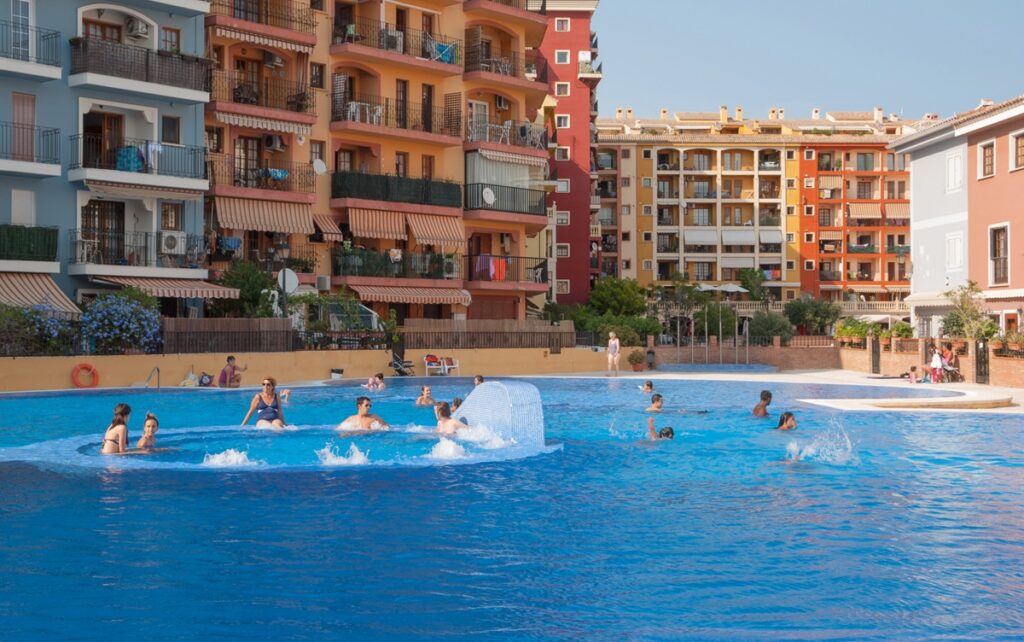
Communal pools are a common source of neighbour disputes during the summer. Credit : Dance60, Shutterstock
Summer has barely begun and, in many apartment complexes across Spain, the same argument is already making the rounds.
You head down to the communal pool hoping for a quiet afternoon, only to find it packed. The neighbour from two floors up has arrived with children, cousins, friends and perhaps a few people nobody in the building has ever seen before. Sunbeds disappear within minutes, the pool is suddenly full, and residents start asking the same question every summer : Surely there must be a limit?
The answer isn’t quite as simple as yes or no.
Spain’s Horizontal Property Law (Ley de Propiedad Horizontal) doesn’t say how many guests someone can invite to the communal pool. But that doesn’t mean residents can treat shared facilities as if they were private property. Depending on the circumstances and your community’s own rules, there are ways to deal with neighbours who repeatedly turn the pool into their own private gathering.
The law doesn’t ban guests, but it does expect common sense
One of the biggest misconceptions is that communal pools are reserved exclusively for residents.
In reality, many communities allow owners to bring guests from time to time, and there’s nothing in the national law that sets a maximum number.
Where problems begin is when occasional visitors become a regular crowd.
Imagine arriving at the pool every Saturday to find one apartment has filled half the sunbeds with friends. Or finding that your children can’t even get into the water because one family has invited so many people that everyone else has been squeezed out.
That’s exactly the kind of situation Article 9 of the Horizontal Property Law is designed to prevent.
The article says owners must use shared areas properly and avoid stopping other residents from enjoying the same facilities. It isn’t really about counting guests. It’s about making sure everyone can use what they’ve all paid to maintain.
That’s an important difference, because many neighbourhood disputes aren’t caused by one extra visitor. They’re caused by repeated behaviour that makes the communal space feel less communal.
Before arguing with your neighbour, check your community rules
This is something many homeowners never think about until a disagreement starts.
While the national law doesn’t set guest limits, individual communities often do.
Many apartment complexes have internal regulations covering everything from pool opening hours to inflatable toys, barbecues and the number of visitors residents can bring.
If those rules exist, they apply to everyone.
So if your community has agreed that each property can only bring a certain number of guests and one neighbour ignores that every weekend, the residents’ association has something concrete to rely on.
The law allows communities to enforce their own internal rules, starting with a formal warning if necessary. If somebody repeatedly ignores those rules and continues causing problems, the matter can eventually be taken further under Article 7.2 of the Horizontal Property Law.
That doesn’t mean every disagreement ends up before a judge.
In reality, many disputes are resolved long before that stage, particularly once residents realise the community is prepared to enforce the rules that everyone agreed to follow.
No guest rules? You’re not necessarily out of options
Of course, not every community has a detailed rulebook.In many buildings, nobody has ever thought about setting limits because it simply hasn’t been an issue until now.
If that’s the case, you can’t suddenly invent a maximum number of guests.
But that doesn’t leave residents powerless.
If large groups are creating excessive noise, blocking access to shared areas or repeatedly preventing other neighbours from enjoying the pool, the community may still be able to act using the general protections already included in the law.
A practical solution is often much simpler.
Rather than allowing the same argument to happen every weekend, residents can ask for the issue to be added to the agenda of the next owners’ meeting.
With a simple majority, the community can approve internal rules covering guest access to the swimming pool. Once those rules are in place, everyone knows where they stand, making future disagreements much easier to resolve.
The biggest summer arguments are rarely about the swimming pool
Interestingly, it’s often not the water that causes the frustration.
It’s the feeling that one person is treating a shared facility as if it belongs only to them.
Nobody expects a communal pool to be empty in July or August. People understand that children will play, friends will visit and weekends will always be busier than weekdays.
What tends to upset neighbours is when the balance disappears.
If one apartment consistently brings so many visitors that other residents struggle to find a place to sit or even get into the pool, it’s no longer just a question of being sociable. It becomes a question of whether everyone is still able to enjoy the facilities they all contribute towards through their community fees.
That’s why Spain’s Horizontal Property Law focuses less on numbers and more on behaviour.
Bringing guests isn’t against the rules.Preventing everyone else from enjoying the communal areas can be.
As thousands of residential pools fill up over the coming weeks, that’s likely to remain one of the most common sources of neighbourly tension across Spain. And before the arguments start beside the sunbeds, it may be worth checking your community’s own rules. They often have the answer long before the law needs to get involved.
Follow Euro Weekly News on Google News
Get breaking news from Spain, travel updates, and expat stories directly on your Google News feed.
Follow on Google NewsSign up for personalised news
Subscribe to our Euro Weekly News alerts to get the latest stories into your inbox!
By signing up, you will create a Euro Weekly News account if you don't already have one. Review our Privacy Policy for more information about our privacy practices.




Farah Mokrani
Farah is a journalist and content writer with over a decade of experience in both digital and print media. Originally from Tunisia and now based in Spain, she has covered current affairs, investigative reports, and long-form features for a range of international publications. At Euro Weekly News, Farah brings a global perspective to her reporting, contributing news and analysis informed by her editorial background and passion for clear, accurate storytelling.
Comments