The King’s fury over Ceuta crisis as Felipe VI delivers one of the strongest statements of his reign
By Molly Grace • Updated: 01 Aug 2026 • 22:54 • 3 minutes read
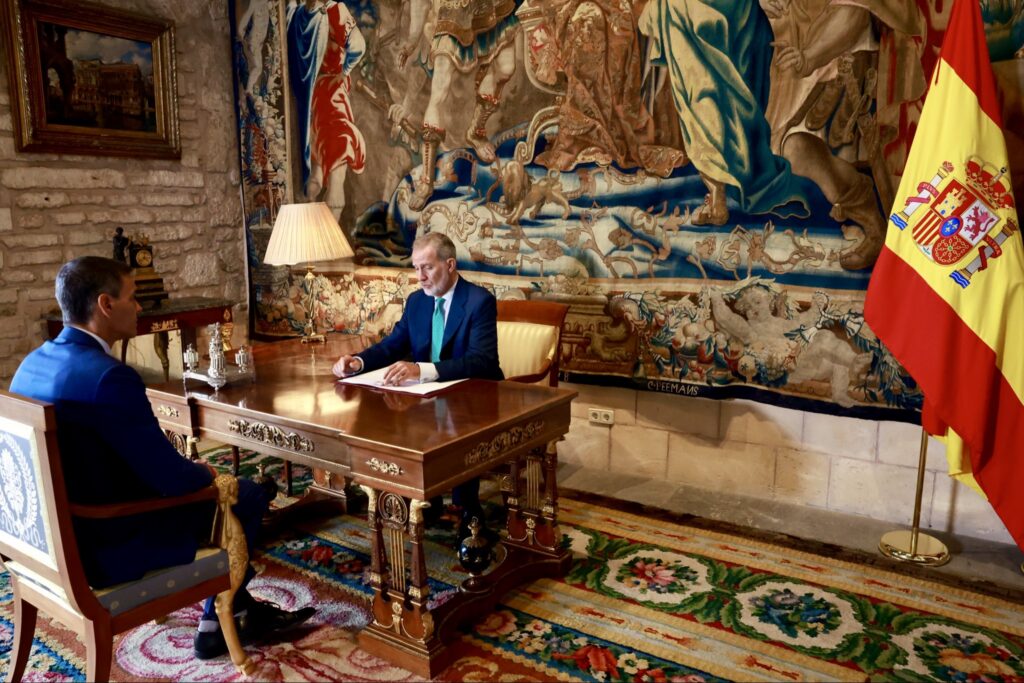
The King watched the events in Ceuta with "great concern and indignation". Photo credit: La casa Real de S.M el Rey on X
Spain’s monarch breaks with tradition after deadly migration emergency, demanding the State guarantees the security of Ceuta and Melilla Spain’s King almost never speaks like this but as politicians traded accusations over the worst migration crisis to hit Ceuta in years, Felipe VI abandoned the measured language expected of a constitutional monarch and delivered a message that has reverberated across the country.
The King said he had watched the events in the North African enclave with “great concern and indignation”, before issuing a serious warning: “The State must ensure the security of Ceuta and Melilla and prevent these events from happening again.” For a monarch whose constitutional role depends on political neutrality, the choice of words was extraordinary. It was not simply a message of sympathy. It was a clear declaration that what unfolded on Spain’s southern frontier was unacceptable.
A crisis that reached the Royal Palace
The statement, issued by the Royal Household from the Marivent Palace in Mallorca, came after a day of unprecedented scenes in Ceuta that stunned Spain and much of Europe. Thousands of migrants crossed into the autonomous city in a matter of hours, overwhelming security forces, emergency services and local authorities. The humanitarian cost quickly became apparent, with dozens of lives lost during the chaos and countless others requiring medical attention.
As the scale of the emergency became clear, Felipe VI remained in constant contact with Prime Minister Pedro Sánchez, Ceuta president Juan Jesús Vivas, Melilla president Juan José Imbroda and opposition leader Alberto Núñez Feijóo. Behind palace walls, the King was being kept informed as one of Spain’s most sensitive border emergencies unfolded. When the Royal Household finally broke its silence, the language reflected the seriousness of the moment.
Not politics, but a constitutional warning
Spanish monarchs do not govern, they do not set migration policy, negotiate with neighbouring countries or direct the security forces. Their role is deliberately removed from day-to-day politics. That is precisely why Felipe VI’s intervention has attracted so much attention.Rather than criticising the Government or entering the political battle now raging in Madrid, the King focused on what he described as the State’s constitutional responsibility: protecting Spanish territory and ensuring the security of its citizens.
He also insisted that Ceuta and Melilla should receive “a united, clear and determined message” that they have the backing of the entire country. For many observers, the King’s use of the word “indignation” was almost as significant as his demand that the crisis must never be repeated.
How did Spain get here?
The political fallout has been immediate, the Government has admitted it failed to foresee the scale of the mass crossings, acknowledging that better intelligence could have changed the response. Opposition parties have accused ministers of losing control of Spain’s borders, while pressure continues to mount for answers over what happened in the hours before thousands of migrants reached Ceuta.
Questions have also been raised about Morocco’s role after reports suggested border controls on the Moroccan side were initially relaxed before later being reinforced. Madrid and Rabat remain in diplomatic contact as investigators attempt to establish exactly how one of the largest irregular border crossings in Spanish history was able to develop so quickly.
Ceuta at the centre of Europe once again
Although geographically located in North Africa, Ceuta is Spanish territory and forms part of the European Union’s external border. That makes every migration crisis there an issue that extends far beyond Spain. The emergency has once again exposed the enormous pressure placed on the city whenever diplomatic tensions or migration flows suddenly intensify. For residents, the scenes were unlike anything they had experienced before.
Emergency workers, police officers, Guardia Civil personnel and military units were stretched to their limits as they dealt with exhausted migrants, frightened families and an unfolding humanitarian tragedy. In his statement, Felipe VI paid tribute to all those who worked throughout the crisis, acknowledging the professionalism shown under exceptionally difficult circumstances.
A message that carries weight
Royal speeches are carefully crafted, every sentence is scrutinised, every word considered and every phrase weighed for constitutional neutrality. That is why Saturday’s statement immediately stood apart. The King did not simply express sadness over the loss of life or solidarity with those affected. He made it clear that Spain has an obligation to guarantee the security of Ceuta and Melilla and that the events witnessed this week cannot become the new normal.
Whether his intervention changes the political debate remains to be seen. What is certain is that when Spain’s monarch, a figure renowned for measured language and restraint, publicly says he is “indignant”, the country takes notice. For the people of Ceuta, who have spent days living through one of the darkest chapters in the city’s recent history, the King’s words will be seen as recognition that what happened was not simply another migration incident. It was a national crisis, and, in the eyes of Spain’s Head of State, one that must never be allowed to happen again.
Follow Euro Weekly News on Google News
Get breaking news from Spain, travel updates, and expat stories directly on your Google News feed.
Follow on Google NewsSign up for personalised news
Subscribe to our Euro Weekly News alerts to get the latest stories into your inbox!
By signing up, you will create a Euro Weekly News account if you don't already have one. Review our Privacy Policy for more information about our privacy practices.

Molly Grace
Molly is a British journalist and author who has lived in Spain for over 25 years. With a background in animal welfare, equestrian science, and veterinary nursing, she brings curiosity, humour, and a sharp investigative eye to her work. At Euro Weekly News, Molly explores the intersections of nature, culture, and community - drawing on her deep local knowledge and passion for stories that reflect life in Spain from the ground up.
Comments
Anne
02 August 2026 • 13:13Ask USrael. This was deliberately orchestrated to shame Spain on migrants. It wasn’t long before 80% of the so-called “migrants” went happily home, no doubt to enjoy money they received to put on the show.
Per Knudsen
02 August 2026 • 15:08Yes, might even have been orchestrated by Russia
Rodrigues De Silva
03 August 2026 • 10:02Why Russia? another nonsense comment. Our enemy is not Russia, our enemy is the EU Leaders who are destroying the EU from within. Look at all the factories closing down because of EU rubbish. We are being taken apart bit by bit by our own EU leaders. Russia cannot win a war against Ukraine so we have little to fear from them but we do have to fear the EU leadership.
D Bath
02 August 2026 • 15:17What an absurd conspiracy theory. One for which I’m sure you have literally zero proof.
Brian
02 August 2026 • 13:56It’s a pity Britain’s King isn’t so strong and forthright!
Jack
02 August 2026 • 18:05Yes! Perhaps Felipe can have a word with Charlie boy!,? 🤔
Andrew
02 August 2026 • 16:49And yet Spain will continue to claim they own Gibraltar despite vowing never to give their two enclaves in Morocco back to Morocco. Such hypocrisy. Bet the king won’t mention that.
Comments are closed.