Mount Etna eruption leads to Catania Airport chaos as ash plume reaches 7,300 metres
By Adam Woodward • Published: 08 Aug 2026 • 10:46 • 2 minutes read
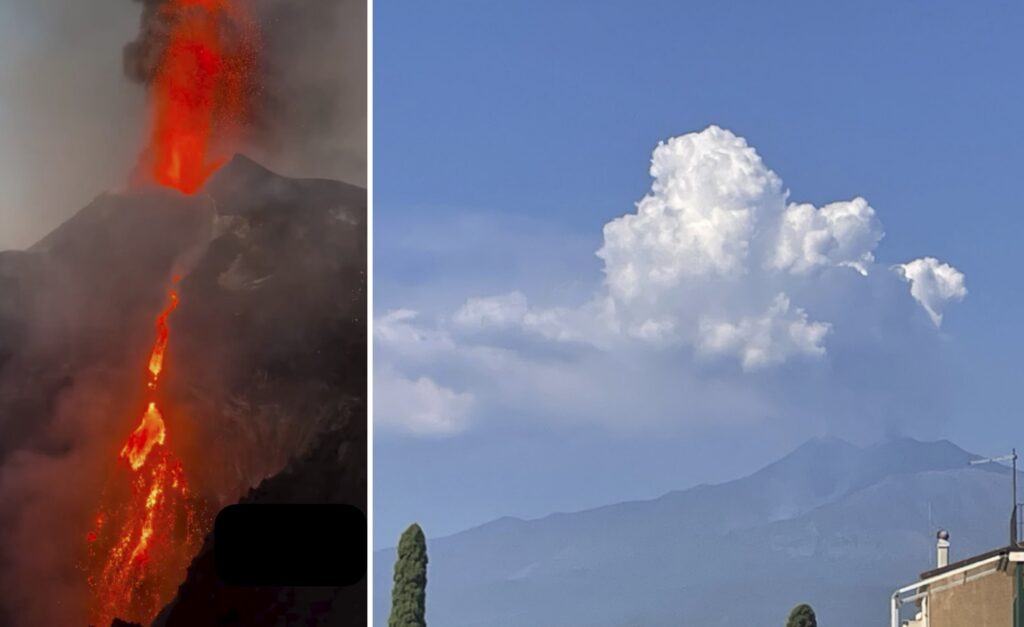
Etna erupts, causing airport chaos in Sicily. Credit: Russell Harris X
Holidaymakers heading to Sicily face severe travel chaos following a dramatic nighttime eruption from Mount Etna, forcing aviation bosses to shut down Catania airport.
Lava fountains shot hundreds of metres into the night sky as Europe’s highest active volcano put on a fierce display. Eruptive activity centred on the Voragine crater before opening a fresh fissure along the Valle del Leone at an altitude of roughly 2,750 metres. Molten rock cascades down the uninhabited slopes toward Valle del Bove, reaching elevations around 2,000 metres.
Volcanic cloud forces red alert and flight suspensions
Thick plumes of dark volcanic ash pushed up to 7,300 metres high, drifting across eastern Sicily and prompting officials to issue a strict red aviation warning. Safety controllers halted incoming flights at Catania’s Vincenzo Bellini Airport. Outbound journeys were quickly grounded due to a complete lack of landed planes sitting on the tarmac.
Brief lulls in activity allowed a handful of aircraft to touch down, but fresh clouds of ash quickly forced runway closures to resume. Airlines diverted incoming jets to alternative Sicilian hubs including Palermo, Trapani, and Comiso. Rail operator Trenitalia added emergency train services through Messina and Palermo, adding hundreds of extra seats to help stranded holidaymakers reach their destinations.
Civil protection volunteers deployed across regional terminals to assist stranded passengers, while towns like Adrano, Ragalna, and Nicolosi experienced heavy falls of fine black ash. Local residents reported loud subterranean booms echoing across the countryside alongside striking views of the fiery orange glow illuminating the night sky.
Details on official travel advisories and aviation safety protocols can also be found via the UK Foreign, Commonwealth & Development Office.
My Etna have a proper love puff tonight 🌋🌋🌋🌋 @LadyPennyP pic.twitter.com/NRcoPniK9k
— Russell Harris (@sarriefan_uk) August 7, 2026
What is going on with Mt Etna?
Mount Etna is in a state of near-constant activity, making it Europe’s most active volcano. Minor Strombolian activity, gas emissions, and small lava flows occur frequently throughout any given year. Major paroxysmal events, characterised by high lava fountains, significant ash columns, and major lava flows, typically take place every few months to every few years.
Flight disruptions at Catania airport happen several times a year. Because Catania sits just 30 kilometres south of the summit, wind direction determines whether ash plumes drift across flight paths and runways.
When ash falls on the tarmac or reduces visibility, authorities routinely suspend flight operations for several hours or days until the air clears and sweeping crews clean the runways.
What are the active volcanoes in Italy?
Italy is home to several active volcanic systems across its southern region and islands:
- Mount Etna (Sicily): Europe’s tallest and most active stratovolcano.
- Stromboli (Aeolian Islands): Renowned for continuous, small-scale explosive eruptions (“Strombolian” activity).
- Vulcano (Aeolian Islands): Famed for thermal springs and fumarolic activity, with its last major eruption occurring in 1888 to 1890.
- Mount Vesuvius (Campania): Highly dangerous stratovolcano overlooking Naples, currently dormant since its last major eruption in 1944.
- Campi Flegrei / Phlegraean Fields (Campania): A massive underground supervolcano caldera near Naples exhibiting ongoing bradyseism (ground uplift) and seismic activity.
- Ischia (Gulf of Naples): Volcanic island with active geothermal vents and seismic history.
- Pantelleria (Sicilian Channel): Submerged volcanic complex with active underwater vents and thermal activity.
- Ferdinandea / Graham Island (Underwater, Sicilian Channel): Submerged seamount that briefly rose above sea level during an eruption in 1831.
The last direct fatal eruption occurred on July 3, 2019, on the island of Stromboli. A sudden, powerful explosive eruption sent pyroclastic material and ash high into the air, killing a 35-year-old Italian hiker from Sicily who was walking along popular trails near the summit.
Whoahh! Etna today 😍 pic.twitter.com/hx5zDNzt7v
— Volcaholic 🌋 (@volcaholic1) August 7, 2026
Follow Euro Weekly News on Google News
Get breaking news from Spain, travel updates, and expat stories directly on your Google News feed.
Follow on Google NewsSign up for personalised news
Subscribe to our Euro Weekly News alerts to get the latest stories into your inbox!
By signing up, you will create a Euro Weekly News account if you don't already have one. Review our Privacy Policy for more information about our privacy practices.


Adam Woodward
Adam is a writer who has lived in Spain for over 25 years. With a background in English teaching and a passion for music, food, and the arts, he brings a rich personal perspective to his work at Euro Weekly News. As a father of three with deep roots in Spanish life, Adam writes engaging stories that explore culture, lifestyle, and the everyday experiences that shape communities across Spain.
Comments