Paddle surf warning after two children rescued from dangerous currents on Spain’s south coast
By Adam Woodward • Published: 13 Aug 2026 • 16:53 • 3 minutes read
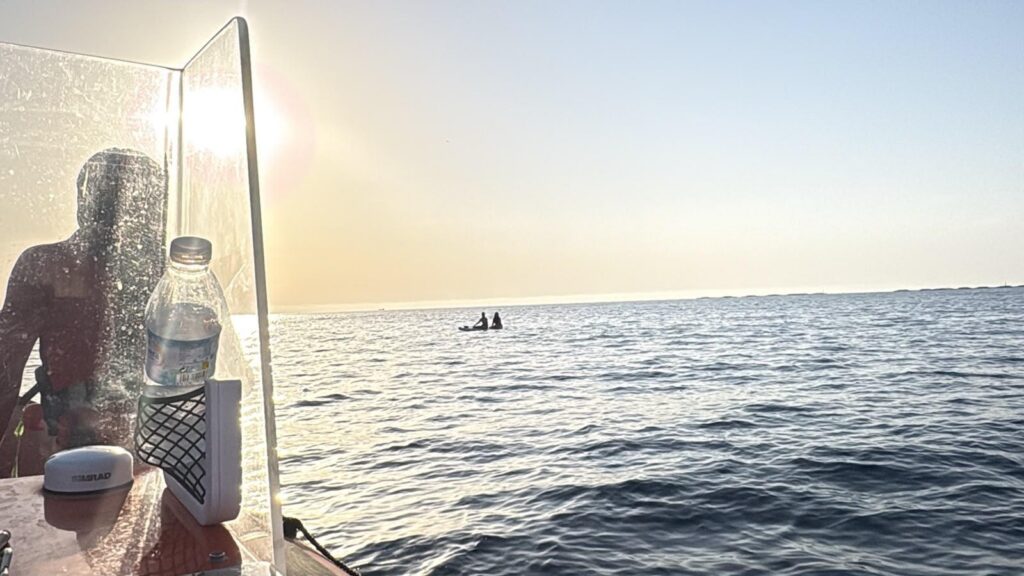
Paddleboarders in trouble. Credit: Salvamento Maritimo X
Two children had to be rescued by the Guardia Civil after their paddle surfboard was caught by currents off Algeciras, which has led to renewed warnings about the risks of taking a SUP into unfamiliar coastal waters.
The kids were found on Tuesday, August 11, after their parents raised the alarm when they lost sight of them while they were paddle surfing off the coast. A patrol boat from the Guardia Civil’s Maritime Service was operating near Getares beach when officers received the emergency call through the 062 telephone number.
Information from the children’s relatives helped officers establish where they had last been seen. Taking the local currents, the likely drift of the paddleboard and the approaching sunset into account, the search was directed towards La Ballenera. Rescuers eventually found both children on their board in a rocky area that was difficult to access. Strong currents had left them unable to get away from the rocks, while the youngsters were visibly nervous about their predicament.
A delicate approach was required because of the unstable paddleboard. Officers managed to bring both children aboard their patrol boat before taking them back to their families in good condition.
Why anywhere near the Strait of Gibraltar is a particularly challenging place for paddleboarders
Algeciras and surrounding areas may look inviting on a calm day, but the coastline around the bay and Strait of Gibraltar can present very different conditions from those found on a sheltered Mediterranean beach.
Currents can become a major problem for anyone on a paddleboard because a SUP offers relatively little propulsion compared with the forces moving the water. Once a paddler loses the ability to make progress towards shore, returning can become surprisingly difficult.
La Ballenera itself is used by experienced paddleboarders and kayakers, but that does not mean conditions are suitable for every level of ability. Routes recorded around the area include trips towards Punta Carnero and other exposed sections of coastline. Some longer SUP routes also describe changing wind conditions, including much stronger winds later in a journey.
Port entrances, shipping routes and areas affected by tidal movement deserve particular caution around Algeciras. Recreational paddlers should never assume that a calm-looking sea means currents are weak.
Malaga Bay also deserves caution
Algeciras is not the only part of southern Spain where paddleboarders need to think carefully about where they launch. Malaga Bay has busy maritime activity, marked channels and areas where boats operate close to popular beaches. Port approaches and vessel manoeuvring areas are especially unsuitable for a SUP.
Previous incidents show how quickly conditions can turn a pleasant paddle into an emergency. Two women were rescued about 300 metres from La Misericordia beach in Malaga last year after a current left them unable to return to shore while paddle surfing.
Malaga’s beaches have also seen other water-related emergencies this year, reinforcing the need to treat the sea with respect even when conditions appear benign.
Other south coast areas where SUP users need extra care
Harbour entrances and commercial shipping areas should generally be treated as no-go zones for recreational paddleboarders. That includes approaches around Malaga, Fuengirola, Marbella, Puerto Banus, Estepona, La Duquesa, Sotogrande, Algeciras, Motril and Almeria. Traffic from ferries, fishing boats, leisure craft and larger vessels can create hazards for someone sitting low on a paddleboard.
Salvamento Maritimo recommends the “Float to Live” technique: turn onto your back, keep your head above the water and make gentle movements with your arms and legs to remain afloat. Recovering your breathing and conserving energy can be crucial while waiting for assistance.
A waterproof mobile phone, or one in a sealed plastic bag tied around one’s wrist can also make an enormous difference. One previous paddleboard rescue off the Spanish coast involved a paddler whose phone remained usable inside its waterproof case, allowing him to contact emergency services and provide his location.
Tuesday’s rescue near Algeciras ended safely, but it provides a timely reminder that paddle surfing is not simply a case of stepping onto a board and heading wherever the sea looks calmest.
For families in particular, staying close to shore, checking conditions and avoiding areas affected by strong currents or boat traffic can make the difference between a memorable day on the water and an emergency call to the rescue services.
Anyone who sees themselves or another person in serious danger should contact the emergency services immediately. In Spain, 112 is the general emergency number, while the Guardia Civil can be contacted on 062.
Follow Euro Weekly News on Google News
Get breaking news from Spain, travel updates, and expat stories directly on your Google News feed.
Follow on Google NewsSign up for personalised news
Subscribe to our Euro Weekly News alerts to get the latest stories into your inbox!
By signing up, you will create a Euro Weekly News account if you don't already have one. Review our Privacy Policy for more information about our privacy practices.




Adam Woodward
Adam is a writer who has lived in Spain for over 25 years. With a background in English teaching and a passion for music, food, and the arts, he brings a rich personal perspective to his work at Euro Weekly News. As a father of three with deep roots in Spanish life, Adam writes engaging stories that explore culture, lifestyle, and the everyday experiences that shape communities across Spain.
Comments