Where have all the cops gone? Fuengirola and Marbella residents concerned they don’t see police presence anymore
By Adam Woodward • Published: 13 Aug 2026 • 22:43 • 3 minutes read
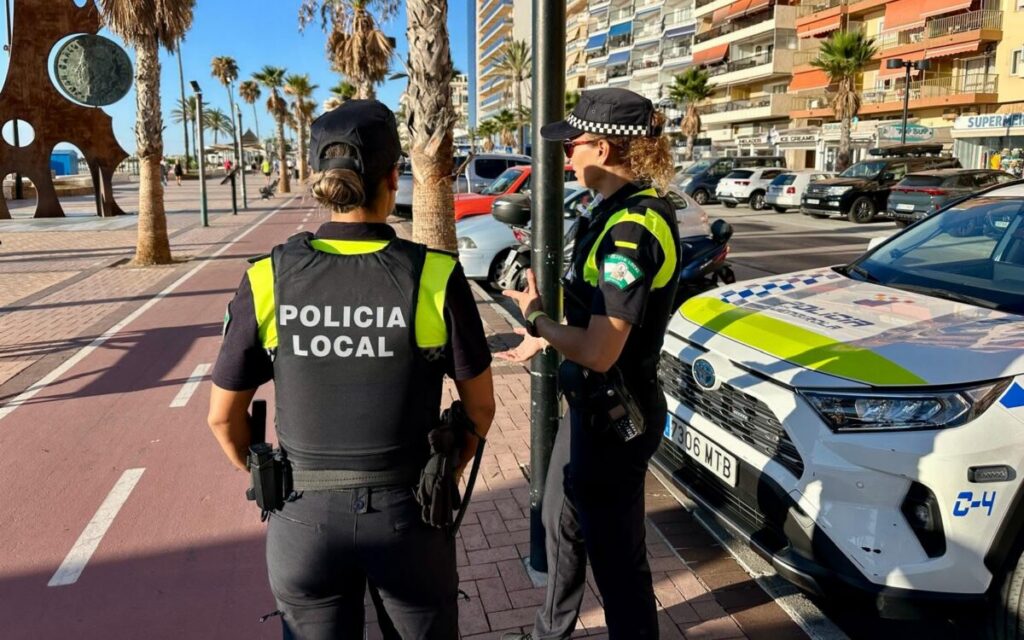
A rare sight on the streets of Fuengirola. Credit: PL Fuengirola.
Residents in Fuengirola and Marbella are questioning where the Policía Local have gone, claiming that officers who once regularly walked the streets are becoming increasingly difficult to spot.
Euro Weekly News has been contacted by several Fuengirola residents who say they have noticed a striking difference since moving to the Costa del Sol a few years ago. One said, “When I moved here you could see them often on street corners, walking up and down, usually in couples,” she said. “Now you never see one.” And that’s not just here in Fuengirola but all along the coast. Even residents in Marbella have commented the same.
Their concern is not necessarily about serious crime. Instead, they believes a lack of visible, everyday policing is allowing relatively minor offences and local regulations to go unchecked.
“It’s all very well passing these all these bylaws aboy scooters and wearing swimwear off on the streets, but where are the Policía Local?”
Curiously, police numbers have actually been increasing
Official figures make the situation more complicated. Fuengirola Town Hall announced in May that its Policía Local currently has 146 officers, with 12 new officers undergoing training and another eight positions approved. The council said the force had been below the staffing ratio recommended according to the town’s population.
Marbella is also increasing its police numbers. In February, the town announced plans for around 30 new Policía Local positions, while 25 students began the latest entry course in May.
Consequently, the issue may not simply be about how many officers a city employs but how many are actually available for visible street patrols at any given time. Residents do not necessarily experience police numbers through staffing statistics. They experience them by seeing an officer walking through their neighbourhood, speaking to shopkeepers and other residents, monitoring busy pedestrian areas or dealing with minor offences.
So, ‘Where are the Policía Local?’
That distinction is at the heart of readers’ complaint. One from Fuengirola said, “The ‘bee in my bonnet’ is that our Gobierno and Ayuntamiento spend thousands of euros a year in meetings and passing laws when both they and the general public know that there are no police on the street to see them upheld,” she wrote.
Her examples include beachwear, drinking alcohol in public places and the rules governing electric scooters and bicycles. She also remembers a time when police visibility itself acted as a deterrent on the coast. “When we had them walking our streets, there was very little local crime or misdemeanours,” she said.
Her argument is that minor infringements can gradually become normalised if nobody appears to enforce the rules. “These things may be small fry in the great scheme of Law and Order but when the small rules are broken and not corrected, you can be sure that people begin to take advantage, and the result is lawlessness which is hard to redress.”
E-scooters and bicycles are one obvious example
New rules governing personal mobility vehicles have given local police another area to monitor. Residents have reported seeing officers stopping scooter users following the introduction of tighter national requirements, including rules relating to safety equipment, helmets, insurance and where the vehicles can be used. Cross the border line (as ambiguous as it is) into Las Lagunas de Mijas, and it is an entirely different story with frequent stops by police of helmet-less scooter riders.
Fuengirola has previously reported substantial enforcement activity involving personal mobility vehicles, while police forces across Malaga Province have increased checks on e-scooters. Fuengirola is also investing in its own police fleet, with a 2026 contract covering five new patrol cars.
For residents, however, a new patrol vehicle is not quite the same thing as an officer strolling down the Paseo Maritimo.
Summer brings another policing challenge
It’s hot out there! And, tourism adds another layer to the question. Police resources can be directed towards traffic enforcement, major incidents, nightlife operations, investigations and emergency calls. A provincial summer security operation this year is providing 409 additional National Police and Guardia Civil personnel across Malaga Province. Marbella is receiving 54 of those officers and Fuengirola 25. Those reinforcements, however, are not the same as additional Policía Local officers carrying out routine neighbourhood foot patrols.
Residents want reassurance, not just more rules
One Marbella reader admits that his complaint is partly tongue-in-cheek. “If there’s an incident after the clubs chuck out, they are there in force, so what are they doing in the day?” he asked. He also remembers the reassurance that visible officers provided, walking around and chatting with people in the evenings. “It used to be reassuring to see police out on the streets, like fatherly-figures keeping their family safe.”
Their comments raise a wider question for the Costa del Sol: does having more police officers on the books necessarily mean residents will see more police officers on the beat?
Fuengirola’s latest recruitment figures suggest the local forces are growing, while Marbella is also actively recruiting. The message from the taxpayers for Mayor Ana Mula and Mayor Ángeles Muñez is almost literally “show us the money”!
Follow Euro Weekly News on Google News
Get breaking news from Spain, travel updates, and expat stories directly on your Google News feed.
Follow on Google NewsSign up for personalised news
Subscribe to our Euro Weekly News alerts to get the latest stories into your inbox!
By signing up, you will create a Euro Weekly News account if you don't already have one. Review our Privacy Policy for more information about our privacy practices.





Adam Woodward
Adam is a writer who has lived in Spain for over 25 years. With a background in English teaching and a passion for music, food, and the arts, he brings a rich personal perspective to his work at Euro Weekly News. As a father of three with deep roots in Spanish life, Adam writes engaging stories that explore culture, lifestyle, and the everyday experiences that shape communities across Spain.
Comments