Airport security checks are changing across Europe: here’s where travellers can now leave liquids in their bags
By Harry Dennis • Updated: 21 Aug 2026 • 11:12 • 3 minutes read
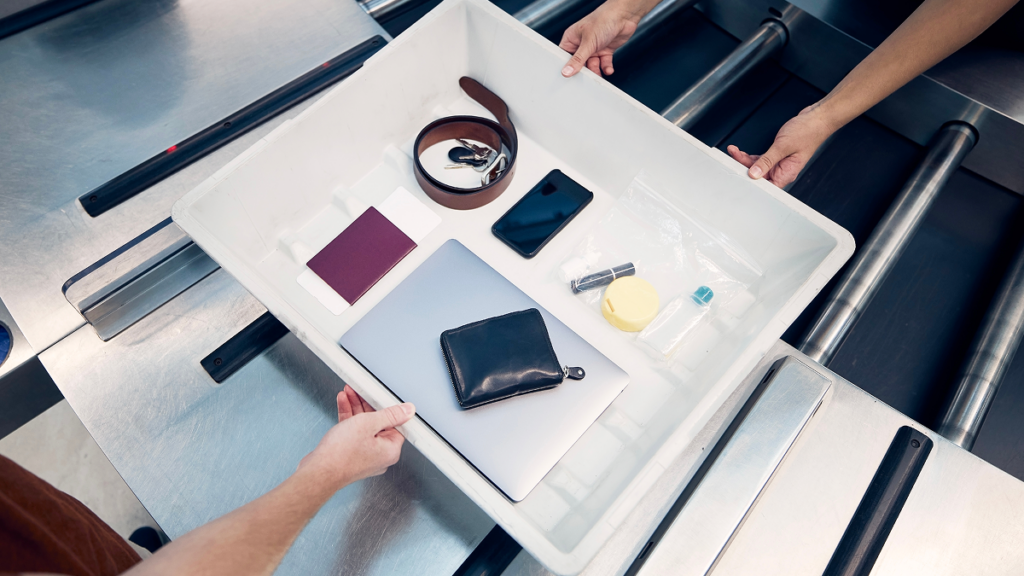
New airport scanners allow liquids and laptops to remain inside hand luggage. Credit: Jaromir Chalabala / Shutterstock
The familiar scramble to unpack miniature toiletries, laptops and tablets is slowly disappearing at a growing number of European airports. Three Spanish hubs already have the technology, and Madrid has now taken a significant step that changes the experience for every passenger using the major checkpoint.
Madrid’s Terminal 4 now has 36 scanners that keep bags closed
Passengers using the main security checkpoint at Madrid-Barajas Terminal 4 can now keep laptops, tablets and toiletries inside their hand luggage instead of stopping to unpack everything into separate trays. Airport operator Aena announced on July 30 that the redesigned screening area had fully opened, giving every passenger using that checkpoint access to the newer procedure.
The checkpoint contains 36 advanced scanners: 31 in the central area and another five at Fast Track. There are also dedicated routes for families and passengers with reduced mobility.
The remodelling cost more than €10.3 million, excluding the inspection equipment itself. Madrid, Barcelona-El Prat and Palma de Mallorca have all been identified in Aena’s corporate reporting as airports where the cabin-baggage technology was being installed. At Barcelona, further improvements to Terminal 2 will include more scanners under a redevelopment scheduled for 2027 to 2031.
Vienna, Cologne and Nuremberg have joined the easier-check list
Several major European airports have joined or expanded the easier-security list since earlier coverage. Vienna completed the rollout at central checkpoints across all its terminals on July 3. The airport installed 35 scanners and now allows liquids and electronic devices to remain in cabin bags, with individual liquid containers permitted up to two litres.
Cologne Bonn followed on July 14, opening 11 modernised security lanes. Its rules also allow individual containers holding up to two litres, without requiring laptops or toiletries to be unpacked.
Nuremberg has introduced the same two-litre allowance alongside its upgraded checkpoint. The airport says liquids, gels and electronic devices can remain inside hand luggage.
Those three airports join an established two-litre list that already includes Rome Fiumicino, Dublin, Billund, Malta and Kraków. Their official passenger guidance confirms that containers of up to two litres can pass through security without being removed from hand luggage. Rome Fiumicino has important exceptions though: the traditional 100ml limit still applies to certain direct flights to the United States and Israel, and to some passengers transferring from non-Schengen countries.
Frankfurt says most Terminal 1 checkpoints and all Terminal 3 checkpoints now accept containers of up to two litres and allow electronics to stay packed. However, gates C1, C2, C4 and C6, certain special checkpoints and transfer controls still apply the 100ml limit.
London Heathrow and London Gatwick are among the UK airports that also publish two-litre allowances in their current passenger guidance.
Spain’s new scanners don’t mean two-litre bottles are universal
The machines use computed tomography, or CT, to create detailed three-dimensional images of cabin baggage, allowing security staff to inspect items without asking passengers to unpack them. But leaving toiletries in a bag and carrying larger bottles are separate changes.
Vienna, Cologne Bonn and Nuremberg explicitly permit both. Aena’s current hand-luggage guidance still states that liquids, creams, gels and similar products must be carried in containers of no more than 100ml, inside a transparent, resealable one-litre bag. An advanced scanner in Madrid, Barcelona or Palma therefore does not, on its own, give passengers permission to carry two-litre bottles through security.
At equipped Spanish checkpoints, the confirmed improvement is that permitted liquids and electronics can remain packed. Medication and necessary baby food are covered by established exemptions. Different limits can also apply on an outward flight, the return journey or during a transfer.
Alicante, Málaga and Ibiza remain the next airports to watch
Aena’s wider investment programme includes an extra €86 million for automated security-screening equipment and tray-return systems across its network. The operator has named Málaga-Costa del Sol, Alicante-Elche Miguel Hernández and Valencia among airports covered by wider improvement projects.
At Alicante, proposed terminal expansion specifically includes equipment allowing authorised liquids and electronics to remain inside hand luggage. The project forms part of Aena’s proposed 2027–2031 investment programme. Ibiza’s planned airport redevelopment also includes the same technology, although Aena says the wider works are expected to begin in 2030.
Travellers using Málaga, Alicante or Ibiza will have to wait a little longer before benefiting from the quicker security process. At Madrid’s Terminal 4, passengers can already pass through the fully upgraded central checkpoint without unpacking their cabin bags.
Follow Euro Weekly News on Google News
Get breaking news from Spain, travel updates, and expat stories directly on your Google News feed.
Follow on Google NewsSign up for personalised news
Subscribe to our Euro Weekly News alerts to get the latest stories into your inbox!
By signing up, you will create a Euro Weekly News account if you don't already have one. Review our Privacy Policy for more information about our privacy practices.




Harry Dennis
Born in the UK and raised on the Cádiz coast, Harry brings his background in design, music, and photography to his writing for Euro Weekly News, sharing stories that celebrate culture and lifestyle across Spain and beyond.
Comments