Police documents put Pedro Sánchez’s government under fresh pressure over Ceuta invasion

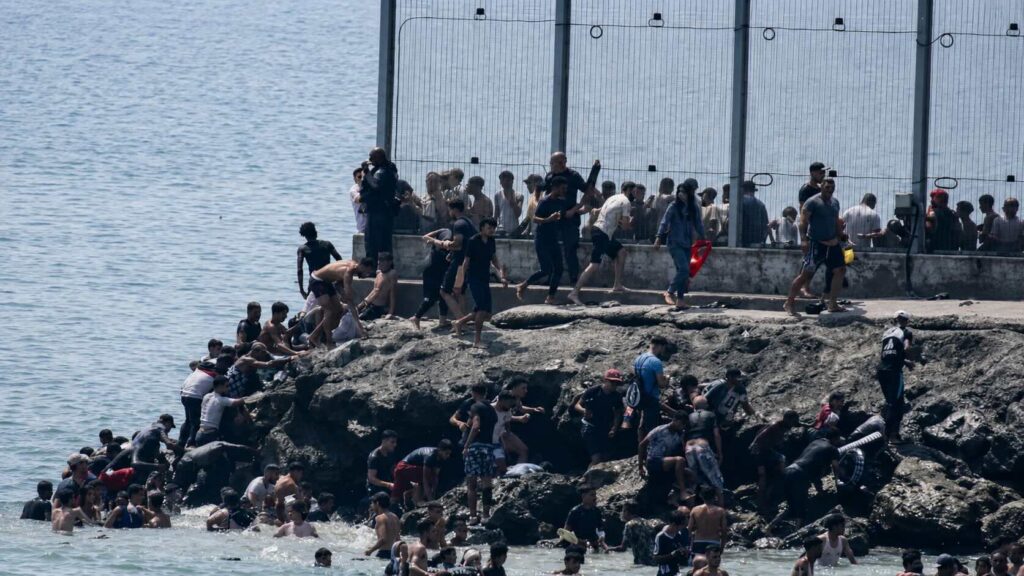
Large group of migrants climb rocks and enter Ceuta from Morocco beside the border fence during the July 2026 invasion.

People cross into Ceuta from Morocco beside the border fence during the mass invasion of July 2026. Credit: JUPOL Nacional / X

Pedro Sánchez’s government is facing fresh pressure over the invasion of Ceuta after police intelligence documents reportedly identified Moroccan security personnel as helping to direct the mass crossing, while warnings allegedly reached the Interior Ministry before it happened.

The reports place the spotlight firmly on the government’s handling of the invasion.

Sánchez has said there was no intelligence evidence that Moroccan authorities were involved. His government instead blamed criminal networks, online disinformation and accounts associated with Russia, Israel and the international far right.

But new reporting suggests Spain’s own police intelligence had already warned of the risk of a mass invasion and later identified alleged Moroccan involvement on the ground.

What the police report is said to show

The material was reportedly prepared by CENIF, the National Police intelligence unit responsible for immigration and borders. Its role is set out in the official Interior Ministry order governing the National Police structure.

According to reports first published by El Español and later shown by Código 10, the police assessment was passed to Audiencia Nacional judge María Tardón.

It reportedly describes the invasion on July 30 and 31 as an organised operation intended to overwhelm Spanish border controls.

The documents are said to identify uniformed Moroccan gendarmes guiding people towards particular points of entry, while officers in plain clothes monitored the operation. RTVE reports that the police file includes photographs and names of Moroccan officers alleged to have taken part.

The assessment reportedly links the operation to Morocco’s long running claims over Ceuta and Melilla.

These claims have not been established by a final court ruling. They are, however, serious enough for Interior Minister Fernando Grande Marlaska to demand an urgent explanation from the director general of the National Police.

Warnings allegedly sent before the invasion

Código 10 says police intelligence issued two warnings before the invasion.

The first was reportedly dated July 28. A second was allegedly sent on July 29 to the Secretariat of State for Security, warning of an extreme risk of a mass invasion by sea or fence during the final days of July.

If confirmed, this creates a major problem for Sánchez’s government.

Marlaska has repeatedly said there was no intelligence report anticipating what happened. Sánchez has also said there was no information from any intelligence agency that raised doubts about Morocco’s involvement.

Yet the reported police documents suggest an Interior Ministry unit had warned of the danger before the invasion, then later assessed possible Moroccan security involvement.

Defence Minister Margarita Robles has already said the CNI and military intelligence detected calls for a crossing and shared information with security forces and the Government Delegation in Ceuta. Marlaska has continued to insist there was no report forecasting an event on the scale that followed.

Sánchez’s government blamed gangs and foreign disinformation

In its official account of Sánchez’s visit to Ceuta, La Moncloa said the crisis was driven by people traffickers exploiting confusion around a Supreme Court ruling on returns at the sea border.

Sánchez later claimed that online accounts associated with Russia, Israel and the international far right had spread false information around the crisis. Russia and Israel rejected the allegation.

Online rumours may have helped persuade people to risk a dangerous crossing. But the new reports raise a different question. If Moroccan officers were allegedly involved, and warnings had reached the Interior Ministry before the invasion, why did Sánchez’s government dismiss Morocco’s possible role so firmly?

The Pegasus shadow over relations with Morocco

The reported police evidence also lands as questions persist over the alleged use of Pegasus spyware by Moroccan intelligence against Sánchez and several Spanish ministers. The recent Pegasus investigation does not prove that spying influenced decisions over Ceuta.

But it adds to the political sensitivity. A government aware that Morocco may have held highly sensitive information about senior Spanish figures could be more reluctant to provoke a public confrontation with Rabat. That is why transparency over what ministers knew before the invasion matters.

For a clear explanation of why Ceuta remains such a sensitive issue between Spain and Morocco, read our Ceuta explainer.

Why this matters beyond Ceuta

This was an invasion of a Spanish city, not merely a local migration incident.

More than 72,000 people crossed from Morocco, according to the Interior Ministry. The invasion led to deaths, a humanitarian emergency and a political row that reached across Europe. It also helped trigger additional travel checks between Spain and Italy, affecting a route used by many British residents and holidaymakers.

As we reported, Italy has extended checks on travellers from Spain while the consequences of the Ceuta invasion continue.

The immediate question is now for Sánchez’s government. It must establish whether the reported police documents exist, what ministers knew before the invasion and why its public version of events appears to conflict with intelligence reportedly gathered by its own police force.

Google News

Follow Euro Weekly News on Google News

Get breaking news from Spain, travel updates, and expat stories directly on your Google News feed.

Follow on Google News
Written by

Nazario Rodriguez

I’ve worked in news media for over 10 years, previously as Production Manager at Euro Weekly News, and I now focus on audience strategy and content performance. I specialise in understanding what readers engage with and shaping content that serves them well.

Comments


    Leave a comment

    Your email address will not be published. Required fields are marked *