Ceuta explained. Why this Spanish city in Africa is suddenly making headlines
By Adam Woodward • Published: 29 Aug 2026 • 14:53 • 8 minutes read
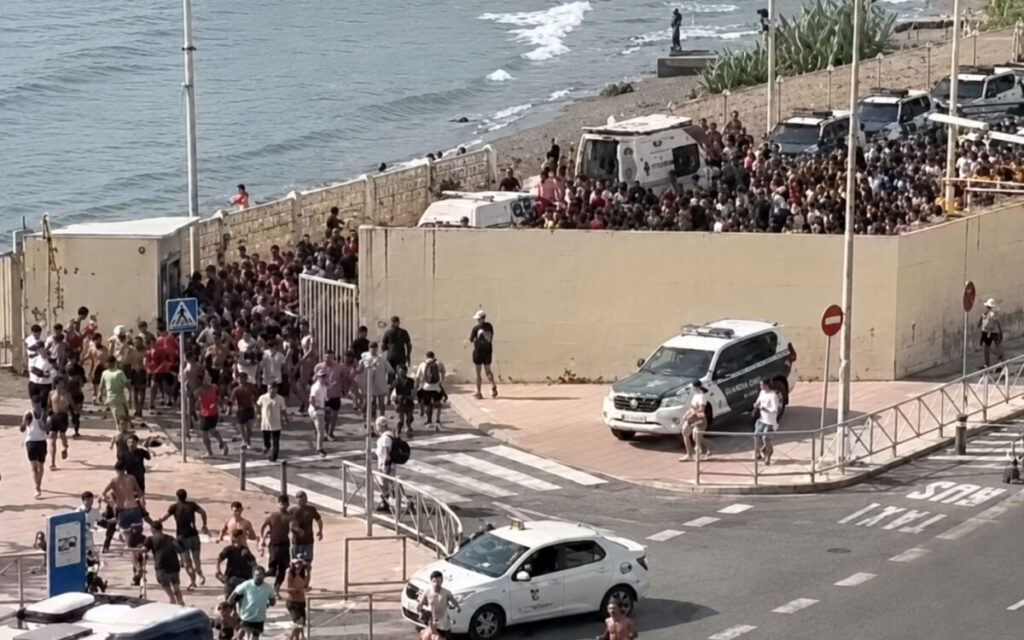
Thousands of immigrants flood Spanish gates in Ceuta in July. Credit: Macarena Olona X
Foreign residents across Spain may notice something unusual outside their local town halls on Wednesday, September 2, when rallies in support of Ceuta are due to take place across the country.
The gatherings will put the spotlight on a small Spanish city on the North African coast that many people have never visited and some may struggle to find on a map.
Ceuta has suddenly found itself at the centre of a migration crisis, a national political battle and renewed tensions with Morocco over its future. But why is it part of Spain in the first place, why does Morocco claim it, and why does a city separated from mainland Spain matter so much to Madrid and the European Union?
Here is the story behind the headlines.
Ceuta is in Africa, but it is part of Spain
Look at a map and the confusion is understandable. Ceuta is on the northern coast of Africa, directly opposite southern mainland Spain across the Strait of Gibraltar. Its only land border is with Morocco.
Yet, politically and constitutionally it is Spanish. Ceuta is one of Spain’s two autonomous cities in North Africa, together with Melilla, further to the west. Its residents are Spanish citizens, elect representatives to Spain’s parliament, and use the euro.
It is also part of the European Union, which makes the border between Ceuta and Morocco much more than just a Spanish border. It is also an external frontier of the EU, which helps explain why events involving a relatively small city can rapidly become an issue for Madrid and Brussels.
Ceuta was Portuguese before it became Spanish
One of the most common misconceptions surrounding Ceuta is that Spain simply took the city from modern Morocco. But, the history is considerably older and more complicated than that.
Ceuta has been controlled by numerous civilisations during its long history, including Romans, Byzantines and a succession of Muslim dynasties.
The crucial turning point came in 1415, when Portugal captured Ceuta, and not from Morocco. That began more than six centuries of Portuguese and subsequently Spanish rule. It happened 77 years before the Catholic Monarchs completed the conquest of Granada in 1492.
Spain and Portugal later came under the same monarch in 1580 during the Iberian Union. When Portugal broke away from the Spanish Crown in 1640, Ceuta did not follow. The city continued under the Spanish monarchy.
The arrangement was formally recognised in the Treaty of Lisbon in 1668, when Spain recognised Portuguese independence and Portugal recognised Ceuta as belonging to the Spanish Crown.
The Autonomous City of Ceuta documents the city’s Portuguese history, including the Portuguese conquest in 1415 and the centuries that followed, Ceuta has remained under Spanish sovereignty ever since.
That chronology matters. Modern Morocco gained independence in 1956, almost three centuries after Portugal had formally recognised Spanish sovereignty over Ceuta.
So why does Morocco claim Ceuta?
Morocco does not accept the Spanish position. Rabat has long maintained claims over Ceuta and Melilla, regarding the cities as territories that should form part of Morocco.
Spain rejects that position and considers both cities integral parts of the Spanish state. This is not simply an old dispute buried in history books. The sovereignty question has returned to the headlines during the current crisis.
Those comments followed remarks by Morocco’s Justice Minister referring to what he described as the country’s “historical and geographical rights” over the two cities.
The timing has made the issue particularly sensitive following the events at the border.
For the people living in Ceuta, however, the current constitutional position is clear. They live in an autonomous Spanish city and are Spanish and EU citizens.
What happened at the border in July?
The reason Ceuta is dominating Spanish headlines now has little to do with a centuries old treaty and everything to do with what happened on July 30 and 31.
An extraordinary number of people entered Ceuta irregularly from Morocco, many attempting the dangerous journey by sea. The sudden movement of people was enormous in relation to a city with a population of around 80,000.
Border controls, accommodation, identification procedures, humanitarian assistance and local public services were placed under extraordinary pressure. Questions quickly came out over whether such an enormous movement of people could have happened spontaneously.
Just days later, Spain’s Audiencia Nacional opened preliminary proceedings to investigate whether criminal organisations had helped coordinate or encourage the mass crossings. The investigation then moved part of the focus away from the people crossing the border and towards the possibility that organised networks had played a role.
Could Spain have known it was coming?
That question has since become politically explosive. The Government has faced growing scrutiny over what Spanish intelligence knew before the mass movement towards the border.
As Euro Weekly News reported, Defence Minister Margarita Robles and Interior Minister Fernando Grande Marlaska have given differing accounts of what information existed before the crossings. Robles said intelligence concerning a possible mobilisation had been communicated before the mass crossing, while the Interior Ministry has maintained that there was no intelligence report predicting what ultimately happened.
The distinction between knowing that people might gather near the border in preparation for a mass breach of the border, and predicting the extraordinary scale of what followed, is now part of the political argument in Madrid.
The crisis did not end when the crossings stopped
The dramatic images from the border may have disappeared from television screens, but Ceuta was left dealing with the consequences. Thousands of people remained in the city, placing enormous pressure on accommodation and public services. Some ended up sleeping in makeshift camps. By August 20, police had begun moving thousands of migrants from makeshift shelters on Playa del Trampolín into temporary accommodation.
The operation involved Policía Nacional, Guardia Civil and Local Police, while extra reception sites were prepared to accommodate those remaining in Ceuta. Moving people off the beach, however, did not resolve the underlying question of what would happen to them.
Can someone who reaches Ceuta simply travel to mainland Spain?
No, and this has become another source of confusion surrounding the crisis. The Spanish Foreign Ministry has explained the rules governing irregular entry into Ceuta and Melilla, including the additional controls involved in travelling onwards towards mainland Spain and the rest of Europe.
Ceuta and Melilla have an unusual border arrangement. There is one control at the border with Morocco and another Schengen control for departures towards mainland Spain by sea or air.
That creates an extra filter before someone can travel onwards. Reaching Ceuta irregularly therefore does not automatically give someone the right to remain in Spain or move freely into mainland Spain and the rest of Europe.
Authorities must also deal individually with people who may be entitled to request international protection, while minors and other potentially vulnerable people have additional legal protections.
Ceuta then gave Madrid an ultimatum
As the number of people remaining in the city continued to put pressure on services, relations between Ceuta’s government and Madrid deteriorated. Ceuta’s president, Juan Jesús Vivas, demanded faster action from the national Government on returns, immigration procedures and additional resources.
The dispute escalated when Vivas gave Madrid 30 days to act, warning that Ceuta could take the battle to Spain’s Supreme Court and Constitutional Court. For such a small territory with limited space, the argument is not abstract. Accommodation, healthcare, policing and other public services all have finite capacity.
Madrid, meanwhile, has to operate within Spanish and international immigration law when determining what happens to each person.
There were fears it could happen again
The anxiety did not disappear after July, as social media messages subsequently called for another mass attempt to reach Spanish territory.
On August 15, Moroccan security forces stopped hundreds of people gathering near the Ceuta border as Spanish police were kept on high alert. Nearly 300 people were reportedly detained as Moroccan authorities broke up the gathering near Castillejos. The episode demonstrated how heavily the security of Ceuta’s border depends on cooperation between Spain and Morocco.
Why did Spain declare a national security situation?
By late August, Madrid had taken an extraordinary step: The Spanish Government formally declared the situation in Ceuta to be a matter of interest for national security.
The official declaration published in Spain’s BOE says the irregular arrivals on July 30 and 31 created unprecedented pressure on border control, identification, humanitarian assistance and reception capacity. It also says ordinary public services have been affected, including social services, child protection, security, transport and administration.
The declaration allows reinforced coordination between national and local authorities while they continue exercising their normal powers. Importantly, it is not the same as declaring a state of emergency. The measure does not suspend fundamental rights or give authorities the exceptional powers associated with Spain’s constitutional emergency provisions. It is currently due to stay in place until December 31, although it can be extended or ended earlier depending on how the situation develops.
Why will people be gathering outside town halls on September 2?
This is where a crisis that may have seemed distant to foreign residents on the Costas becomes much more visible.
September 2 is Ceuta Day.
The Spanish Federation of Municipalities and Provinces, FEMP, has called on town halls across Spain to hold gatherings at 8pm on September 2 as a show of solidarity with the autonomous city and its residents.
There is also a separate citizen movement organising gatherings around the country. Euro Weekly News has reported on how the Ceuta crisis is now reaching mainland Spain through rallies planned in towns and cities across the country.
The gatherings are deliberately timed to coincide with Ceuta Day.
The rallies are not simply anti immigration protests
There is an important distinction for foreign residents who encounter one of the gatherings. FEMP is presenting its events as a show of solidarity with Ceuta and the people who live there, rather than as protests against migrants.
Separate citizen movements and other groups participating around Spain may have their own messages about immigration, border security and the Government’s handling of the crisis. It would therefore be misleading to assume that everybody gathering outside a town hall on September 2 is there for precisely the same reason.
For some, it is about supporting Ceuta’s residents. For others, border security is the central issue. Others are angry about immigration policy or Madrid’s handling of the crisis.
The rallies are coming to the Costas too
The nationwide campaign means the issue will be visible in areas with large foreign populations. Fuengirola and Torremolinos are among the Costa del Sol towns that have already joined the nationwide show of support for Ceuta.
Both gatherings are scheduled for 8pm on September 2, with Fuengirola’s event in Plaza de España and Torremolinos holding its gathering outside the town hall. Similar events are planned elsewhere across Spain.
For foreign residents who normally encounter Ceuta only in headlines about migration, the September 2 gatherings will bring what has largely seemed a distant North African crisis much closer to home.
Why Ceuta matters to the rest of Spain
Ceuta has fewer residents than many mainland Spanish towns, but its strategic importance is far greater than its size suggests.
It is Spanish territory in the continent of Africa. It sits on an external frontier of the European Union and beside one of the world’s most strategically important shipping routes. It is also at the centre of Spain’s complicated relationship with Morocco over migration, security and sovereignty. That relationship can have very practical consequences. The events of the past month have demonstrated how quickly pressure on a relatively short border can become a humanitarian emergency, a security issue, a diplomatic dispute and a national political crisis.
Behind all those geopolitical questions are tens of thousands of ordinary Spanish residents trying to live normally in a city that has spent the past month under extraordinary pressure. That helps explain why events at the Moroccan border at the end of July have travelled all the way to Madrid, Brussels and now town hall squares across Spain.
For foreign residents who see those gatherings on September 2, understanding Ceuta means understanding that this is about much more than one month of migration.
It touches on Spain’s borders, its relationship with Morocco, European security and more than 600 years of history.
Follow Euro Weekly News on Google News
Get breaking news from Spain, travel updates, and expat stories directly on your Google News feed.
Follow on Google NewsSign up for personalised news
Subscribe to our Euro Weekly News alerts to get the latest stories into your inbox!
By signing up, you will create a Euro Weekly News account if you don't already have one. Review our Privacy Policy for more information about our privacy practices.





Adam Woodward
Adam is a writer who has lived in Spain for over 25 years. With a background in English teaching and a passion for music, food, and the arts, he brings a rich personal perspective to his work at Euro Weekly News. As a father of three with deep roots in Spanish life, Adam writes engaging stories that explore culture, lifestyle, and the everyday experiences that shape communities across Spain.
Comments
F. Gillard
30 August 2026 • 09:56Good clear article. There has been a rise of xenophobia in Spain which affects all of us immigrants. Thank you for clarifying who the different factions are.
Martyn King
30 August 2026 • 13:36According to a police union spokesman, the number of calls regarding crimes being committed in Cueta has increased 1,000% since the invasion.
“Normally, we get 20 or 30 calls a day to report crimes, and that number increases on weekends. But we’re registering more than 200 calls every day. What we’re experiencing is overwhelming.”
There’s no phobia in not wanting criminals in your neighbourhood.
D Bath
30 August 2026 • 17:02It’s hard to fathom anyone could be so obtuse as to not be aware of what’s going on in Ceuta. What is happening there is not immigration, but an invasion.
Comments are closed.