Police move an estimated 4,000 migrants off Ceuta’s sand in dawn operation
By Harry Dennis • Published: 20 Aug 2026 • 12:58 • 3 minutes read
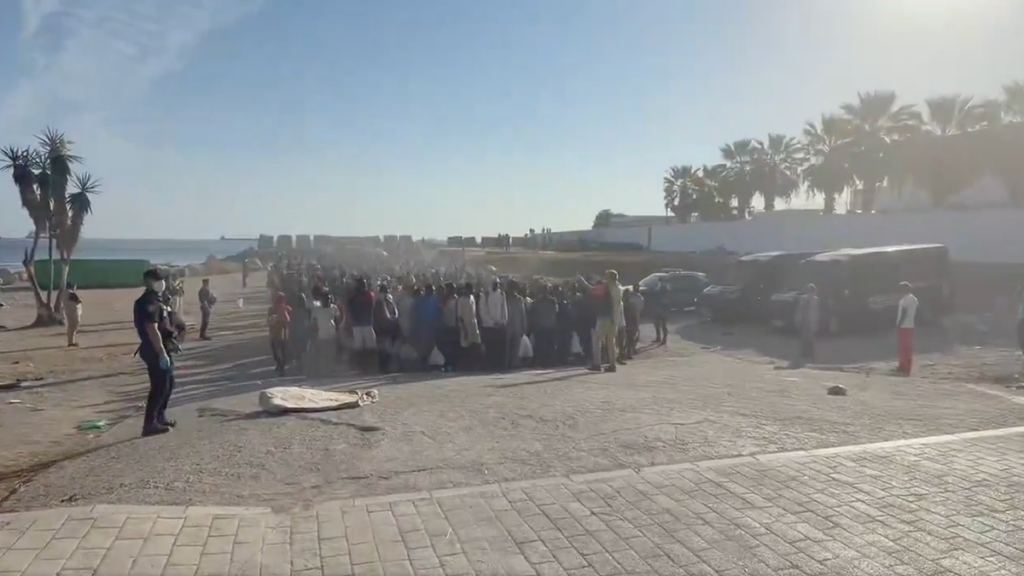
Two further sites are being prepared to provide shelter to over 2,000 more migrants. Credit: @KARIMPRIM / X
Three weeks of tents built from reeds, rope and cardboard are gone from Playa del Trampolín after a Thursday morning police operation left the beach almost empty for the first time since July. More than 1,200 people have been confirmed moved into shelters so far, migrants are being kept apart by nationality to prevent clashes, and none of them are being sent home yet.
Migrants split by nationality as police cleared the beach in stages
Officers from the Policía Nacional, Guardia Civil and Local Police surrounded Playa del Trampolín shortly after 7am on Thursday August 20, forming a perimeter with around 30 police vans before the transfer began.
🚨🚨 Trasladan a parte de los inmigrantes que ocupaban la playa del Trampolín en #Ceuta al embolsamiento de Loma Colmenar , cerca de la barriada príncipe
Alfonso y frontera del Tarajal #Inmigracion #Traslado #Desalojo pic.twitter.com/Sd7P8d3pgy— KARIM PRIM (@KARIMPRIM) August 20, 2026
Translators worked alongside officers throughout, moving people out in groups of roughly 30 at a time on foot under police escort. Migrants were also divided by nationality between the reception sites, a deliberate move officials said was meant to prevent the kind of clashes reported between different groups over the past two weeks.
By late morning, Spain’s Migration Ministry said the beach was empty for the first time since the settlement formed.
Thousands of people ended up sleeping on the beach after the irregular crossings
The camp grew out of the wave of irregular crossings that began on Thursday July 30, when tens of thousands of people entered Ceuta by sea after a Supreme Court ruling on July 8 stopped fast-track rejection procedures being applied to migrants intercepted while swimming into the territory. That ruling meant new arrivals had to go through Spain’s full immigration process rather than being returned immediately, and Ceuta’s reception centres, built for a fraction of that number, filled within days.
The majority of people returned across the border after a few days once supplies ran low and the hope of finding refuge dwindled, however, the few thousand that stayed with nowhere else to go built makeshift shelters on Playa del Trampolín. Conditions then deteriorated badly: the settlement had just two toilets and two showers between thousands of residents, and a scabies outbreak spread among Spanish troops housed nearby while the Red Cross distributed an estimated 4,000 meals a day.
Confirmed transfers still lag the numbers who were living on the beach
Ceuta’s Government Delegation confirmed more than 1,200 people had been moved into two temporary sites, Loma Margarita and El Embolsamiento, by late Thursday morning. Combined capacity at those two sites is about 1,800, short of the 3,500 to 5,000 people police estimated had been living across the beach and the neighbouring Loma Colmenar settlement.
Two further sites, including a former equestrian centre, are being prepared, and officials say total capacity across all four will eventually exceed 5,000 places. Separately, the government said 500 unaccompanied children would be transferred to reception centres on the Spanish mainland.
The charities Engloba and ACCEM are providing support at the new sites alongside the Red Cross. Spain’s inclusion minister said the operation was designed “to guarantee proper humanitarian care, protect people’s fundamental rights and preserve their dignity, while we help Ceuta get back to normality as soon as possible.”
No deportations, and a 30-day ultimatum still hanging over Madrid
Migrants moved off the beach were reportedly told they would not be deported to Morocco, consistent with the legal reality since the July 8 ruling: fast-track return is not available to most of those who arrived by sea, and each case now requires individual processing.
That leaves the political pressure on Madrid largely unchanged. Around 10,000 migrants are now estimated to remain in Ceuta, up from the more than 8,000 in place when the city’s president, Juan Jesús Vivas, gave the central government a 30-day deadline last week to speed up returns, warning he would take the crisis to Spain’s Supreme Court and Constitutional Court if nothing improved.
The far-right party VOX had separately been pressing Ceuta’s government for days to invoke the city’s beach-use bylaw, which bans tent camping on any beach year-round, to force the camp’s removal on public-health grounds rather than through immigration law.
The sand may now be empty, but with no deportations and Vivas’s deadline still running, Ceuta’s migration crisis has simply moved indoors.
Follow Euro Weekly News on Google News
Get breaking news from Spain, travel updates, and expat stories directly on your Google News feed.
Follow on Google NewsSign up for personalised news
Subscribe to our Euro Weekly News alerts to get the latest stories into your inbox!
By signing up, you will create a Euro Weekly News account if you don't already have one. Review our Privacy Policy for more information about our privacy practices.




Harry Dennis
Born in the UK and raised on the Cádiz coast, Harry brings his background in design, music, and photography to his writing for Euro Weekly News, sharing stories that celebrate culture and lifestyle across Spain and beyond.
Comments