Watch as hundreds swim into Spain and Ceuta calls for national emergency
By Harry Dennis • Published: 30 Jul 2026 • 15:17 • 3 minutes read
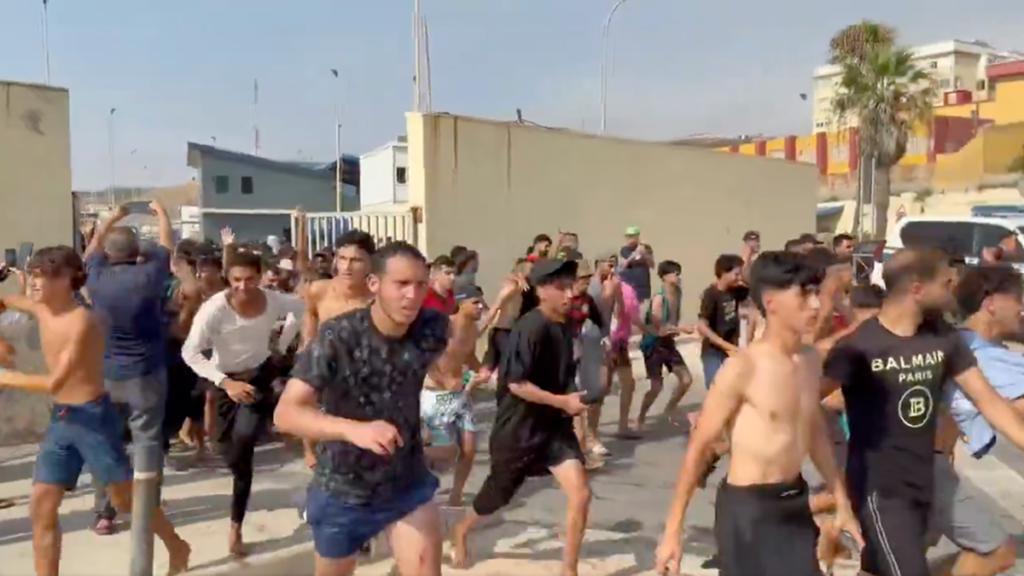
Migrants run from Guardia Civil facilities at El Tarajal in Ceuta after arriving from Morocco by sea on July 30. Credit: Jupol Nacional / X
People have been reaching Ceuta’s beaches with flippers, wetsuits and inflatable rings, while others are already queuing outside full reception centres. The crossings have now triggered a direct demand for Madrid to assume control of the situation.
Hundreds reach Ceuta as reception centres run out of room
Hundreds of people reached Ceuta by swimming around the border breakwater from Morocco during the early hours of Thursday, July 30, adding to an exceptional rise in crossings over recent days. Most of those arriving have been young Moroccan men, although women and Algerian nationals have also been among the swimmers. Spain’s Guardia Civil, Maritime Rescue Service and Red Cross have been using boats to bring people safely ashore.
La situación en Ceuta está completamente descontrolada.
Desde JUPOL, sindicato mayoritario de la Policía Nacional, llevamos días alertando y denunciando la grave crisis que se estaba gestando en la ciudad autónoma. Hoy, lamentablemente, se confirma lo que… pic.twitter.com/1AZAvbuRiO
— JUPOL (@JupolNacional) July 30, 2026
Ceuta president Juan Jesús Vivas said approximately 1,500 people had entered the autonomous city by sea during the previous week, equivalent to almost 2 per cent of its population. He described the city’s reception centres as “collapsed and saturated”. Figures supplied by Ceuta’s presidency indicate that around 700 of the recent arrivals are minors. More than 1,000 people were also reported to be waiting outside the Centre for the Temporary Stay of Immigrants, known by its Spanish initials CETI, which normally has space for just over 500.
The crossings have also proved deadly. The bodies of two men were recovered on Wednesday while they were attempting to reach Ceuta, taking the Guardia Civil’s reported count to 29 deaths off the city’s coast during 2026 at that point.
Ceuta wants Madrid to assume a single command
Vivas has asked Spain’s central government to treat the situation as a “national emergency” and establish a single command capable of directing the different authorities involved. The Ceuta government said its reception resources were overwhelmed and that the proposed command should have the authority to coordinate border security, adult accommodation, the care of minors and the work of humanitarian organisations.
Those responsibilities are currently divided. The Spanish state manages the adult reception system and national border forces, while Ceuta is responsible for unaccompanied children arriving in the city. Vivas is now seeking temporary accommodation for adults, financial support for the care of minors, additional police resources and closer cooperation with Morocco.
The Interior Ministry responded that migration flows are not covered as a qualifying risk under the civil-protection rules used to declare an emergency of national interest. Under Spain’s 2015 National Civil Protection System Law, such a declaration would place the Interior Minister in charge of coordinating state, regional and local resources. Madrid’s position therefore means Vivas’s call remains a request for help, rather than an emergency status already in force.
How a Supreme Court ruling changed the sea-border procedure
Ceuta’s government has linked the pressure partly to a Supreme Court judgment issued on July 8. It confirmed that the special fast-track rejection procedure used at the Ceuta and Melilla borders cannot be applied to people intercepted while attempting to enter by swimming. Judges found that the procedure only applies when someone crosses physical border-containment structures, such as the fences. Those reaching Spain by sea must instead be dealt with through the normal immigration process, including the relevant procedural and protection rights.
The ruling does not prevent removal through the ordinary legal system, but it stops immediate summary returns from being used in these swimming cases. Vivas called the judgment a “change of scenario” and wants Spain’s immigration law amended. The reason behind the sudden rise in crossings hasn’t officially been established or related to the new ruling. Good summer weather often increases attempts, while rights campaigners cited by the Associated Press questioned whether most swimmers would have known about the court ruling.
What will happen after Marlaska’s visit
Interior Minister Fernando Grande-Marlaska has acknowledged that Ceuta is facing an “extraordinary” and “exceptional” situation, although he initially said the authorities were responding with the resources already permanently deployed there. He is now expected to travel urgently to Ceuta after speaking with Vivas. Grande-Marlaska has also maintained that Morocco is cooperating to restrict irregular departures, despite Ceuta’s request for that cooperation to be intensified.
The visit will serve as an indicator as to how quickly Madrid can expand emergency accommodation, reinforce personnel and help relieve the large queues outside the city’s reception facilities.
Follow Euro Weekly News on Google News
Get breaking news from Spain, travel updates, and expat stories directly on your Google News feed.
Follow on Google NewsSign up for personalised news
Subscribe to our Euro Weekly News alerts to get the latest stories into your inbox!
By signing up, you will create a Euro Weekly News account if you don't already have one. Review our Privacy Policy for more information about our privacy practices.




Harry Dennis
Born in the UK and raised on the Cádiz coast, Harry brings his background in design, music, and photography to his writing for Euro Weekly News, sharing stories that celebrate culture and lifestyle across Spain and beyond.
Comments