Morocco revives Ceuta and Melilla claim in front of King Mohammed VI
By Molly Grace • Published: 25 Aug 2026 • 22:42 • 2 minutes read
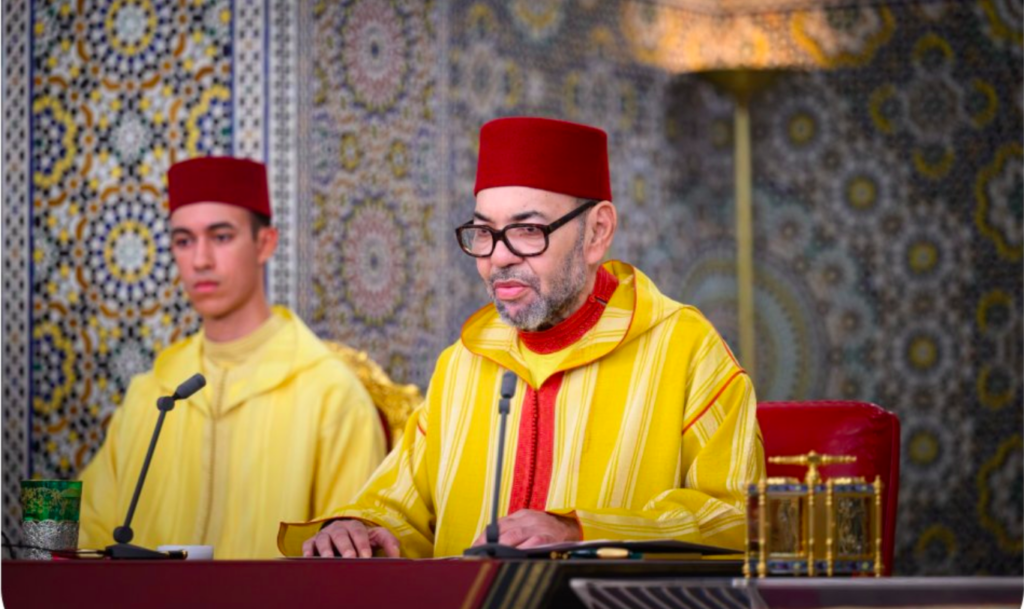
Toufiq made the comments during celebrations marking Eid al Mawlid. Photo credit:@Portailmaroc_ma on X
If Ceuta and Melilla weren’t already at the centre of political tension these past few weeks, new remarks made before Morocco’s king and crown prince are likely to deepen questions about where relations between Madrid and Rabat go next. At a major religious ceremony in the Royal Palace in Rabat, Morocco’s Minister of Islamic Affairs, Ahmed Toufiq, used historical and religious references linked to Ceuta while speaking in the presence of King Mohammed VI, Crown Prince Moulay Hassan, Prime Minister Aziz Akhannouch and senior state officials.
His comments have been widely interpreted as reviving Morocco’s long-standing claims over the two Spanish cities. The timing is significant. The remarks come less than a month after the mass entry into Ceuta at the end of July and only days after Morocco’s Justice Minister, Abdellatif Ouahbi, referred to Morocco’s “historical and geographical rights” over Ceuta and Melilla.
Claims raised before Morocco’s highest authorities
Toufiq made the comments during celebrations marking Eid al Mawlid, the commemoration of the birth of the Prophet Mohammed, one of the most important events in the Islamic calendar. During his speech, he referred to two Islamic scholars born in Ceuta before the city came under Spanish sovereignty in 1580. He also spoke about religious works that, according to Moroccan tradition, became symbols of the struggle to liberate “occupied cities” on Morocco’s Atlantic coast. Spanish media and analysts interpreted the references as an indirect claim over Ceuta and Melilla.
The setting gives the remarks added weight, This was not an interview or an isolated political comment. The speech was delivered in front of Morocco’s monarch, heir to the throne and senior political and military figures during one of the country’s most important religious ceremonies. That has prompted fresh debate in Spain over whether Morocco is increasing pressure over Ceuta and Melilla through historical, religious and political messaging.
Why it matters to Ceuta and Melilla
For residents of Ceuta and Melilla, sovereignty is not an abstract diplomatic issue. The two cities sit on Europe’s southern border and play a key role in migration, trade and security between Spain, Morocco and the European Union. The issue has become even more sensitive since the mass crossing into Ceuta at the end of July, when more than 70,000 people entered the city in an unprecedented movement that overwhelmed local services and triggered a political crisis in Spain.
Against that backdrop, statements touching on sovereignty are likely to attract much greater attention than they might have done only a few months ago. Morocco has maintained its claim to Ceuta and Melilla since independence in 1956, while Spain insists that both cities are an integral part of Spanish territory and therefore part of the European Union. The Spanish Government has already rejected recent Moroccan claims “categorically” through diplomatic channels.
A new phase in the debate?
What makes the latest comments notable is that they come from two Moroccan ministers within days of each other and at a time when relations between Madrid and Rabat are already under intense scrutiny. Justice Minister Ouahbi spoke openly about Morocco’s claims last week. Toufiq’s remarks were more indirect, relying on religious symbolism and historical references rather than direct political demands.
Whether this represents a coordinated shift in Moroccan messaging it remains unclear. What is clear however is that, after weeks dominated by migration and border security, Ceuta and Melilla are once again at the centre of a debate about sovereignty, identity and the future of relations between Spain and Morocco.
Follow Euro Weekly News on Google News
Get breaking news from Spain, travel updates, and expat stories directly on your Google News feed.
Follow on Google NewsSign up for personalised news
Subscribe to our Euro Weekly News alerts to get the latest stories into your inbox!
By signing up, you will create a Euro Weekly News account if you don't already have one. Review our Privacy Policy for more information about our privacy practices.



Molly Grace
Molly is a British journalist and author who has lived in Spain for over 25 years. With a background in animal welfare, equestrian science, and veterinary nursing, she brings curiosity, humour, and a sharp investigative eye to her work. At Euro Weekly News, Molly explores the intersections of nature, culture, and community - drawing on her deep local knowledge and passion for stories that reflect life in Spain from the ground up.
Comments
cati
25 August 2026 • 22:57“If Ceuta and Melilla weren’t already at the centre of political tension these past few weeks, new remarks made before Morocco’s king and crown prince are likely to deepen questions about where relations between Madrid and Rabat go next.” Don’t be daft, they already said the quiet part outloud, as to why they would stop their citizens entering their own territory.
The invasion wasn’t just spurred by influensers, it was encouraged by the state.
On one hand, if you don’t hold territory in AFRICA, and call it part of the EU / Spain, you won’t be under the LEGAL obligation to house “refugees” into that territory. On the other hand, if you insist that British sovreign territory belongs to Spain, you are being “Hoist by your own petard” and making Europe more vulnerable because of your own “Bloody-minded hypocrisy”.