Africa’s richest monarch celebrates 27 years as Madrid-Rabat ties under new border pressure
By Adam Woodward • Published: 02 Aug 2026 • 16:54 • 3 minutes read
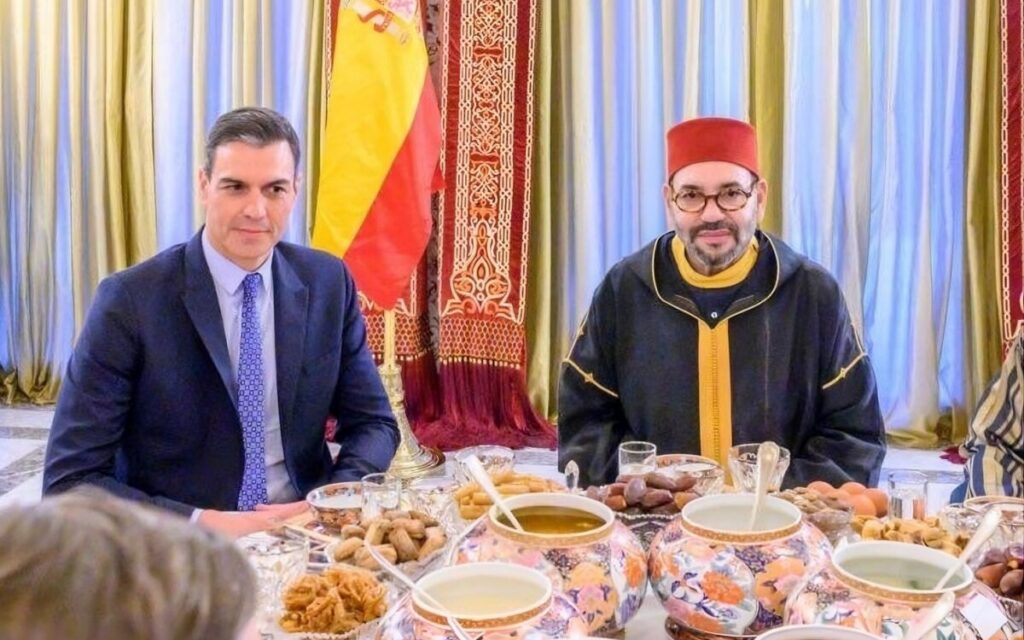
Pedro Sánchez and King Mohammed VI. Credit: maroc.ma/ar
King Mohammed VI has completed 27 years ruling Morocco, confirming his place as Africa’s richest monarch while the kingdom’s industrial expansion continues to draw praise from world leaders. Yet the same week thousands of young Moroccans entered Spain’s North African enclave, exposing social gaps that still drive people abroad and testing the future of the Madrid-Rabat partnership.
Congratulatory messages arrived for the royal anniversary celebrations held at the palace in Tetouan. Britain’s King Charles III, Dutch King Willem-Alexander, Belgian King Philippe, Swedish King Carl XVI Gustaf and Jordan’s King Abdullah II all sent good wishes. Oman’s Sultan Haitham bin Tarik, Bahrain’s King Hamad bin Isa Al Khalifa, Saudi Crown Prince Mohammed bin Salman, Chinese President Xi Jinping, Russian President Vladimir Putin, Egyptian President Abdel Fattah El-Sissi and Senegal’s Bassirou Diomaye Faye also paid tribute. Estimates put Mohammed VI’s personal fortune near $5.7 billion, largely through the royal family’s Al Mada holdings.
From quiet economy to industrial strength
When Mohammed VI took power in 1999 after King Hassan II, Morocco relied heavily on farming, tourism, phosphates and money sent home by workers abroad. Factories stayed limited and many rural families struggled. Heavy investment since then has altered the picture. Ports, roads, high-speed trains, solar and wind projects plus industrial zones have taken shape. Tangier Med now ranks among Africa’s top ports, giving the country a clear logistics gateway to Europe and beyond.
Car and aircraft makers have set up plants and supply chains, drawn by trade deals and closeness to European markets. Per-person income has nearly doubled since the late 1990s. Growth reached about 4.8 per cent in 2025, and forecasts point to 4.4 per cent this year, helped by farming recovery and building work. Foreign investment almost doubled to roughly $3.34 billion last year, with electric vehicles, batteries and clean energy projects leading the way. Defence ties have grown too, including a ten-year roadmap with the United States running to 2036 and deals covering missiles, Apache helicopters and possible F-35 jets.
King Mohammed VI of Morocco has named the 1,055-km Tiznit–Dakhla road the President Donald J. Trump Highway. pic.twitter.com/2juYzJwmvV
— Globe Eye News (@GlobeEyeNews) July 27, 2026
Social gaps and the border pressure
Benefits have not reached everyone. Youth joblessness remains high and inequality still bites. Protests led by young people flared in September 2025 over work, hospitals and schools. Some turned messy before officials promised talks and extra funding. Euro Weekly News has already reported the full details of the late-July events at the Spanish North African enclave, when an estimated 50,000 to 60,000 people crossed by land and sea. At least 67 died. Most went back within a day or two once Spanish forces regained control.
Spanish officials pointed to people-smuggling gangs and social-media claims that the border stood open after a court ruling. Questions remain over how freely Moroccan forces acted in the early hours. EU figures show around 275,000 cases of Moroccan citizens found irregularly across the bloc between 2021 and 2025. The episode left Madrid under pressure from other European capitals and reminded both sides how population movements can still dominate the relationship.
Looking ahead for Madrid and Rabat future
Trade between the two countries now runs well over €20 billion a year, making Spain Morocco’s top commercial partner. Cars, wiring, clothes, fruit, vegetables and energy move both ways. Plans for a rail tunnel under the Strait of Gibraltar keep moving forward, with studies confirming it is technically possible. Realistic opening dates sit between 2035 and 2040. Spanish funding for technical work has continued even after the recent border pressure.
Madrid has chosen careful language, calling Morocco a reliable partner on border management while reinforcing the enclave’s sea barrier. Future ties will rest on balancing strong business links and long-term tunnel vision against repeated population movements and youth frustration at home. Mohammed VI’s next years in power will show whether industrial gains can finally create enough jobs to keep more young Moroccans from risking the journey north.
The next few days of diplomatic tussle will only tell what happens to the relationship.
Follow Euro Weekly News on Google News
Get breaking news from Spain, travel updates, and expat stories directly on your Google News feed.
Follow on Google NewsSign up for personalised news
Subscribe to our Euro Weekly News alerts to get the latest stories into your inbox!
By signing up, you will create a Euro Weekly News account if you don't already have one. Review our Privacy Policy for more information about our privacy practices.

Adam Woodward
Adam is a writer who has lived in Spain for over 25 years. With a background in English teaching and a passion for music, food, and the arts, he brings a rich personal perspective to his work at Euro Weekly News. As a father of three with deep roots in Spanish life, Adam writes engaging stories that explore culture, lifestyle, and the everyday experiences that shape communities across Spain.
Comments