Morocco stops hundreds of migrants near Ceuta border and orders Spanish journalists out
By Adam Woodward • Published: 15 Aug 2026 • 21:11 • 4 minutes read
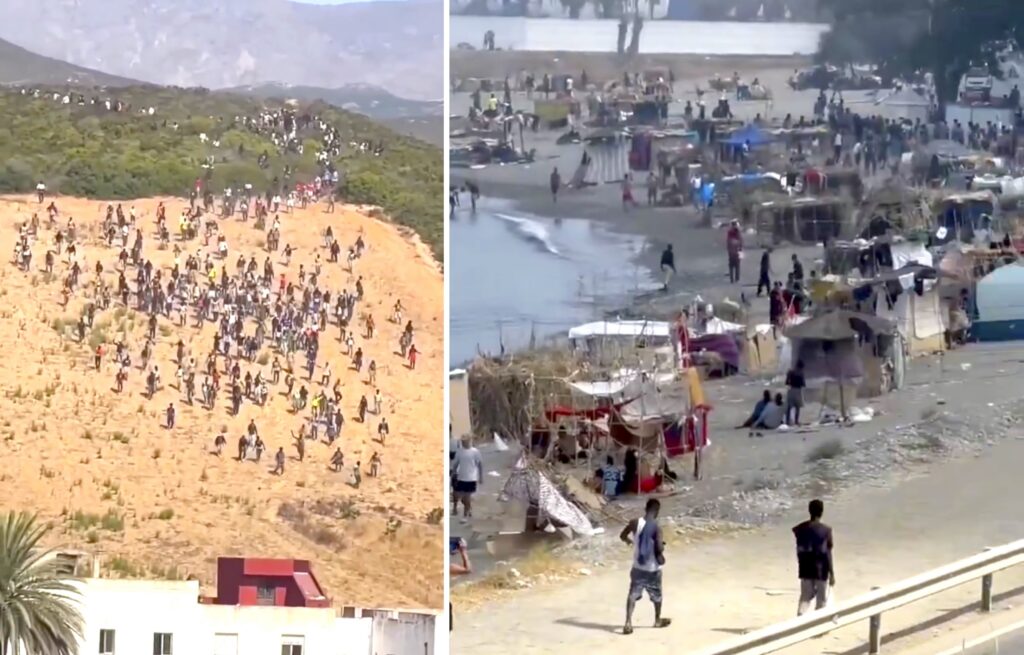
Hoards of people run towards border fence August 15, 2026. Credit: Viral X videos
Spanish and Moroccan security forces kept a tight grip on the frontiers around Ceuta and Melilla this Saturday, August 15, after social media calls urged another mass attempt to cross into the Spanish enclaves. Calm held on the Spanish side while Moroccan police broke up a large group of would-be crossers outside Castillejos, detaining nearly 300 people, most of them reportedly of sub-Saharan African origin.
Heavy police presence on both sides of the border prevented any repeat of the late-July chaos when tens of thousands entered Ceuta in a matter of hours. Guardia Civil, Policía Nacional units stayed on high readiness in Ceuta. Similar reinforcements, around 150 officers plus a patrol boat, helicopter and specialist teams, operated in Melilla.
Government officials there described the day as normal and free of incidents. A floating barrier and extra fencing on the Melilla breakwater added extra layers of control following a Supreme Court ruling that limited certain push-backs by sea.
La situación en Ceuta va cada cada vez peor, más de 10.000 invasores ya están creando campamentos en la playa, la situación de insalubridad es total, la playa está llena de mierda literalmente, la basura se acumula, cada vez aparecen más chabolas, ya van más de 8 violaciones a… pic.twitter.com/k8JtYuBiQH
— Javier Negre (@javiernegre10) August 14, 2026
Moroccan forces break up mountain gathering near Castillejos
Moroccan security sources said hundreds of migrants, largely sub-Saharan, had hidden in the hills southwest of Ceuta near Castillejos. Agents used tear gas and a helicopter to scatter the group before making the arrests for encouraging illegal migration. Road checks remained in place on the main routes from Tetuan and Tangier. The urban centre of Castillejos itself stayed quiet under a large police presence.
Ceuta under Islamist attack from two sides. pic.twitter.com/AhwORyrRMC
— RadioGenoa (@RadioGenoa) August 15, 2026
This came two weeks after the biggest recent influx, when estimates put arrivals into Ceuta somewhere between 50,000 and 80,000 people, many swimming or walking around coastal barriers. Most returned within days, yet several thousand, mainly sub-Saharan men and some minors, were still in the city. Officials counted at least 90 deaths across both sides of the border during that earlier rush, the majority by drowning.
Spanish reporters told to leave Castillejos at once
A local representative of Morocco’s Interior Ministry, identified as Youssef Hajji, ordered journalists from the most respected Spanish news agencies, EFE and TVE, to leave Castillejos while they were covering the police operation against the migrants. He gave no reason beyond saying he was following instructions and warned that press credentials and equipment could be seized if they stayed. Hotels later told the teams the same message from local authorities.
La policía marroquí abre fuego contra los asaltantes de Ceuta mientras la Guardia Civil mira. pic.twitter.com/XynvCEhsaQ
— Muy.Mona/🇪🇸💚 (@Capitana_espana) August 15, 2026
Why keep the cameras away right now?
Questions quickly arose about Morocco’s decision to push Spanish media out of the area. Controlling the images and narrative around these events matters for Rabat. Past episodes have shown how migration flows at Ceuta and Melilla can become a pressure point in relations with Spain. In May 2021, after Spain allowed Polisario Front leader Brahim Ghali medical treatment, Moroccan forces eased controls, and roughly 8,000 to 10,000 people crossed into Ceuta, many of them Moroccan, including minors. Controls tightened again once diplomatic talks advanced.
Analysts have long described the ability to open or close the tap on migrant movements as a recurring tool linked to wider disputes, including Western Sahara.
Morocco routinely cooperates with Spain and the EU on returns and interdictions, and has used force against attempts, as seen in the deadly 2022 Melilla events. Yet selective non-enforcement has appeared during periods of tension. Illegal emigration itself carries serious penalties under Moroccan law, which helps explain why many who reach Ceuta fear being sent back.
Unconfirmed reports have circulated of Moroccan police opening fire during some past crossing attempts, adding to the climate of risk for those involved.
Spanish side stays locked down
Miguel Angel Perez Triano, the government delegate in Ceuta, spent the early hours checking the Tarajal crossing in person. Extra barriers on the Spanish side, including the floating one at Melilla, reflect lessons from July. Social media calls for another August 15 push had circulated widely, so both capitals prepared in advance. EU migration experts were already on the ground in Ceuta assessing needs after the earlier crisis.
Residents in both enclaves continue to feel the strain and have been crying out for more security from central government. Ceuta’s reception centres remain under pressure from remaining arrivals and unaccompanied minors. Local leaders have called for more mainland support while insisting the situation is under control for now.
Looking back at the pattern
Migration pressure at these two Spanish cities on the North African coast has flared repeatedly for two decades. Scale varies, yet the geography stays constant: short sea or land distances, economic gaps, and political undercurrents. Morocco does not recognise Spanish sovereignty over Ceuta or Melilla and has used the frontier as leverage before. Spain maintains both are integral parts of its territory and the only land borders between the EU and Africa.
For the moment the fences held, and the planned mass attempt failed. Whether the calm lasts depends on continued coordination between Madrid and Rabat, plus the ability of authorities on both sides to keep social media-driven crowds from gathering again. Spanish media exclusion from Castillejos leaves fewer independent eyes on the Moroccan side of the story just when tensions are still high.
Follow Euro Weekly News on Google News
Get breaking news from Spain, travel updates, and expat stories directly on your Google News feed.
Follow on Google NewsSign up for personalised news
Subscribe to our Euro Weekly News alerts to get the latest stories into your inbox!
By signing up, you will create a Euro Weekly News account if you don't already have one. Review our Privacy Policy for more information about our privacy practices.



Adam Woodward
Adam is a writer who has lived in Spain for over 25 years. With a background in English teaching and a passion for music, food, and the arts, he brings a rich personal perspective to his work at Euro Weekly News. As a father of three with deep roots in Spanish life, Adam writes engaging stories that explore culture, lifestyle, and the everyday experiences that shape communities across Spain.
Comments