Who’s lying? Government ministers turn on each other over what was known about Ceuta
By Molly Grace • Published: 25 Aug 2026 • 16:55 • 3 minutes read
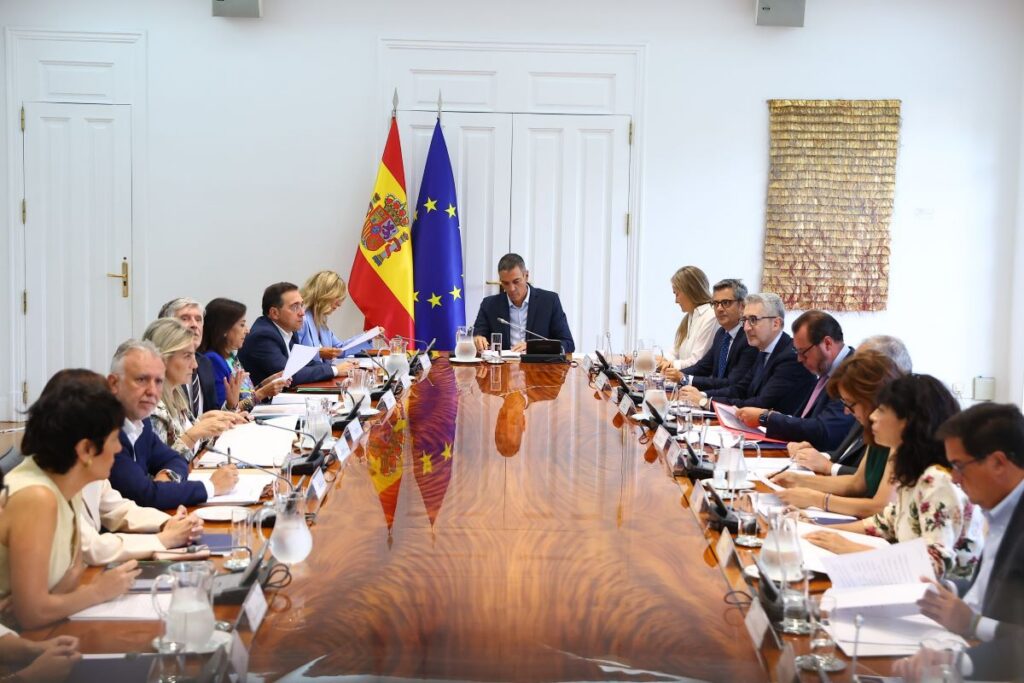
Comments suggest that intelligence information existed concerning plans or calls for people to move towards the border. Photo credit:Pool Moncloa/Fernando Calvo.
When more than 70,000 people crossed into Ceuta during the mass entry at the end of the month, overwhelming the city, more than one was left asking a simple question: Did the Spanish Government know about it? That question has now turned into a political dispute after Defence Minister Margarita Robles and Interior Minister Fernando Grande-Marlaska gave sharply different accounts of what Spain’s intelligence services knew beforehand.
The disagreement centres on the CNI, Spain’s National Intelligence Centre, and whether information warning of a potential mass crossing reached the authorities before the unprecedented influx. The stakes are high because the answer could determine whether the crisis was an unforeseeable event or whether information existed that might have allowed Spanish authorities to prepare more effectively.
Robles says the information was shared
Appearing before the Defence Committee in Congress today August 25, Robles defended the work of the CNI and the other intelligence services operating in Ceuta. She said the intelligence services had carried out the work that was expected of them and that information had been shared and analysed with Spain’s State Security Forces and the Government Delegation.
Robles also confirmed that the CNI had communicated information to the Government before the mass entry. She said the information had been communicated verbally to the Government one day before the mass crossing and concerned a call for migrants to gather and take advantage of the Moroccan festivities to attempt to cross into Ceuta.
Her earlier description of the CNI’s role was equally significant. Robles said the service had performed the work that was required of it within its responsibilities. That appears to place responsibility for what happened elsewhere in the chain of decision-making rather than with the intelligence service itself. But Marlaska has now given a very different account.
Marlaska rejects the warning claim
Speaking after the Cabinet meeting, the Interior Minister insisted that there was no intelligence report anticipating the scale of what happened. His wording was unequivocal: “There was no report indicating that what ultimately happened on July 30 was going to happen,” Marlaska said.
He defended Spain’s intelligence services as “excellent” and said they had acted correctly. Marlaska’s position is not simply that the CNI failed to predict the exact number of people who would arrive. He is rejecting the existence of an intelligence report that foresaw an event comparable to the mass crossing that eventually took place.
That directly conflicts with Robles’ account that information had been shared with the relevant authorities beforehand. Marlaska has insisted that no intelligence report anticipated the mass entry, while Robles says information about the planned mobilisation was communicated before it happened.
What did the CNI actually know?
That is now the central question. The distinction between having information about a possible gathering and having a formal intelligence report predicting a mass border crossing may prove crucial. Robles’ comments suggest that intelligence information existed concerning plans or calls for people to move towards the border and that this information reached authorities before the event. Marlaska, meanwhile, says there was no report that anticipated what ultimately happened.
Both positions can only be fully reconciled if the information passed to officials was considered too general, uncertain or insufficient to predict the extraordinary scale of the crossing. But that leaves another question: if officials knew there was a potential mobilisation around the border, what action followed? The answer matters particularly in Ceuta, where the border with Morocco is a highly sensitive security point and where a sudden influx on the scale seen in July can rapidly overwhelm local resources.
The crisis exposed a major vulnerability
The mass entry of July 30 was by no means a minor border incident. The scale has already prompted the Spanish Government to introduce additional measures, including a new central command structure for Ceuta and proposals to change immigration and asylum procedures. But those measures do not answer the question now hanging over the Government: was the warning there before the border was overwhelmed?
Robles’ statements suggest that information did reach officials. Marlaska says there was no report predicting what happened. Until the Government explains precisely what information the CNI received, who received it, when it was passed on and what decisions followed, the contradiction between the two ministers is likely to remain at the heart of the political fallout from the Ceuta crisis.
Follow Euro Weekly News on Google News
Get breaking news from Spain, travel updates, and expat stories directly on your Google News feed.
Follow on Google NewsSign up for personalised news
Subscribe to our Euro Weekly News alerts to get the latest stories into your inbox!
By signing up, you will create a Euro Weekly News account if you don't already have one. Review our Privacy Policy for more information about our privacy practices.



Molly Grace
Molly is a British journalist and author who has lived in Spain for over 25 years. With a background in animal welfare, equestrian science, and veterinary nursing, she brings curiosity, humour, and a sharp investigative eye to her work. At Euro Weekly News, Molly explores the intersections of nature, culture, and community - drawing on her deep local knowledge and passion for stories that reflect life in Spain from the ground up.
Comments