Do you have it in orange? This rare shark discovery has scientists fascinated
By Molly Grace • Published: 10 Sep 2026 • 17:41 • 2 minutes read
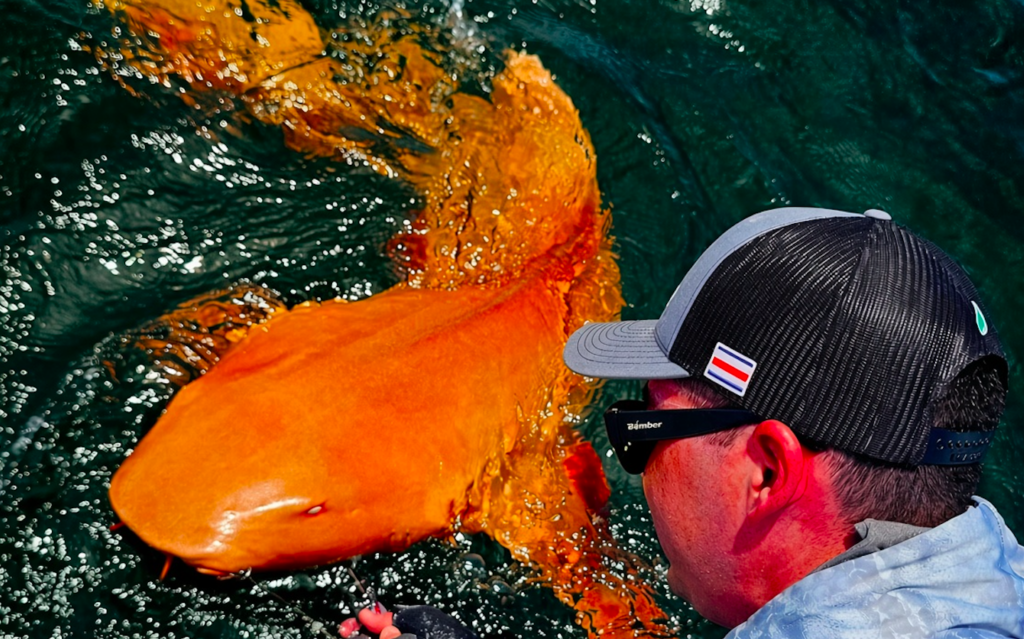
No, its not AI, the shark was discovered in Costa Rican waters. Photo credit: Parismina Domus Dei on Facebook
Imagine being the person who discovers something unique, something that has never been seen by humans before. One moment you are out fishing; the next, you are looking at an animal that could change the scientific record. That is exactly what happened off Costa Rica, where a sport fisherman encountered a bright tangerine-coloured nurse shark with startlingly pale eyes.
Instead of discovering a new shark species, however, researchers found something arguably more intriguing: an extremely unusual combination of pigmentation conditions that has never previously been documented in a nurse shark, and no, before you say it, its not AI, the shark is very much the real deal.
A shark unlike any other
The extraordinary encounter happened during a fishing trip near Tortuguero National Park on Costa Rica’s Caribbean coast. The shark was caught at around 37 metres below the surface and measured roughly two metres long.
Rather than keeping the unusual animal, the fishermen photographed it and released it back into the sea. Those photographs later gave scientists the chance to examine an animal that would otherwise have been almost impossible to study. The shark was identified as a nurse shark (Ginglymostoma cirratum), a species normally found with grey-brown or yellow-brown colouring.
This one was dramatically different.
Its body was an intense yellow-orange, while its eyes appeared almost completely white. Scientists believe the unusual appearance is linked to xanthism, a rare pigmentation condition associated with an excess of yellow colouring, combined with signs of albinism, which affects the production of darker pigment. The combination is what makes this particular shark so remarkable.
How did it become orange?
Colour is not simply decoration in the animal world, for many species, it can mean the difference between eating and being eaten. Nurse sharks spend much of their time close to the seabed, where their normal colouring can help them blend into their surroundings. They are generally slow-moving and feed on animals including fish and invertebrates.
So an adult shark carrying such a bright striking colour raises an obvious question: how did it survive long enough to reach adulthood? The Costa Rican shark was around 6.5 feet long when photographed, suggesting that its unusual colouring had not prevented it from successfully navigating life in the Caribbean.
Scientists still do not know exactly what caused the unusual pigmentation. The conditions are generally associated with genetic factors, although researchers have noted that other influences may also deserve investigation. There was no genetic testing of the shark itself, so the precise mechanism behind its appearance remains unknown.
A first for nurse sharks
The discovery is significant because the scientific report, published in Marine Biodiversity in 2025, describes it as the first documented case of xanthism in a nurse shark. It is also the first reported case of xanthism in a cartilaginous fish in the Caribbean, a group that includes sharks, rays and skates. That does not necessarily mean an orange shark has never existed before, but this is the first documented case of one, it means scientists now have a evidence that they can use, examine and compare with future discoveries.
And that may be one of the most fascinating things about the encounter, the ocean is full of animals whose biology remains poorly understood, particularly when unusual individuals are rarely seen. One brightly coloured shark, photographed for a few moments before being returned to the water, has given researchers another small glimpse into just how much variation can exist within a familiar species. For now, the orange nurse shark is back somewhere beneath the Caribbean waves, and nobody knows whether another one just like it is quietly swimming nearby.
Follow Euro Weekly News on Google News
Get breaking news from Spain, travel updates, and expat stories directly on your Google News feed.
Follow on Google NewsSign up for personalised news
Subscribe to our Euro Weekly News alerts to get the latest stories into your inbox!
By signing up, you will create a Euro Weekly News account if you don't already have one. Review our Privacy Policy for more information about our privacy practices.





Molly Grace
Molly is a British journalist and author who has lived in Spain for over 25 years. With a background in animal welfare, equestrian science, and veterinary nursing, she brings curiosity, humour, and a sharp investigative eye to her work. At Euro Weekly News, Molly explores the intersections of nature, culture, and community - drawing on her deep local knowledge and passion for stories that reflect life in Spain from the ground up.
Comments