Spain’s new emergency corridor rule starts October 1. What every driver needs to do
By Tara Russell • Published: 21 Sep 2026 • 23:00 • 2 minutes read
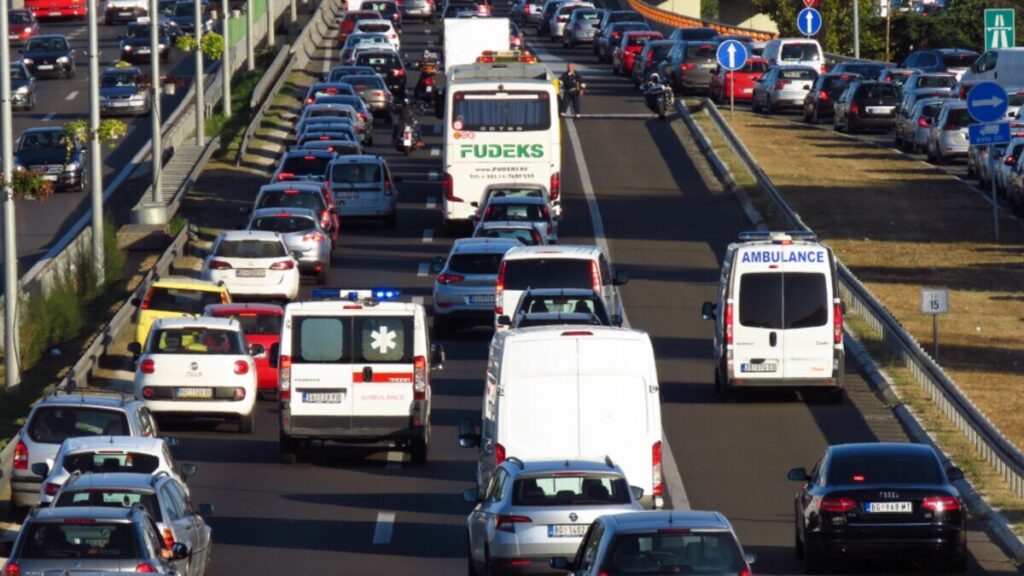
Ambulances face heavy motorway congestion as Spain prepares to require drivers to create an emergency corridor from October 1. Credit: DGT
A traffic jam on a Spanish motorway will soon mean more than slowing down and waiting. From October 1, drivers must create a clear route for ambulances, police, fire crews and other emergency vehicles whenever traffic is moving at walking pace or has stopped.
The new rule applies across Spain’s autopistas and autovías. It is designed to prevent emergency vehicles being trapped behind long queues after collisions, fires or medical incidents.
When do drivers have to form an emergency corridor?
The obligation starts when there is a traffic hold up and vehicles are either crawling at walking pace or stationary.
You do not have to wait until an ambulance is visible in the mirror. Once the queue forms, drivers should position their vehicles to leave the route open. Emergency vehicles can then get through immediately when they arrive.
The measure applies on motorways and dual carriageways, not ordinary single carriageway roads or town streets.
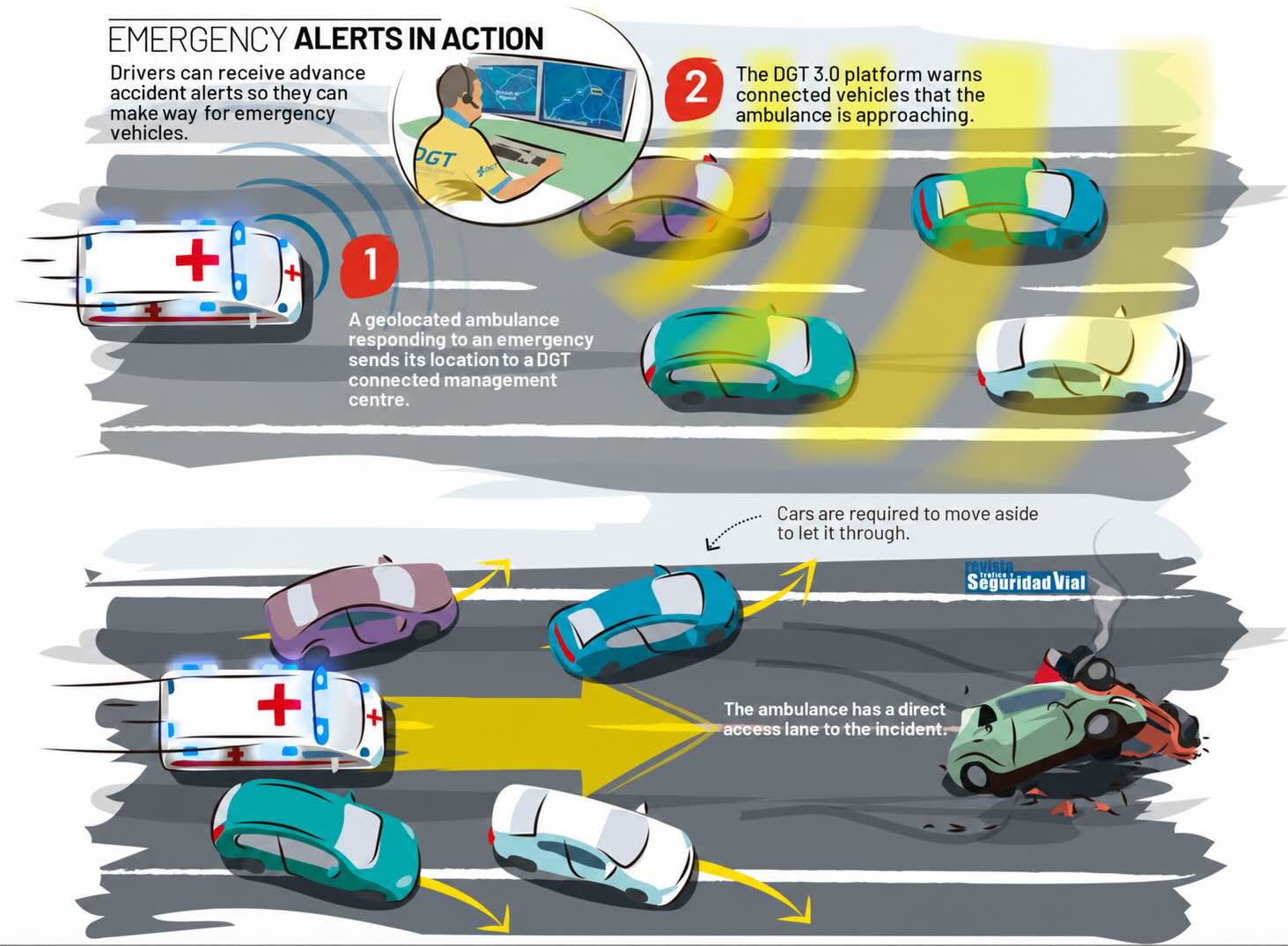
Where does the emergency corridor go on a two lane road?
On a motorway or dual carriageway with two lanes travelling in the same direction, the clear route must be created between the two lanes.
Drivers in the left lane should move as far left as safely possible. Drivers in the right lane should move as far right as safely possible.
The gap in the middle is for emergency services. It is not an extra lane for impatient drivers, motorcyclists or anyone trying to bypass the queue.
What happens when there are three or more lanes?
The rule changes slightly on larger motorways.
The emergency corridor must be formed between the far left lane and the lane immediately beside it. Drivers in the far left lane move as far left as possible, while vehicles in every other lane move as far right as possible.
This leaves a continuous route on the left side of the carriageway for ambulances, police, fire engines and rescue services.
What drivers should not do
Do not drive along the hard shoulder to escape the traffic. Do not follow an ambulance through the gap it has created. Do not block the corridor while trying to change lanes at the last moment.
Drivers should also avoid stopping so close to the vehicle in front that they cannot move aside. Leaving sensible space becomes particularly important in tunnels, on bridges and in heavy holiday traffic, where access for emergency services can be difficult.
Could you be fined?
The new emergency corridor requirement forms part of Spain’s updated General Traffic Regulations. Failing to follow lane use rules can be treated as a serious traffic offence, which normally carries a €200 fine.
The exact penalty will depend on the circumstances and enforcement decision. Where a driver obstructs an emergency vehicle or creates a genuine danger, the consequences may be more serious. Drivers should not rely on the corridor being merely a courtesy. From October 1, it is a legal obligation.
The rule is set out in Royal Decree 518 of 2026, published in the BOE, which updates Spain’s General Traffic Regulations.
For the wider list of traffic changes arriving this autumn, including new rules affecting cyclists, motorcyclists and scooters, read our guide to Spain’s road rule changes from October 1.
Follow Euro Weekly News on Google News
Get breaking news from Spain, travel updates, and expat stories directly on your Google News feed.
Follow on Google NewsSign up for personalised news
Subscribe to our Euro Weekly News alerts to get the latest stories into your inbox!
By signing up, you will create a Euro Weekly News account if you don't already have one. Review our Privacy Policy for more information about our privacy practices.




Tara Russell
Tara is a writer and editorial team member at Euro Weekly News, specialising in news reporting and feature writing. Born and raised in Spain, she holds a B.A. in Applied Languages and Translation Studies. With a strong background in linguistics, communication, and cross-cultural storytelling, Tara previously worked as a language teacher before transitioning to journalism and media.
Comments