WhatsApp scam using guests’ real booking details now targets holiday lets: how to spot it
By Harry Dennis • Published: 09 Nov 2026 • 14:00 • 4 minutes read
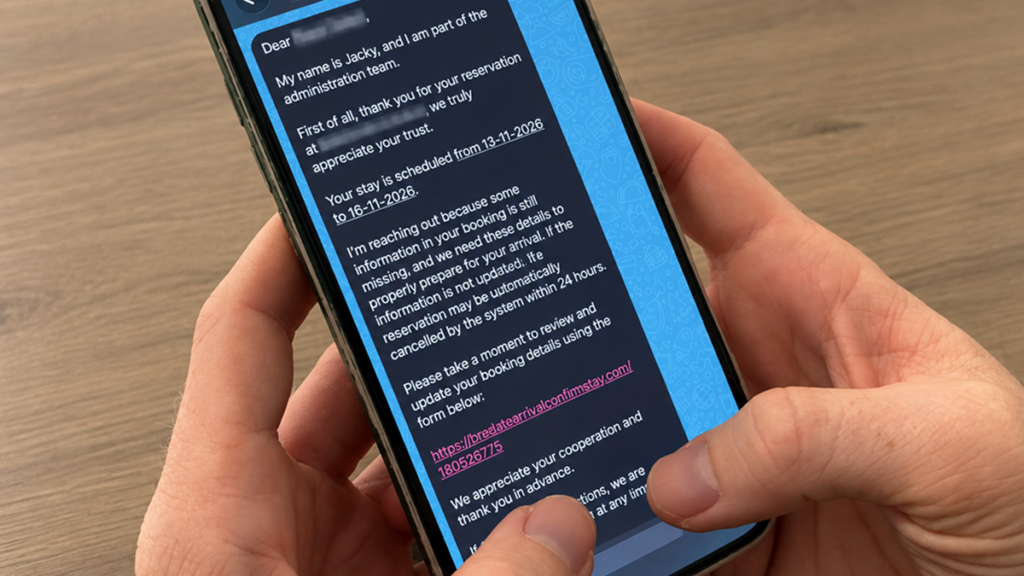
The scam message that reached one holiday let guest. Credit: Euro Weekly News
Holidaymakers with short-term rental bookings are being sent WhatsApp messages that carry their full name, their host’s real company name and their exact dates, along with a warning that the stay will be cancelled within 24 hours. A group of friends travelling with a Euro Weekly News reporter was among those targeted, and the link led straight to a request for card details.
A message that knew the booking inside out
The group had booked an apartment through Airbnb for a three-night city break in mid-November, and had paid for the whole stay up front. Then a WhatsApp message arrived from a UK mobile number. The sender, calling herself ‘Jacky’ from the ‘administration team’, addressed the reporter by his full name, thanked him for his reservation using the host’s correct company name and listed the exact check-in and check-out dates.
She said some information in the booking was ‘still missing’ and that the reservation ‘may be automatically cancelled by the system within 24 hours’ unless a form was filled in through the link provided. The polite, slightly formal tone is exactly how plenty of genuine hosts write.
An ‘outstanding fee’ on a stay that was already paid
The link opened a page asking for personal details and then card details, to settle a fee that was supposedly still owed on the booking.
That’s what gave it away. With the stay already paid in full, there was nothing left to pay, so the group realised the message was a fake. Someone who’d only paid a deposit, or who couldn’t quite remember what they’d paid, could easily have carried on.
The real host then confirmed it was a scam
The genuine warning came through Airbnb’s own messaging system, sent by the host and delivered to the group by email from Airbnb. It said fraudulent messages were ‘currently targeting our guests via WhatsApp and email’, and that they ‘may include your name and reservation dates, making them appear legitimate’. Some had been sent under the name ‘ESI ENERGY, INC.’, the host added.
Crucially, the host told guests not to click the link and said reservations ‘will not be cancelled simply because you ignore these fraudulent messages’. It added that it would ‘never request additional payments through unverified WhatsApp messages or suspicious links’, and named the single web address its genuine check-in links always begin with.
Hotels and rural homes have been hit since spring
The same trick has been aimed at hotel guests in Spain for months, and EWN reported in August on how it was fooling holidaymakers with their own booking details. It’s now reaching smaller holiday lets too.
On Tuesday October 6, the Basque Country’s regional police (the Ertzaintza) said it had logged 98 complaints between April and September from people with bookings at hotels and rural holiday homes, with victims losing more than €57,000. Police said the real booking details had been stolen in cyberattacks on booking platforms, hotels and rural accommodation websites.
Spain’s data protection watchdog, the AEPD, received 919 notifications of personal data breaches in July alone, its highest monthly total in a year, with accommodation businesses and booking software companies among the main targets. Researchers at Gen Digital also described in March how criminals trick hotel staff into handing over their booking system logins, then message real guests from inside them.
INCIBE-CERT, the technical arm of Spain’s National Cybersecurity Institute (INCIBE), explains that reservation details are only known to the guest and the systems handling the booking. So if they turn up in a scam, one of those systems has been breached, whether that’s the accommodation, the booking agency or a technology provider. It isn’t known how the details in the reporter’s case were obtained.
Why genuine check-in requests make the fakes harder to spot
Part of the problem is that real hosts do send pre-arrival forms. Since Monday December 2, 2024, anyone renting out holiday accommodation in Spain, tourist flats included, has had to record a long list of guest details for the Ministry of the Interior, including passport or ID numbers, home address, phone number and email. Professional operators must also log how the stay was paid for.
Many hosts collect that information through outside check-in services, so guests are used to links from unfamiliar websites asking for passport details before arrival. The scammers are copying exactly that.
Airbnb’s own rules give guests a clear line though. Hosts aren’t allowed to ask guests to take a booking off the platform, every mandatory charge has to appear in the price breakdown at checkout, and anyone who pays outside Airbnb loses its AirCover protection. Airbnb also blocks risky messages containing outside links, which WhatsApp sidesteps completely.
The warning signs in this message
- It arrived on WhatsApp rather than through Airbnb’s messaging, from a UK mobile number for a property abroad. The Ertzaintza advises checking whether a number’s country code matches the country of the booking.
- It set a 24-hour deadline with the threat of automatic cancellation.
- The link went to a web address with no connection to Airbnb or the host.
- It asked for money on a booking that had already been paid in full.
- It came from a vague ‘administration team’ rather than the host by name.
INCIBE has also warned that a hotel logo, or even a verified business badge on WhatsApp, doesn’t prove a message is genuine.
What to do if one lands on your phone
Don’t click the link or reply. Open the Airbnb app or the booking website by typing the address in yourself, check the reservation there and message the host through the platform rather than on any number in the message. Then block and report the sender on WhatsApp.
If card details have already been entered, call the bank straight away to block the card. Keep screenshots of the messages, number and link, and report it to the Policía Nacional or Guardia Civil if you’re in Spain. INCIBE’s free 017 helpline answers from 8am to 11pm every day, and is also on WhatsApp on 900 116 117.
In the UK, Report Fraud, which replaced Action Fraud in December 2025, takes reports online or on 0300 123 2040 in England, Wales and Northern Ireland, while in Scotland it’s Police Scotland on 101.
So if a message about a booking ever turns up on WhatsApp with a ticking clock and a link, check it with the host through the app you booked on before doing anything else.
Follow Euro Weekly News on Google News
Get breaking news from Spain, travel updates, and expat stories directly on your Google News feed.
Follow on Google NewsSign up for personalised news
Subscribe to our Euro Weekly News alerts to get the latest stories into your inbox!
By signing up, you will create a Euro Weekly News account if you don't already have one. Review our Privacy Policy for more information about our privacy practices.


Harry Dennis
Born in the UK and raised on the Cádiz coast, Harry brings a creative eye to his writing, sharing stories that celebrate culture and lifestyle across Spain and beyond.
Comments