What lies beneath Mallorca? Cave sealed for 800 years reveals human remains and fossils of mysterious extinct animal
By Lottie Verrier • Published: 29 Nov 2026 • 13:09 • 2 minutes read
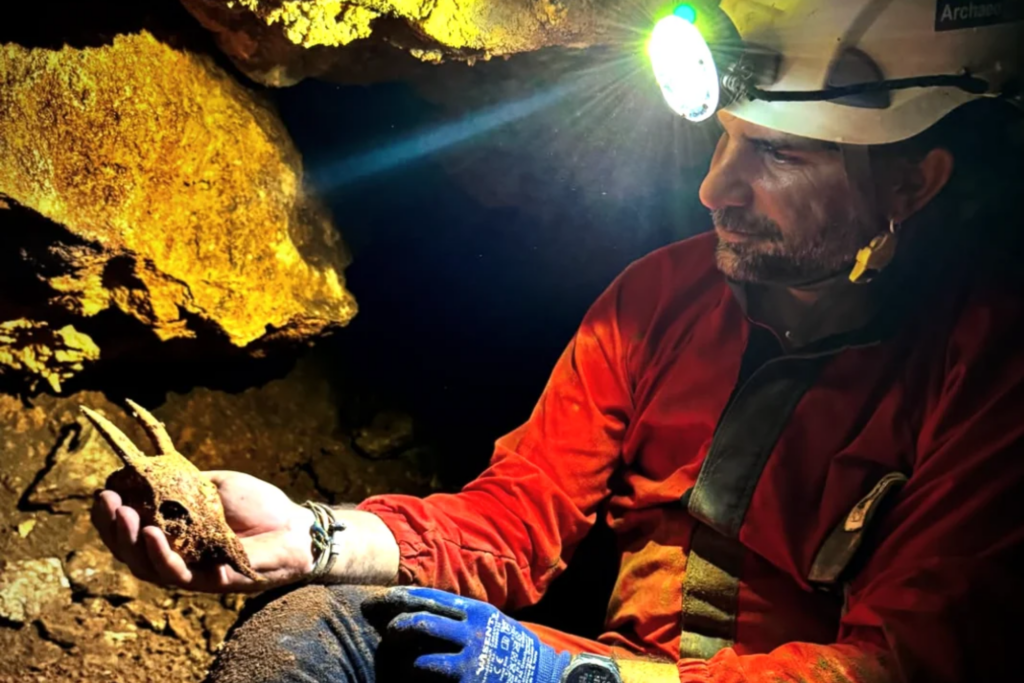
The extraordinary discovery was led by archaeologist Jaume Deya Credit: Instagram/jaume_deya
For centuries, life continued above ground in Mallorca, with civilisations coming and going, settlements disappearing and the island gradually transforming into the Mediterranean destination we know today.
Yet beneath the surface in Llucmajor, an extraordinary piece of the island’s history remained hidden, seemingly untouched for around 800 years.
Now, an unexpected discovery during construction work at the Son Noguera industrial estate has opened a fascinating window into Mallorca’s ancient past.
Among the treasures concealed inside the underground chamber are human remains, fragments of ancient pottery and fossils belonging to an extraordinary animal that disappeared thousands of years ago.
An unexpected discovery beneath an industrial estate
The discovery of the Cova de Son Fosquet prompted an investigation by the Societat Espeleològica Balear, led by archaeologist Jaume Deyà and authorised by the Consell de Mallorca’s heritage department.
The cave contains 124 metres of passages and reaches a depth of 14 metres.
Perhaps its most intriguing feature is an underground lake, accessible via a simple stone staircase that researchers believe could date back to prehistoric times.
The discovery raises fascinating questions about the people who once ventured underground. Who built the staircase? Was the water used for everyday survival, and did the cave hold a deeper significance for Mallorca’s earliest communities?
The mystery of the underground burial site
Among the most intriguing discoveries were bones belonging to at least one adult and one child, found in a passage known as the Rampa dels Morts, alongside pottery and animal remains.
Researchers believe the cave may have served as a burial site during the Bronze Age, although further archaeological investigation is needed to establish the age and circumstances of the human remains.
Were the individuals related? How did their remains come to rest underground? For now, these are questions that remain unanswered.
The extraordinary creature that once roamed Mallorca
Alongside the human remains, researchers identified a complete skull and the jawbone of a young Myotragus balearicus.
This extinct mammal was native to the Balearic Islands and had a goat-like appearance, although it was more closely related to sheep.
Long before Mallorca became synonymous with beach holidays and Mediterranean sunshine, this remarkable creature inhabited the islands.
Its discovery inside the cave adds another dimension to the investigation, offering scientists an opportunity to explore Mallorca’s prehistoric natural history alongside its human past.
However, the presence of both human and animal remains does not necessarily mean they date from the same period.
Eight centuries of hidden history
The archaeological material spans several chapters of Mallorca’s history, from prehistoric communities through Roman rule and the Islamic period in the 13th century.
Researchers have found no evidence of subsequent visits, suggesting the cave remained sealed for approximately eight centuries.
For archaeologists, such a discovery offers a rare opportunity to examine historical material that may have escaped centuries of human disturbance.
What other secrets could the cave reveal?
Researchers are calling for the site to be protected against looting and for further archaeological excavations to establish how the cave was used throughout history.
For Mallorca’s residents, the discovery is a fascinating reminder that there is far more to the island than its familiar landmarks, beaches and mountain villages.
And after around 800 years of silence, the Cova de Son Fosquet may only just be beginning to tell its story.
Follow Euro Weekly News on Google News
Get breaking news from Spain, travel updates, and expat stories directly on your Google News feed.
Follow on Google NewsSign up for personalised news
Subscribe to our Euro Weekly News alerts to get the latest stories into your inbox!
By signing up, you will create a Euro Weekly News account if you don't already have one. Review our Privacy Policy for more information about our privacy practices.



Lottie Verrier
Lottie Verrier is a journalist and digital media specialist based in Mallorca. After a decade in London media, including a role as Deputy Editor for the MailOnline’s eCommerce division, she now combines her editorial expertise with a passion for the island to create engaging content that celebrates the best of life in Spain. Instagram @lottieinmallorca
Comments