Mijas Pueblo coach chaos highlights Andalucia’s mass-tourism problem
By Adam Woodward • Published: 22 Nov 2026 • 20:44 • 4 minutes read
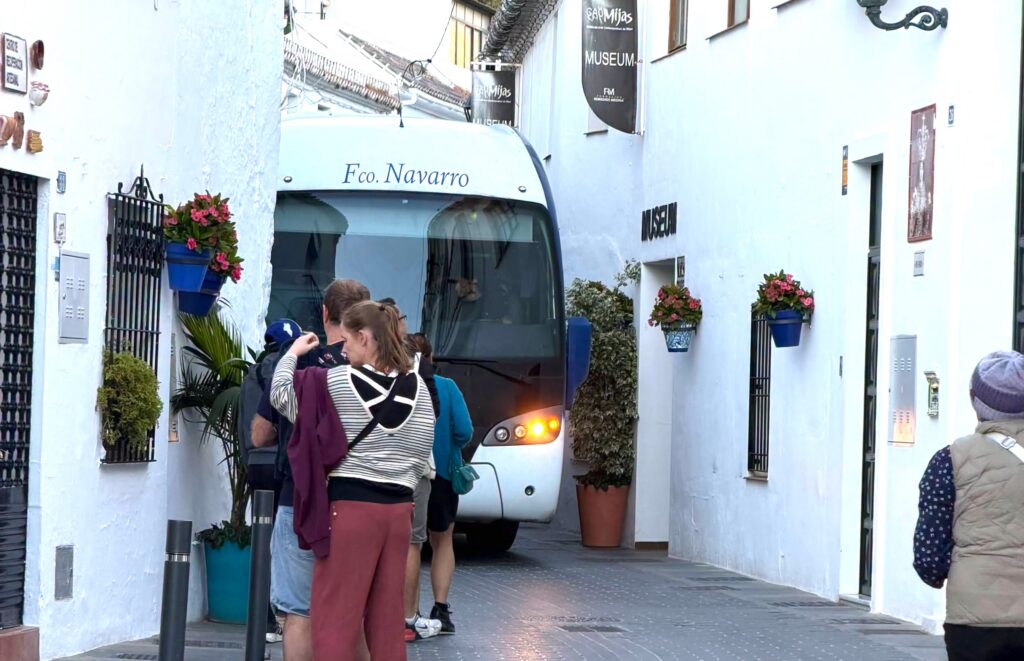
Coach stuck where it really shouldn't be. Credit: FsQ
An oversized tourist bus became trapped in a narrow street of Mijas, as calls grow for better controls on organised tours.
A tourist coach became trapped in the narrow streets of Mijas Pueblo on Sunday, November 22, after attempting to negotiate Calle Malaga with a vehicle far too large for the road.
The incident is an example of a growing problem across Andalucia, especially in its pueblos blancos, where popular destinations are being included on organised coach tours despite having streets, facilities and infrastructure that were never designed for such large-scale tourism.
The coach became stuck in the historic village’s narrow streets, with little room to manoeuvre. It is understood that the vehicle may eventually have had to reverse out, although the full circumstances and any damage to nearby buildings or businesses have yet to be confirmed.
The situation could have been considerably worse had the driver continued along the route, which becomes even narrower and more difficult to navigate.
Mijas Pueblo is a major tourist destination, with its whitewashed houses, traditional streets and mountain views attracting visitors from across the World. Tourism is also the most important part of the local economy. However, the incident raises questions about how many visitors the village can accommodate at one time, particularly when large groups arrive together.
Barranco Blanco offers another warning
The problem is not just confined to Mijas Pueblo. A few kilometres down the road is Barranco Blanco, in the area of Coin, which is another example of a natural attraction that is included in tourism itineraries without visitors necessarily understanding the limitations of the location. It is even listed on Google as a “tourist attraction”. The area is famous for its natural pools and waterfalls, but it is not equipped like a conventional tourist attraction. But, this is no Disneyland.
During the summer, the forest track leading to Barranco Blanco is closed to vehicles between June 15 and October 15 for non-residents as a fire-prevention measure. Visitors must leave their vehicles at the roadside and continue on foot. Coin Town Hall’s official information about Barranco Blanco explains the seasonal restriction and recommends visiting during the week, when the area is less busy.
Facilities are also zero, with no public toilets or conventional visitor services at the site. There is not even a waste paper basket. The combination of large visitor numbers, difficult access and limited facilities raises questions about whether the location is suitable for unrestricted organised tourism.
Barranco Blanco is a beautiful natural area, but its popularity does not automatically make it suitable for everyone, certainly not at the same time.
When tourism overwhelms the places people come to see
Similar problems can be found elsewhere in Andalucia. Setenil de las Bodegas, in near Ronda, is famous for its houses built beneath enormous rock overhangs. Its narrow historic streets are popular with visitors, but large groups can create congestion and difficulties for residents and local businesses.
The official Setenil tourism website lists the village’s designated parking areas, illustrating why visitors and tour companies need to consider where they leave their vehicles before exploring the historic centre. In Mijas Pueblo, the problem is particularly noticeable when coachloads of visitors arrive together.
Local businesses depend on tourism, but a group of 30 or 40 people entering a small bar without warning can place considerable pressure on staff and other customers. For a business such as Bar Porras i Mijas Pueblo, a sudden influx of 40 tourists, just off a tour bus, can turn an ordinary working day into panic stations.
The issue is not that tourists should be discouraged from visiting. It is that organised tours need to consider whether the places they include can safely accommodate their groups. A village can be a tourist destination without being suitable for unrestricted coach access.
What can be done to control mass tourism?
The coach incident raises questions about whether tour operators should be required to check vehicle restrictions and access arrangements before bringing large groups into historic villages. Possible measures include designated coach drop-off and collection points outside narrow historic centres, restrictions on oversized vehicles, and limits on the number of organised groups entering particularly busy areas at one time.
Tour companies could also be encouraged to arrange visits with local businesses rather than bringing large groups into small establishments without warning. For natural attractions such as Barranco Blanco, clearer information about access restrictions, walking distances, facilities and seasonal conditions could help prevent visitors arriving with unrealistic expectations.
Local authorities may also need to consider whether certain destinations require visitor limits during the busiest periods. The challenge is to protect the places that make Andalucia attractive while allowing local businesses to benefit from tourism.
Mijas Pueblo’s economy depends heavily on visitors, but the village’s narrow streets and historic buildings cannot simply be adapted to accommodate unlimited numbers of coaches. The incident on Calle Málaga is a reminder that tourism needs to work for the people who live and work in these places, as well as for those who visit them.
The question is not whether Andalucia should welcome tourists, but whether it can continue to do so without allowing mass tourism to overwhelm the communities and landscapes that attract visitors in the first place
Follow Euro Weekly News on Google News
Get breaking news from Spain, travel updates, and expat stories directly on your Google News feed.
Follow on Google NewsSign up for personalised news
Subscribe to our Euro Weekly News alerts to get the latest stories into your inbox!
By signing up, you will create a Euro Weekly News account if you don't already have one. Review our Privacy Policy for more information about our privacy practices.



Adam Woodward
Adam is a writer who has lived in Spain for over 25 years. With a background in English teaching and a passion for music, food, and the arts, he brings a rich personal perspective to his work at Euro Weekly News. As a father of three with deep roots in Spanish life, Adam writes engaging stories that explore culture, lifestyle, and the everyday experiences that shape communities across Spain.
Comments