It’s over for Sánchez? Spain delivers a political earthquake as PP and Vox surge to power
By Molly Grace • Updated: 29 Nov 2026 • 23:26 • 3 minutes read
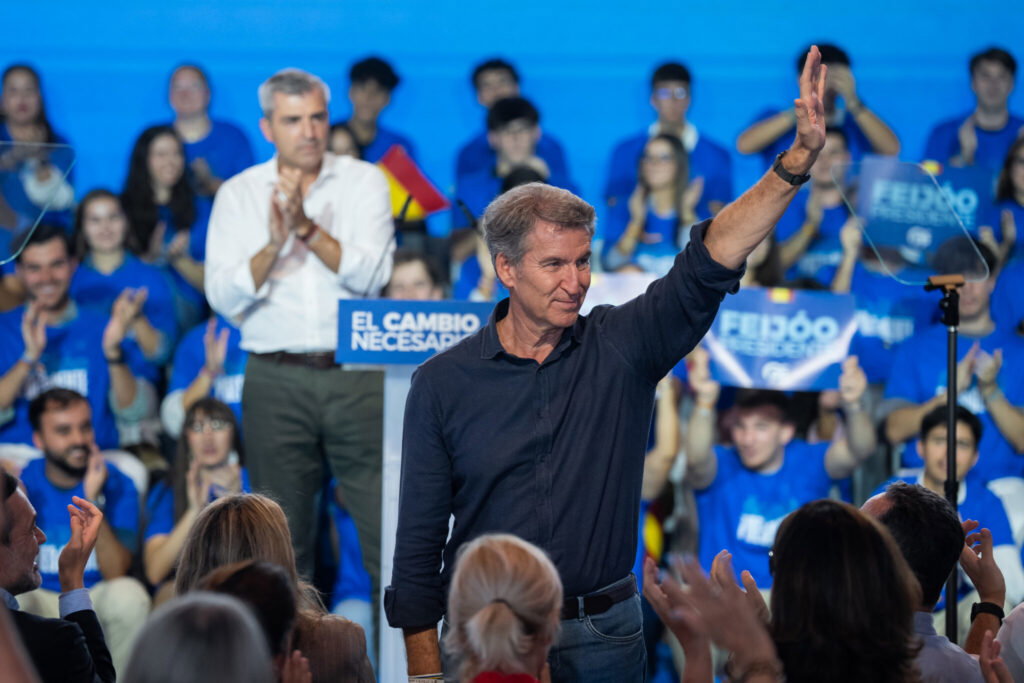
The election result now leaves Feijóo facing the task of building a government capable of surviving parliamentary votes. Photo credit: PP.es
Spain has spoken, and voters have delivered a clear victory for Alberto Núñez Feijóo’s Partido Popular (PP), bringing Pedro Sánchez’s eight years as prime minister to an end and putting a new government within reach.
The PP has emerged as the largest party, while its combined strength with Vox gives the right-wing bloc an absolute majority in Congress. Sánchez has already called Feijóo to congratulate him, marking a decisive moment in a night that has reshaped Spain’s political landscape.
PP wins as Sánchez’s PSOE falls behind
The PP has secured 133 seats, taking 31.5 per cent of the vote, while the PSOE has fallen to 119 seats with 29.8 per cent. Vox has won 49 seats, giving it a much stronger position in parliament than it held after the previous election. The figures represent a major setback for Sánchez. His party has lost two seats compared with the 121 it won in 2023, while the PP has also fallen slightly from its previous total of 137, losing four seats.
The campaign has been dominated by public frustration over housing, immigration and the state of the country’s politics, alongside corruption allegations that have placed further pressure on the Socialist government. The election also followed months of political tension, with Sánchez facing criticism over his administration and having to defend his record during a particularly difficult campaign. His televised apology during the campaign became another talking point, as explored in our earlier report, Sánchez apologised on live TV, but one question about his rise to power went unanswered.
Vox gives the right-wing bloc its majority
Although the PP has won the election, it cannot govern alone. The party needs support from other parliamentary groups to reach the 176 seats required for an absolute majority in the 350-seat Congress. Together, the PP and Vox hold 182 seats. With the two seats won by Unión del Pueblo Navarro (UPN), the total rises to 184, giving the bloc a majority of eight seats above the threshold.
That puts Vox in a powerful negotiating position. Its 49 seats represent an increase of 16 from the 33 it won in 2023, and Feijóo will need its backing if he is to secure the investiture. The relationship between the two leaders will now come under close scrutiny. Feijóo and Vox leader Santiago Abascal have held private discussions, while their parties already share power in several regional administrations, including Andalucía, Extremadura, Aragón and Castilla y León. However, those arrangements do not amount to a confirmed national coalition agreement.
Before the election, the question of whether Vox could determine the shape of Spain’s next government was already attracting attention. Our earlier report looked at whether the right could hold the key to Spain’s next government.
A different balance from the 2023 election
The result is particularly significant when compared with the previous general election. In 2023, the PP won 137 seats, the PSOE secured 121 and Vox took 33. This time, the PP has lost four seats and the Socialists have fallen by two, while Vox has gained 16.
It is that increase for Vox, rather than a larger number of seats for the PP, that has changed the parliamentary arithmetic and given the right-wing bloc a route to power. Turnout finished at 70.4 per cent, matching the figure recorded at the previous general election in 2023.
What happens next?
The next stage is the formation of a government. Feijóo must secure enough support in Congress to pass an investiture vote. A candidate needs 176 votes in the first round; if that threshold is not reached, a second vote is held in which more votes in favour than against are required. The PP and Vox have enough seats between them to clear the first hurdle, provided they reach an agreement. UPN’s support would strengthen that position, although it is not mathematically essential if Vox backs Feijóo.
The PSOE would face a much more complicated route to forming an alternative government, needing support from a broad collection of left-wing and regional parties. With the final count completed, the seat totals establish the parliamentary balance that Feijóo must now navigate as he seeks to form a government. Readers can check the final results of the Spanish general election on the official results website.
Follow Euro Weekly News on Google News
Get breaking news from Spain, travel updates, and expat stories directly on your Google News feed.
Follow on Google NewsSign up for personalised news
Subscribe to our Euro Weekly News alerts to get the latest stories into your inbox!
By signing up, you will create a Euro Weekly News account if you don't already have one. Review our Privacy Policy for more information about our privacy practices.




Molly Grace
Molly is a British journalist and author who has lived in Spain for over 25 years. With a background in animal welfare, equestrian science, and veterinary nursing, she brings curiosity, humour, and a sharp investigative eye to her work. At Euro Weekly News, Molly explores the intersections of nature, culture, and community - drawing on her deep local knowledge and passion for stories that reflect life in Spain from the ground up.
Comments