Low emission zones backlash begins: Torrevieja latest to announce no fines from January 1
By Adam Woodward • Published: 29 Nov 2026 • 12:34 • 3 minutes read
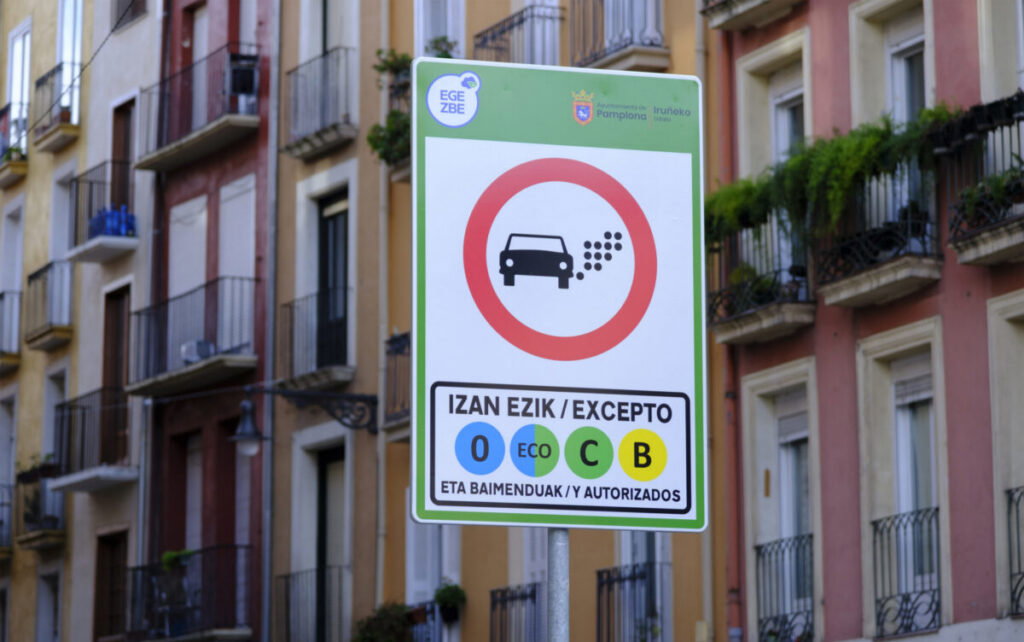
Low emissions sign in Pamplona. Credit: Ayto
Torrevieja has become the latest Spanish town to back away from enforcing its Low Emission Zone (LEZ/ZBE), confirming that drivers will not be fined from January 1, 2027, despite the date being written into its council regulations. The announcement comes as councils across Spain face legal challenges, public opposition and growing questions over millions of euros spent installing the schemes.
Torrevieja Town Hall confirmed on November 27 that it was still acquiring the equipment needed to operate its system and was considering changing the implementation timetable. Vehicles carrying B, C, ECO and ZERO environmental stickers will be allowed into the zone to park, while exemptions are also planned for residents, workers, traders, garage users and families taking children to school. The announcement follows earlier delays in the town’s plans, which were covered in previous reports on Torrevieja’s Low Emission Zone delays.
The council has also been monitoring legal challenges involving other Spanish municipalities. Its announcement comes just days after new national regulations requiring councils to demonstrate that their restrictions and penalty systems are actually operating.
Malaga court ruling opens wider questions
A particularly important development came from Malaga, where the High Court of Justice of Andalucia (TSJA) overturned the city’s Low Emission Zone regulations following a legal challenge. Judges found that Malaga had unfairly treated vehicles registered outside the city compared with equivalent vehicles belonging to local residents. The ruling cited Article 38 of the Spanish Constitution, which protects freedom of enterprise, and the principle of market unity.
It was not a ruling declaring Low Emission Zones unconstitutional. Instead, it found that the way Malaga had designed its exemptions was unlawful.
The financial consequences are considerable. Around 13,600 drivers who paid fines are due refunds totalling approximately €1.38 million, while another 35,400 outstanding cases are to be cancelled. Malaga has stopped imposing fines under the overturned regulations while a replacement system is considered.
Which other Spanish towns are backing away?
According to the national Atlas ZBE tracking database, updated on November 26, six councils have suspended their schemes: Malaga, Avila, Segovia, Guadalajara, Badalona and Badajoz. Another 13 are operating warning systems without fines, including Cadiz, Burgos, Cuenca, Parla, Vigo, Lugo, Sagunto and Molina de Segura.
A further eight have approved zones or additional phases which have yet to be applied. These include Motril, Santa Cruz de Tenerife, Torrevieja, Alcobendas and Merida. Some councils already enforce other parts of their schemes, so the classifications do not necessarily mean their entire zones are inactive.
Marbella is another interesting case for Costa del Sol drivers. Its provisional scheme for the historic centres of Marbella and San Pedro Alcantara was approved in October 2023, but financial penalties have never been enforced. Drivers without an environmental sticker have received warnings and a wag of a finger from Local Police instead, while the council has continued work towards definitive regulations.
Millions spent as councils struggle with enforcement
Spain has already allocated €145 million in European recovery funding specifically to help 80 towns establish Low Emission Zones, including boundaries, signage and supporting equipment. The Spanish Government’s breakdown of European mobility funding confirms the amount.
Torrevieja alone awarded a contract worth approximately €1.19 million, including VAT, for cameras, air-quality monitoring equipment and traffic management systems. The Torrevieja council announcement detailing its €1.19 million LEZ contract provides a breakdown of the planned installation.
The wider sustainable mobility programme has involved billions more, although that money also covers public transport, cycle lanes and other urban transport improvements.
Government tightens the rules
Royal Decree 953/2026, published in Spain’s Official State Gazette, came into force on November 26 and requires councils to provide evidence that their restrictions, monitoring arrangements and penalty systems are genuinely operational. Prolonged warning-only periods will no longer qualify as properly implemented schemes.
Under Spain’s Climate Change Law, towns with more than 50,000 inhabitants were required to introduce Low Emission Zones by January 2023. Yet a March report by El Pais found that two-thirds of the 153 towns covered by the requirement had still not properly installed theirs.
With drivers questioning restrictions, councils facing court action and public money already committed, the future of Spain’s Low Emission Zones is becoming an increasingly contentious issue.
Follow Euro Weekly News on Google News
Get breaking news from Spain, travel updates, and expat stories directly on your Google News feed.
Follow on Google NewsSign up for personalised news
Subscribe to our Euro Weekly News alerts to get the latest stories into your inbox!
By signing up, you will create a Euro Weekly News account if you don't already have one. Review our Privacy Policy for more information about our privacy practices.





Adam Woodward
Adam is a writer who has lived in Spain for over 25 years. With a background in English teaching and a passion for music, food, and the arts, he brings a rich personal perspective to his work at Euro Weekly News. As a father of three with deep roots in Spanish life, Adam writes engaging stories that explore culture, lifestyle, and the everyday experiences that shape communities across Spain.
Comments